Rules of Engagement (Design) — No. 01
Hooked, Line, and Sinker
A Peek Under the Hood
Engagement design–also referred to as behavioral design, persuasive technology, or habit-forming design–sits at the intersection of psychology and technology.1 Understanding why humans make certain decisions is the foundation upon which engagement design’s objective rests: to influence human thoughts and behaviors. Engagement design may not be a term you’re familiar with, but if you are living in the year 2026, you’ve encountered it in your digital products and increasingly, so! There are several principles that the tech industry utilizes to maintain your attention, but I will be primarily focusing on the heavy-hitters in this article.
The first, and arguably most load-bearing pillar in engagement design is a principle called variable rewards. Explored by psychologist B.F. Skinner in the 50s, the theory proposes that when rewards received after performing an action are varied, it increases our persistence to perform the action again until we get that reward again.(Hooked, pg 99)2 This feeling of unpredictability is what keeps you and me checking our email to see if something compelling reaches our inbox, rather than, let’s say, spam. It’s how the infinite scroll and pull to refresh mechanisms put us all in a chokehold.
The next important pillar is what psychologists refer to as loss aversion. First introduced by Daniel Kahneman and Amos Tversky in 1979, the concept is that humans feel the pain of loss roughly twice as deeply as equivalent gains. It usually feels way worse to lose $100 than to randomly find $100 on the street. One might stay at a job they hate because the fear of potentially landing a worse job outweighs the hope of finding a better one. A tech-related example might be the hesitation to unsubscribe from or change a music streaming service where all your favorite music and countless playlists are saved, or the anxiety of missing a daily log-in bonus.
The last main pillar is called social comparison. First proposed by social psychologist Leon Festinger in 1954, this theory explains that humans evaluate themselves by comparing their status to that of others. Engagement design distorts this naturally occurring human behavior by creating an environment that puts only others’ successes on proud display and hides all of the negative, nuanced parts. Tech companies were able to commodify social standing through mechanisms such as likes, follower counts, and views. The monetization of social standing has only complicated the issue, as content from creators is more likely to be dictated by whatever is selling or trending rather than their true thoughts and interests. For some, keeping track of metrics is a matter of life or death.
Computers to Captology
Up until I turned 12 or 13, my family had a dedicated computer room in which we conducted all of our online business. I would walk in with a mission, and little room to stray. It was Club Penguin, Miniclip, or deviantArt. The games had their own hold on me.3 I was a friendless, inside kid and the games were genuinely fun and I would pout when I was booted off by my parents or siblings. Yet, I didn’t have notifications chasing after me. When I wasn’t on the computer, I didn’t wonder about what was happening while I was away. Our family computer was more of a destination.
Between its invention and today, computers have gone through many phases. They were made to store data and make calculations and later, they became a means of communication. By the time they made their way into my family’s home, they were a source of entertainment and play. Turning computers into companions was the next step, and this process had been cooking for decades. Rather than explore how computers could serve users, social scientist B.J. Fogg wanted to learn how psychology could be applied to technology to change users’ minds and behaviors.4 In the late 1990s he coined the term ‘captology’, or the study of computers as persuasive technologies. In 1998 Fogg founded the Stanford Behavior Design Lab (formerly known as the Persuasive Technology Lab) to formalize the study of persuasive technologies as an academic field. This program would go on to influence Mike Krieger, co-founder of Instagram. It also produced two figures who would represent opposing sides of the engagement design debate: The first subject being Tristan Harris, a former Google design ethicist and co-founder of the Center for Humane Technology, and one of the most outspoken critics of the tech industry. The second figure being one of its biggest defenders and the primary subject whose lens I will be using to critique engagement design: Nir Eyal.
Nir-Sighted
Nir Eyal has been a significant and highly visible advocate for engagement design. After working for Boston Consulting Group and starting a solar panel company, Sunshine, he attended Stanford for his MBA at the Graduate School of Business. Though he studied persuasive technologies in Fogg’s program (where Mark Zuckerberg would occasionally stop in, by the way), his origins were in strategic decision-making and financial reasoning rather than behavioral psychology.
In fact, before diving into the psychology-heavy part of his career, he worked in the ad-tech industry. During his time at Stanford, he and a team of other Stanford MBAs started a company, AdNectar, that placed ads in Facebook-specific applications. In his book, he discusses observing the meteoric rise of what was likely Farmville. “Notable companies were making hundreds of millions of dollars selling virtual cows on digital farms while advertisers were spending huge sums of money to influence people to buy whatever they were peddling. I admit I didn’t get it at first and found myself standing at the water’s edge wondering, ‘how did they do it?’”(Hooked, pg 4)
FarmVille reached 83.76 million monthly active users at its peak in March 2010.5 By his own account, Eyal saw that something in the industry was shifting, and he wanted to get in on the ground floor. AdNectar was acquired in 2011, after which Eyal became a “consultant to a host of Silicon Valley companies, from small start-ups to Fortune 500 enterprises.” He went on to design and teach a course at Stanford on the science of human behavior. (Hooked, p. 5) In 2014, his book, Hooked: How to Build Habit-Forming Products, hit the shelves.
The Beginner’s Guide to User Manipulation
Hooked spread like wildfire in Silicon Valley and found a dedicated fanbase among project managers, designers, and start-up founders—aka the people in charge of the consumer attention economy. Gibson Biddle, former VP of Product Management at Netflix, called it “the definitive guide to customer engagement and retention in the digital age.” Hooked was by no means the blueprint for engagement design, but what it did was synthesize consumer behavior into a how-to guide straightforward enough for those unfamiliar with human psychology to understand. In Eyal’s own words: “The Hooked Model is a way of describing a user’s interactions with a product as they pass through four phases: a trigger to begin using the product, an action to satisfy the trigger, a variable reward for the action, and some type of investment that, ultimately, makes the product more valuable to the user. As the user goes through these phases, he builds habits in the process.”(Hooked, Chapters 2–5):
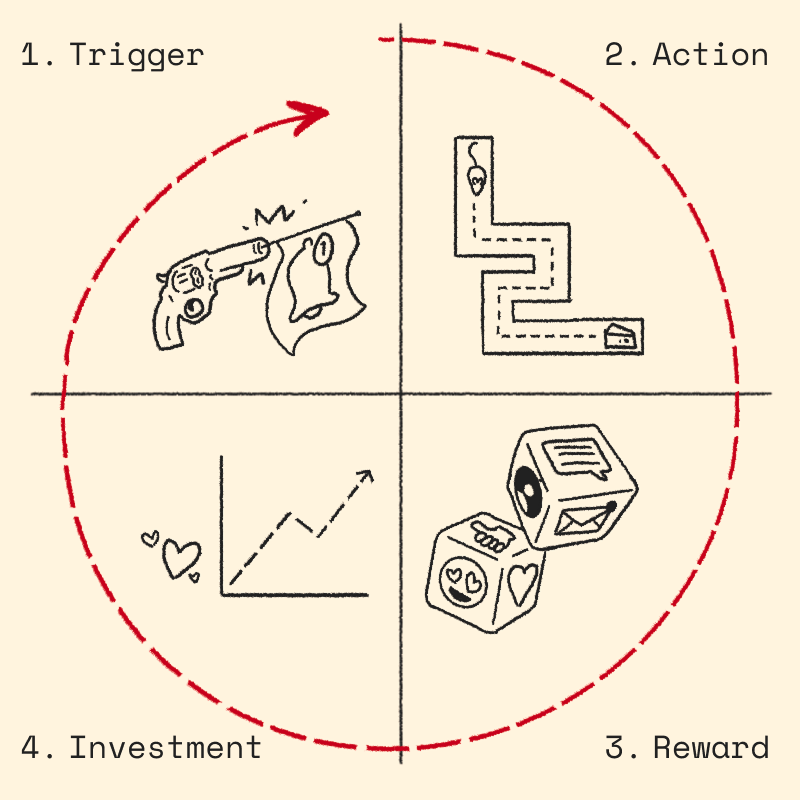
Trigger
The trigger of a hooked cycle can be sorted into two types, external and internal. An external trigger is an element that calls the user to act. Eyal names four categories of external triggers:
- Paid (ads)
- Earned (PR, viral content)
- Relationship (word of mouth, friend recommendations)
- Owned (notifications, app icons on home screen, email newsletters from companies you’ve subscribed to)
The other type, internal triggers, are emotions, situations, or thoughts the user already has–such as boredom, loneliness, FOMO, and stress–that get attached to the product through repeated use.
Action
The action phase informs what the user does next as a response to the trigger. The easier the action is, the more likely a user is to perform it.
Reward
Users are rewarded for performing the desired action. Eyal stresses the importance of variability in order to reinforce the user’s motivation to perform the action again. He sorts variable rewards into three types
- Rewards of the Hunt (resources, information)
- Rewards of the Tribe (social validation)
- Rewards of the self (mastery, completion, “leveling up”)
Investment
Users escalate their commitment to the product once they make investments such as time, labor, and money. This step compounds over usage to make each experience more consequential, more rewarding. This closes the session loop, setting up the emotional response to the next trigger.
Could/Should/Would
Eyal divorces the mechanics of the Hooked model from its ethical implications. By default, its design goal is to create compulsions in the user, eventually migrating the triggers from external sources to internal, emotion-based ones. In Hooked, Eyal frames the model in a neutral light. It can be used for good, potentially creating positive reinforcement for healthy habits. He touches on the potential misuse of engagement design in the chapter The Morality of Manipulation, but he immediately undercuts this concern by alleging that for the majority of the population, addiction will not be an issue. His stance is that “even though the world is becoming a more addictive place, most people have the ability to self-regulate their behaviors.” (Hooked, pg 171) From everything that I’ve read (and I will provide the receipts later on), Eyal seems to align himself with his community of fellow Silicon Valley investors when it comes to weighing accountability: users bear all responsibility for their decisions.
He explains that industry insiders have proposed that an ethical code of conduct be established, though he doesn’t specify whether such a code would be industry-self-imposed, government-enforced, or otherwise structured. Eyal’s own solution is a “decision-support tool” he calls the Manipulation Matrix.(Hooked, pg 167) This tool does not determine the moral status of a business, but assists entrepreneurs in asking, in his words: “not ‘Can I hook my users?’ but instead ‘Should I hook my users?’” (Hooked, pg 167) As will be explored in a future piece, placing the responsibility solely on users and leaving it up to companies to evaluate themselves is an evergreen tactic used by some of the most harmful industries. Interestingly enough, this narrative differs from Eyal’s major influence, B.J. Fogg, who believes culpability lies on users, creators, and distributors.(Persuasive Technology, pg 229) Though he does lean toward users bearing some of the weight, his opinion is that it shifts on a case-by-case basis. Fogg outright states that “once creators become aware of harmful outcomes, they should take action to mitigate them.” (Persuasive Technology, pg 229)
Now that we’ve become so accustomed to consuming online media, 4.8 hours a day on average, I’d like to reframe Eyal’s Manipulation Matrix question: “Just because we can, does that mean that we should?” Do the positives of manipulating user behavior outweigh the negatives? There are many well documented cases of engagement design helping people, and I fundamentally believe that technology has the power to meaningfully improve lives. However, I think that the ways and methods that engagement design is widely deployed across the consumer attention economy, as well as the way it is being fiercely defended by big tech, is worth examining.
In the next piece, I’ll be covering my research on the beautiful partnership between gambling, slot machines, compulsive behavior, and technology. If you are interested in learning about how the free-to-play game industry became an insanely lucrative business, subscribe to Subject to Change to receive a heads-up when part 2 of the Engagement Design series drops :-) Probably a week from now. idk
Footnotes
-
What’s in a Name?
Each of these terms have slightly different connotations. “Persuasive technology” and “behavior design” originated in academic research (B.J. Fogg, behavioral economists). “Habit-forming design” comes from an industrial environment (Nir Eyal, Hooked). I’m deliberately using “engagement design” to keep the critique grounded in the field’s own language rather than adopting the framing of its advocates or its critics. ↩
-
You Deserve a Little Treat… But Not Every Time
Psychologist B.F. Skinner was one of the major foundational figures in behavioral engineering. In the 1950s, he discovered that delivering rewards inconsistently actually increases addictive and persistent behavior. He conducted experiments in which he would put hungry pigeons in a box that would deliver food pellets when they press a button, teaching them the cause-and-effect relationship: action →reward. In the next step of the experiment, Skinner introduced variability, randomizing the pellet delivery. What he found was that variability increased the frequency of the pigeons tapping the button.
-
A Computer Room of One’s Own
I think it’s important to acknowledge that these sites did have elements of engagement design, and it would be dishonest to claim I was immune to these mechanics as a kid. Club Penguin had login bonuses and some members-only content (would have financially ruined my parents if I had access to a debit card lol) and deviantArt had an in-site notification system. Having said that, there was no infinite scroll, no algorithmic feeds, and no push notifications. They lacked the infrastructure to create an experience that would follow me out of the computer room. Each session had a beginning, middle, and end. ↩
-
From the first line of Fogg’s preface to Persuasive Technology: “When I was 10 years old, I studied propaganda.” Just wanted to share. No reason. ↩
-
*I really wasn’t planning on doing a crazy FarmVille dive, but it was so insane that I couldn’t resist. It’s a bit of a read, so feel free to finish the main piece before this enormous tangent.*
Country Girls Make Do
If you were on Facebook in the late 2000s, you probably recall playing or hearing about FarmVille. FarmVille, created by game company Zynga in 2009, was one of the earliest mass market free-to-play games to tie people’s social contacts to gameplay and brought microtransactions into mainstream consumer culture. The following mechanics that it used weren’t novel on their own, but the combination of them all created a fierce contagion that spread through social graphs with unprecedented speed.
- Social-graph viral growth: every significant move users made in-game could be posted to their Facebook wall, visible to all.
- Time-based mechanics: crops would wither if they weren’t harvested by a specific time. This would get users to return to the game on an at-least-daily basis.
- Pay-to-skip time gates: if a user needed crops and they needed them immediately, they could pay real American dollars to accelerate timers.
- Reciprocity loops: a user could help a friend with their “farm tasks,” creating social obligations.
- Limited-time events: Occasionally, there would be seasonal drops such as crops, holiday items, or crossover promotional material that would manufacture a sense of FOMO in the user.
Between 2009 and 2012, FarmVille would participate in sponsored events that lasted anywhere between a mere 24 hours to a few months. Companies and movie franchises would open their own digital “farms” to visiting users and give away promotional items. Some notable participants included McDonald’s, Frito Lay, Miracle Gro, Stouffers, and movies Megamind, and Rio. 7-11 and Frito Lay launched their own individual promotions where players could receive free virtual items… with the purchase of specific irl products!! FarmVille also hosted events to assist with natural disaster relief in Haiti (2009-2010) and Japan (2011). Zynga donated 50%-100% of all funds collected, raising thousands to millions of dollars within days of each campaign’s release.
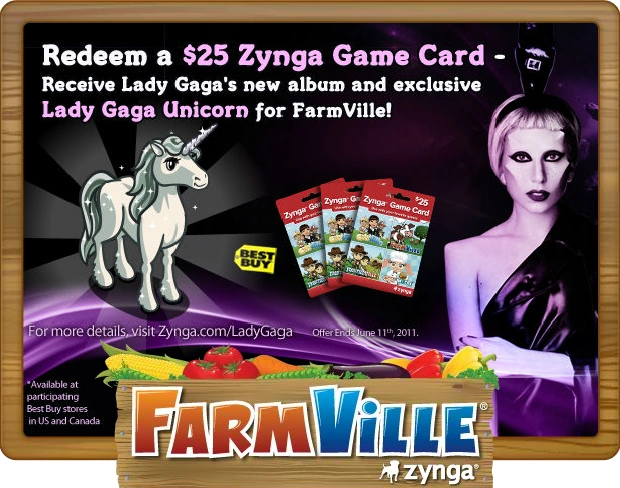
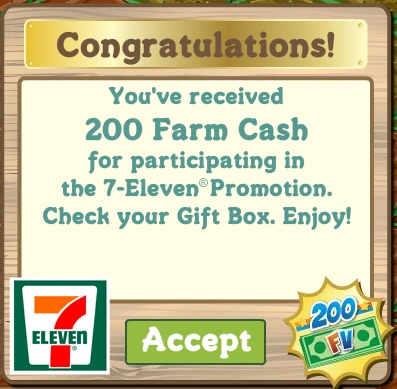
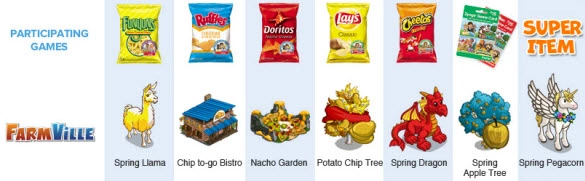
A small percentage of users paid a fortune to access virtual goods, boosts, or convenience features. Most players didn’t pay any money to play. Within both of these groups, there were people who chose to use advertising offers in order to gain more Farm Cash. In this exposé, TechCrunch journalist Michael Arrington exposed that companies like Zynga made substantial amounts of money through deceptive means. Players would receive offers (costly subscriptions or services they may not fully understand) promising free Farm Cash, then the revenue from accepted offers would be reinvested into user acquisition, and the process would repeat itself. Several of these offers allegedly hid things like recurring charges, misleading subscriptions, or other unethical terms. The article also criticized offer providers, advertising networks that distributed the offers, and platforms like Facebook and MySpace for insufficient enforcement of their own policies. Everyone in the chain benefited financially while consumers were robbed. The illusion that social gaming’s success was the result of innovative game design rather than questionable monetization practices was shattered. Womp womp.
FarmVille is RICH in material. Someday, I’ll write a thesis on how free-to-play games would be built and deployed for the following decade (and not usually in a good way). Ugh I can’t wait to dig into this more. tysm for reading lol ↩
Disclaimer: I used Claude AI as a research tool for this piece (basically as a more advanced search engine) and all resources have been vetted by yours truly. Every thought, argument, and word is my own.
Subscribe to receive emails ONLY when new articles drop xoxo