Rules of Engagement (Design) — No. 03
The House Always Wins: Part 2
“Play is an occasion of pure waste.” Roger Caillois, Man, Play, and Games (1958)
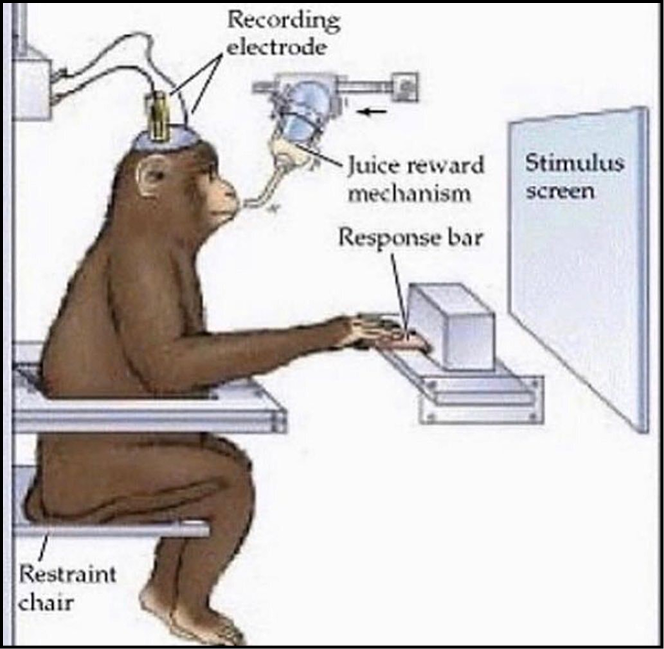
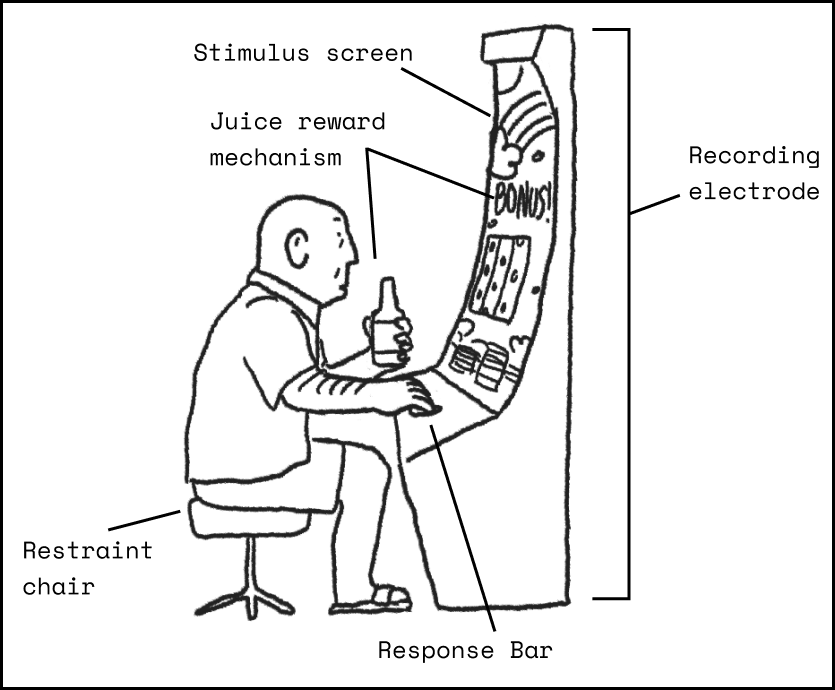
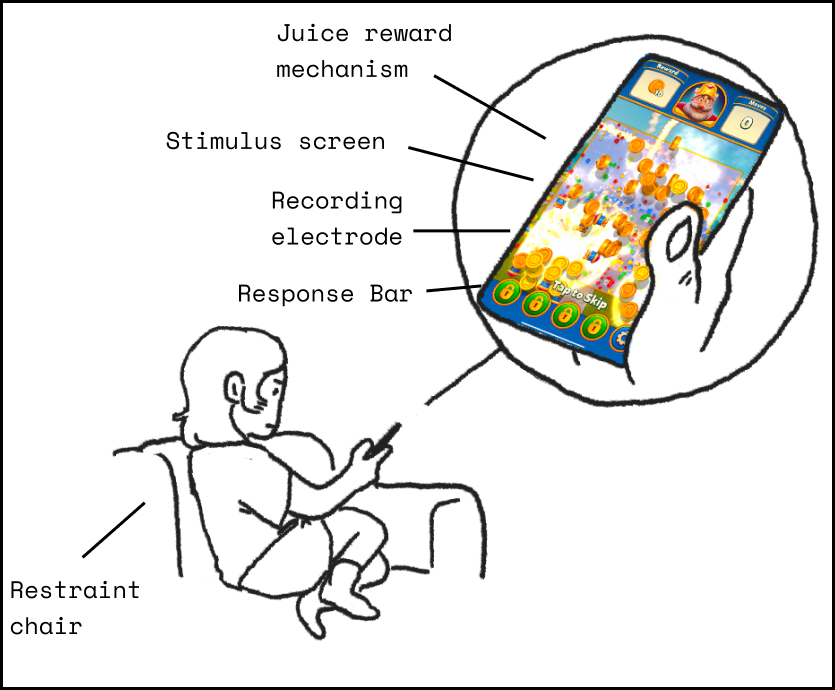
At the beginning of my investigation, I admittedly made the ignorant assumption that these games were simply low-brow entertainment for the unaware average Joe. I was able to understand from an “oh these tactics are predatory” point of view, but personally just didn’t get it. What was it about F2P that was so appealing to people? My line of thinking completely changed after my flight to Seattle two weeks ago. I sat next to a woman who, like many flight passengers, was absorbed in her phone. From the corner of my eye, I caught some familiar images on her tiny screen; she opened a folder revealing the app icons for at least 3 out of the top ten grossing F2P games I had been studying.
I’ve found that some players (at least online) can become extremely defensive about their relationship to F2P games. After all, who would want to feel targeted and condescended upon about something they’ve invested so much time and energy into? I strategically waited until the last hour of the flight to start a conversation… just in case. Not only was she open to a conversation, but she was extremely kind! Her name was Amanda: she was a TikTok casino personality (before her account got banned over new gambling content policies at over 25,000 followers).
I shared that I was doing research on F2P games and let her know that I played some of them myself. I showed her my meager stats (as I had not played each game for very long), small potatoes compared to an F2P veteran such as herself. I asked her, tentatively: “Why do you like these kinds of games? What do you like the most about them?”
Amanda paused for a moment, looked down at her phone, and smiled. “I just really like how it turns my brain off. It’s relaxing.”
“It gets me in a zone.”
She talked about how she enjoyed the social aspect of F2P, that they made it easy and fun to feel close despite being hundreds of miles away. I was struck with a sense of humility and contrition after our conversation. As Amanda spoke more about her experience, it became clear that she knew about the predatory mechanisms. “I know they can get really tricky, so I have a limit of $25-30 a month for my games. Though I do have a lot of friends that spend waaay more. I have a feeling that they make the game way harder when they know you’re close to a big win, don’t you think?” We wished each other a beautiful summer and parted ways. Amanda, girl, if you’re reading this, shout out to you, hope you get your TT account back ✌️🫰
Last time, I covered the history and evolution of the slot machine, their use of variable ratio schedules (or “variable rewards” as Nir Eyal calls it) to create compulsive behaviors in players, and its role in the casinofication of F2P (free-to-play) games. I want to dive a little deeper into the mechanisms that farm people’s attention as well as their money. Ok for real: buckle up for this one because the world of F2P is so insane, I’m almost at 4,000 words—not including footnotes LMAO
“Skill Issue”
One of the reasons mobile gaming has become so popular is because of its extremely low barrier to entry. Until recently, the title of “gamer” was culturally reserved for primarily lanky, white, nerdy young men. An individual would have to possess the money to afford a console, more money to purchase games, and most importantly (in my opinion), have time and attention dedicated to playing said games. FarmVille, which I touched on in the footnotes of Hooked, Line, and Sinker, was a trojan horse that rolled the social, freemium microtransaction model into the non-gaming American mainstream via Facebook in 2009 (Nieborg et al., 2022); with the release of the iPhone/iPod touch, one could download a F2P game and play anywhere and at any time. Because they have no cost barrier and require minimal attention that, in turn, provide maximum reward, I think this type of game opened the door for demographics that were previously unreachable by the gaming market: women, commuters, hourly workers, the elderly, really anyone who had a spare moment.
In order to write about these games with full-throated confidence, I needed to get down and dirty and do some research in the field, so I actually played a chunk of the top ten grossing F2P games1 (as of June 2026, the leaderboards change constantly). I have to tell you, these were some of my most surreal mobile experiences to date. The games I played include: Monopoly Go!2, Candy Crush3, Royal Match3, Gossip Harbor4, Whiteout Survival5, and CoinMaster6. (Coinmaster was not quite in the top ten at the time of writing this, but the gameplay was so slot machine-like yet lies outside of the casino category… bananas. Had to bite.) Each one has far too many details for me to write in the main body of this already long piece (I encourage you to read about my full experience with these games in the footnotes, listed in order of “relevance”/”importance”) but here are the essential takeaways:
NOTE: I played each game anywhere between 3-8 hours total. This means there may be additional mechanics that I didn’t reach due to my lack of investment.
I am affronted by a carnival of sights, sounds, and sensations the moment I open these apps. The music for all the games sound almost cinematic, as though there is a grand adventure awaiting me. For most of the apps, every move, tap, or event is accompanied by an admittedly pleasing vibration that mimics whatever action is taking place on the screen: a pull, a push, an explosion, tension and release—a touchscreen that touches back, if you will. For games such as Monopoly Go!, Candy Crush, and Royal Match, moves I make seem inconsequential, as they would lead to unpredictably “delightful” chain reactions that made it feel as though I performed some specialized technique.
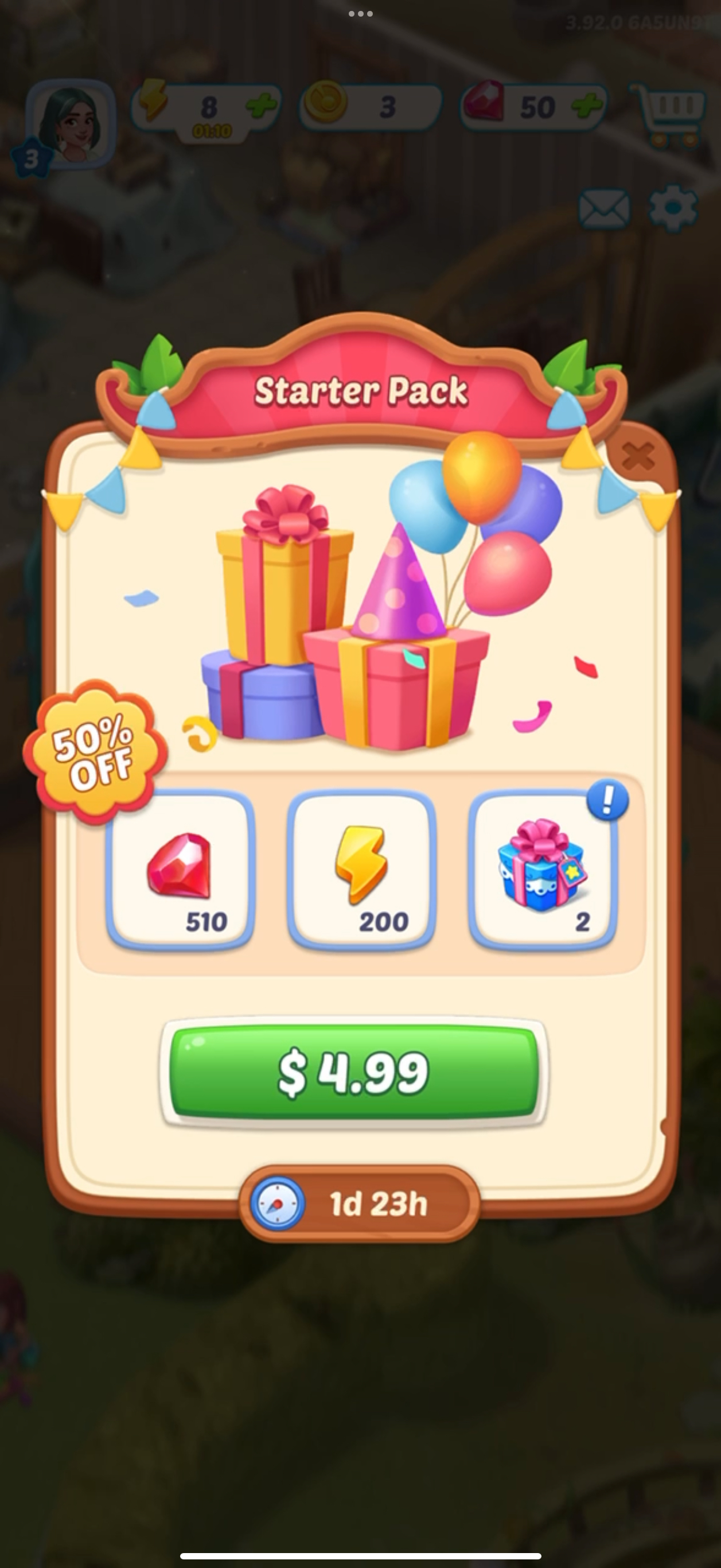
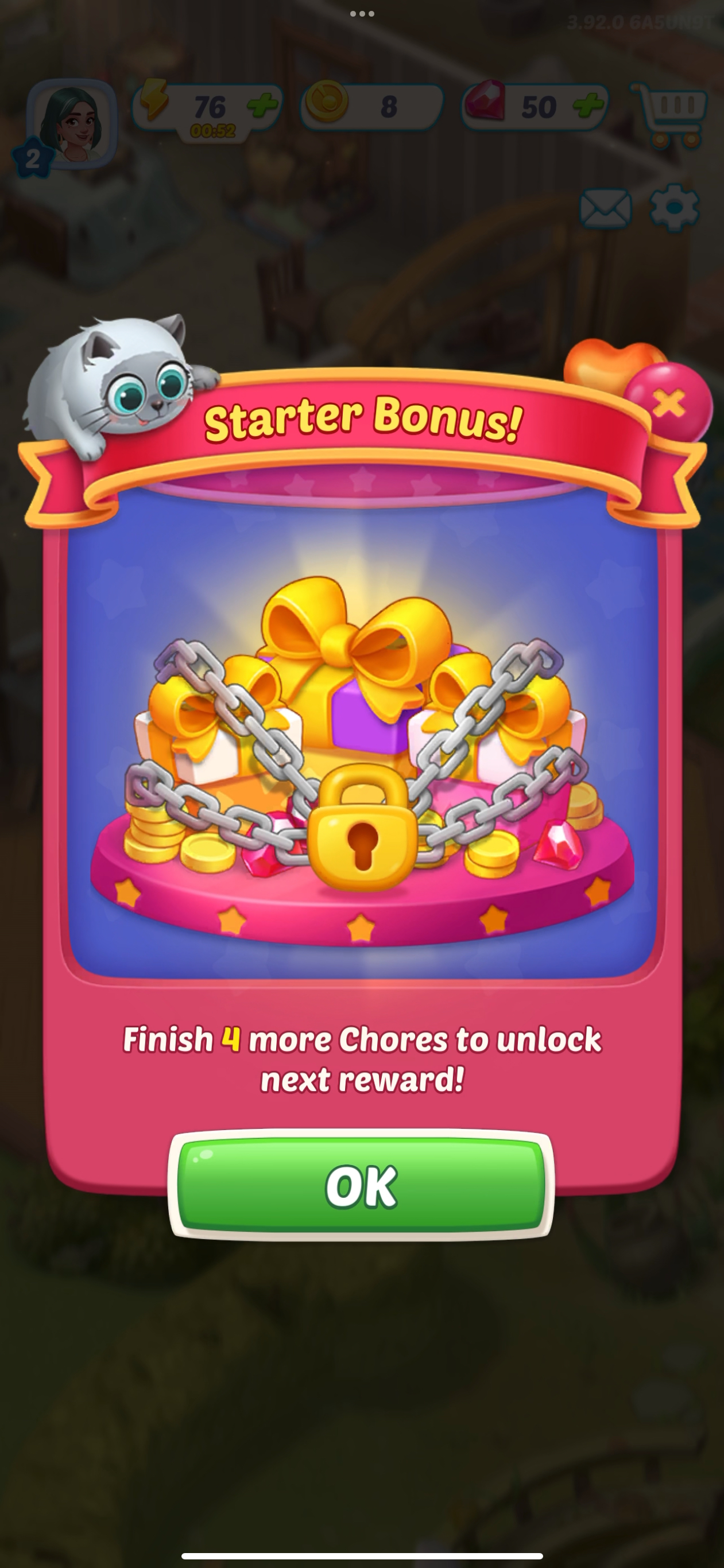
The games introduce multiple points systems that can be used to either acquire items to assist your gameplay or simply extend your playtime. The games themselves are free, but limit gameplay using capped, time-based resources (lives that run out, set number of turns) that can be extended or replenished for as low as 99 cents to as much as $99. A significant amount of these games have a “card pack” or “loot box” opening element, where the player is rewarded with its contents, which are unknown before purchasing. My screen is littered with limited-time offers, promotions, and events (even games within the games!) all accompanied by a clock counting down.
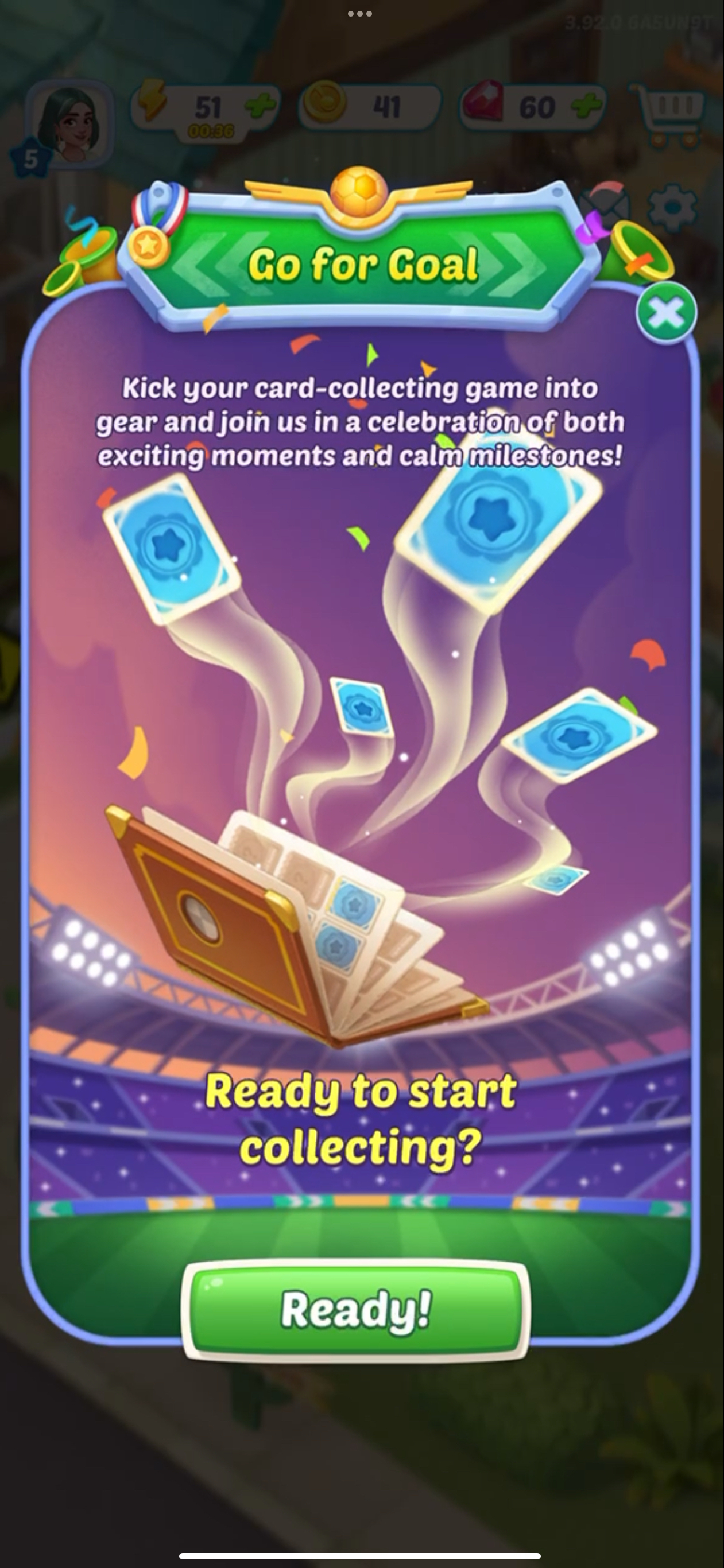
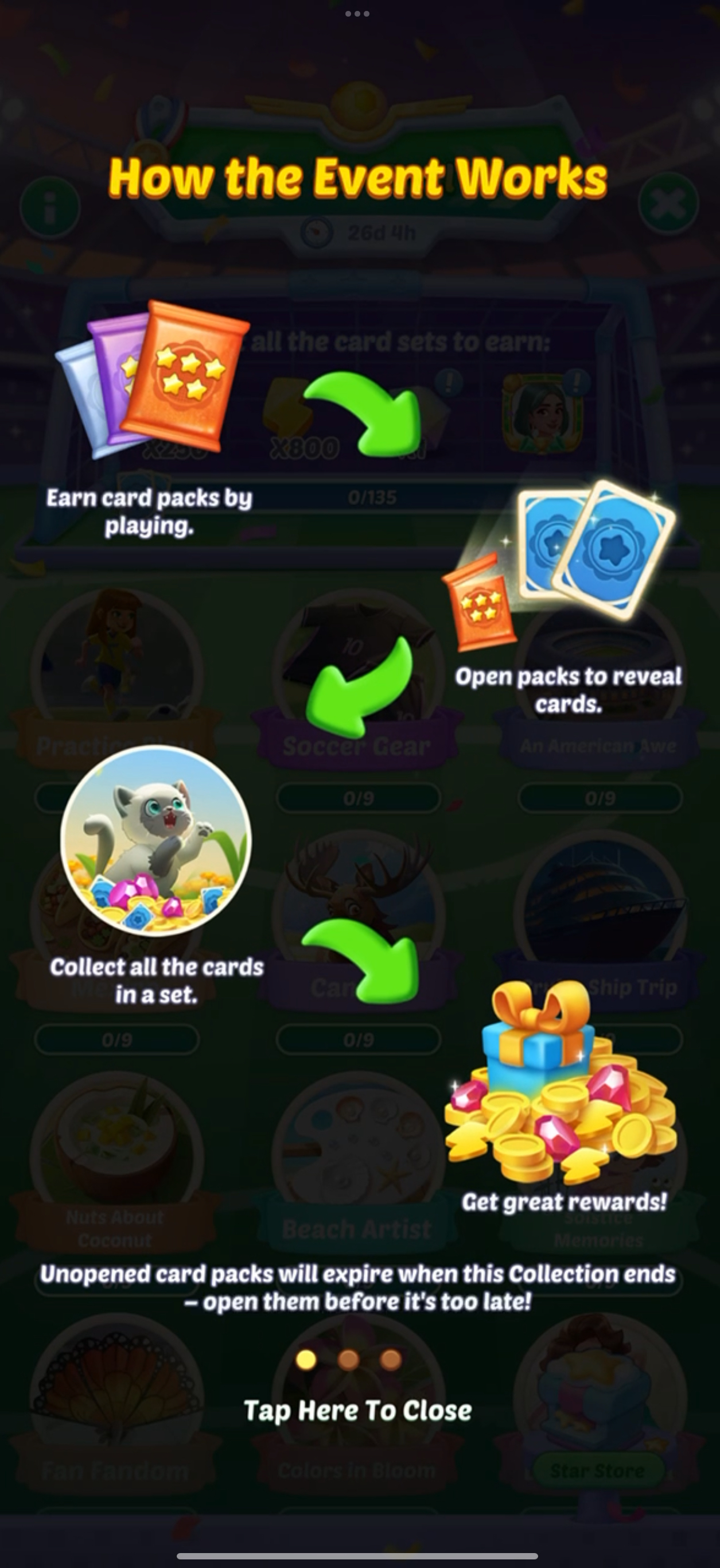
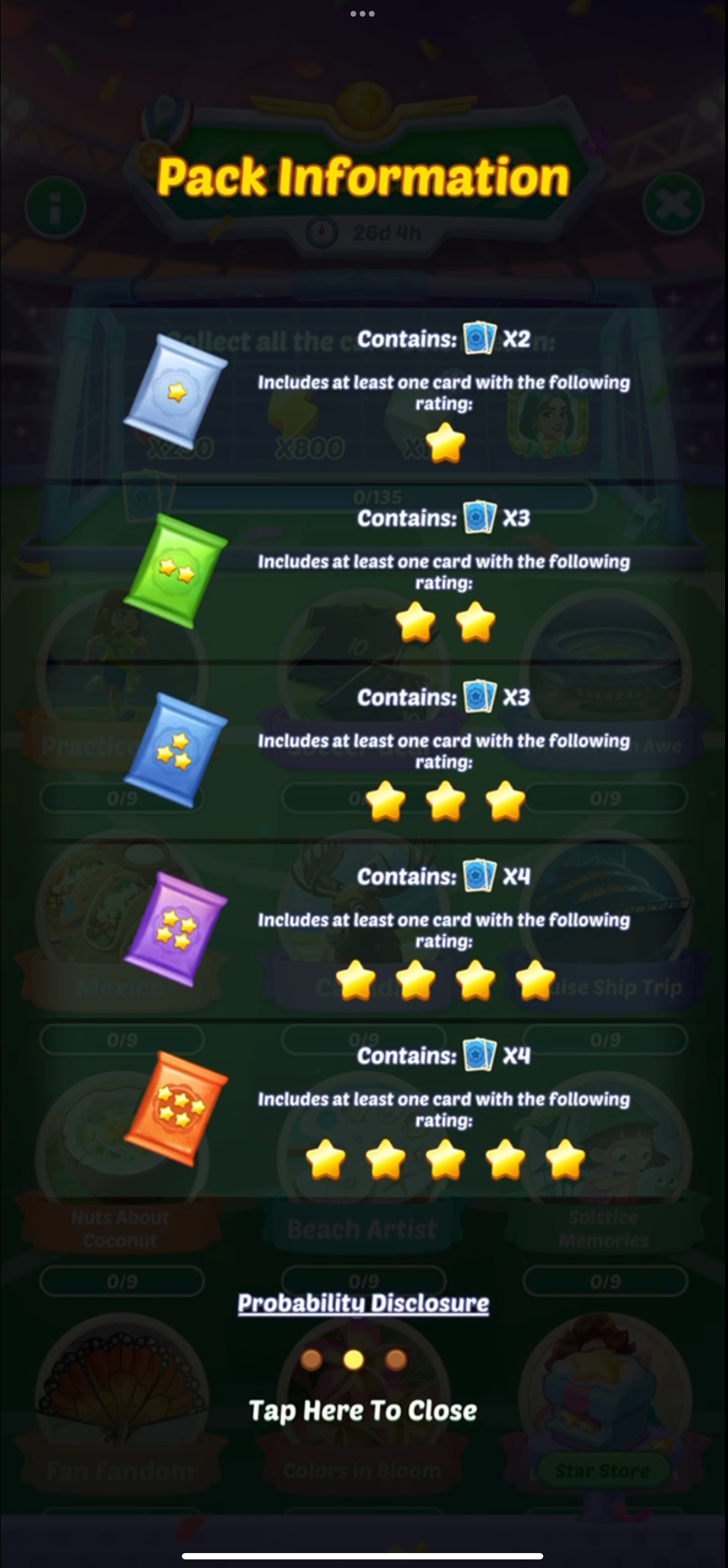
There were no feelings of winning or losing. For me, there was no satisfaction from advancement or mastery because the game doesn’t require any immediate specific skills (thus, nothing to master). Playing and succeeding in the game was only a means to playing more of the game, and I felt the primitive human drive to chase the feeling of completion. I can’t say whether or not I was having “fun,” but I can say that time ceased to exist. I entered the sticky “machine zone,” or, as Natasha Schüll puts it in the preface of her book, Addiction By Design, “a disconnected state in which daily worries, social demands, the sense of time and monetary value, and even physical awareness dissolve in the flow of gamified interaction.” The three hours I spent playing Gossip Harbor felt more like 20 minutes.
I originally thought that there was absolutely no strategy involved in playing these games, and this is partly true. (with the exception of Whiteout Survival, whose complexity requires multiple spreadsheets to play optimally.) On one hand, much of the gameplay in this genre is very simple: tap a button, drag an object, move onto the next level. On the other hand, I didn’t consider the less obvious type of strategy involved, separate from “increasing one’s score” or “becoming more skilled.” Natasha Schüll recalls a turning point at which a new type of player emerged: escape players. She describes them as those “willing to forgo large jackpots for regular wins and extended play time.”(ABD, pg 109)
I browsed Reddit to learn about others’ experiences and came across posts where players wrote extensively about how to stretch one’s dollars and increase their time-on-device.
“Cash is infinite. Dice are not.”
“Stickers reward patience and planning. More spins = more sticker packs.”
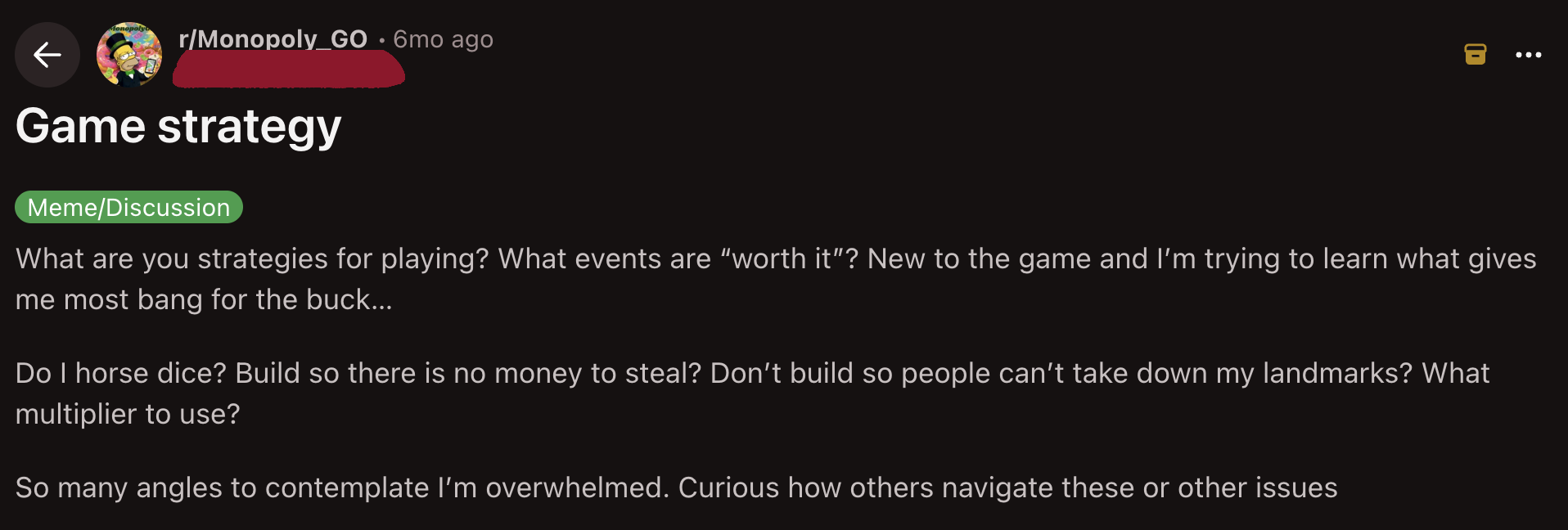
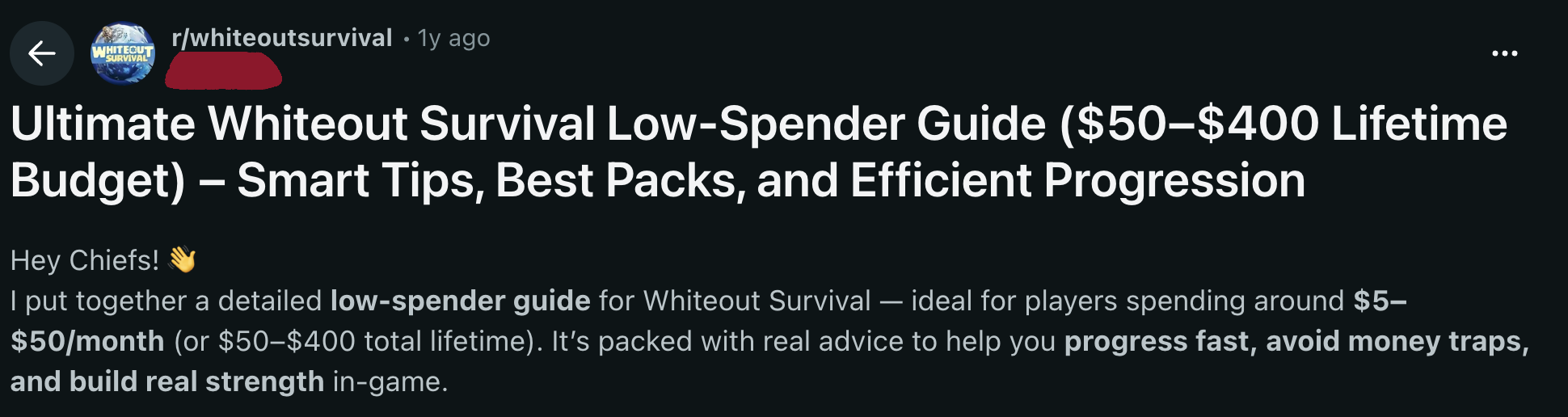

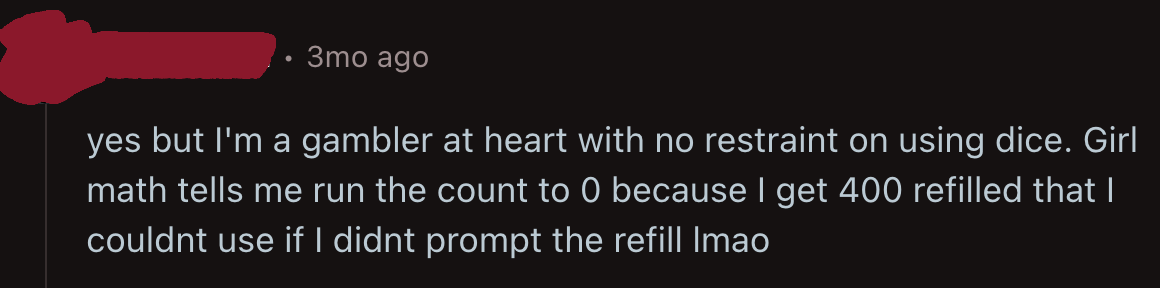
These players were admirably gaming the system, adamant to keep their free-to-play games free. Nevertheless, at one point or another, players will always inevitably hit that wall, depending on the urgency one feels to progress.
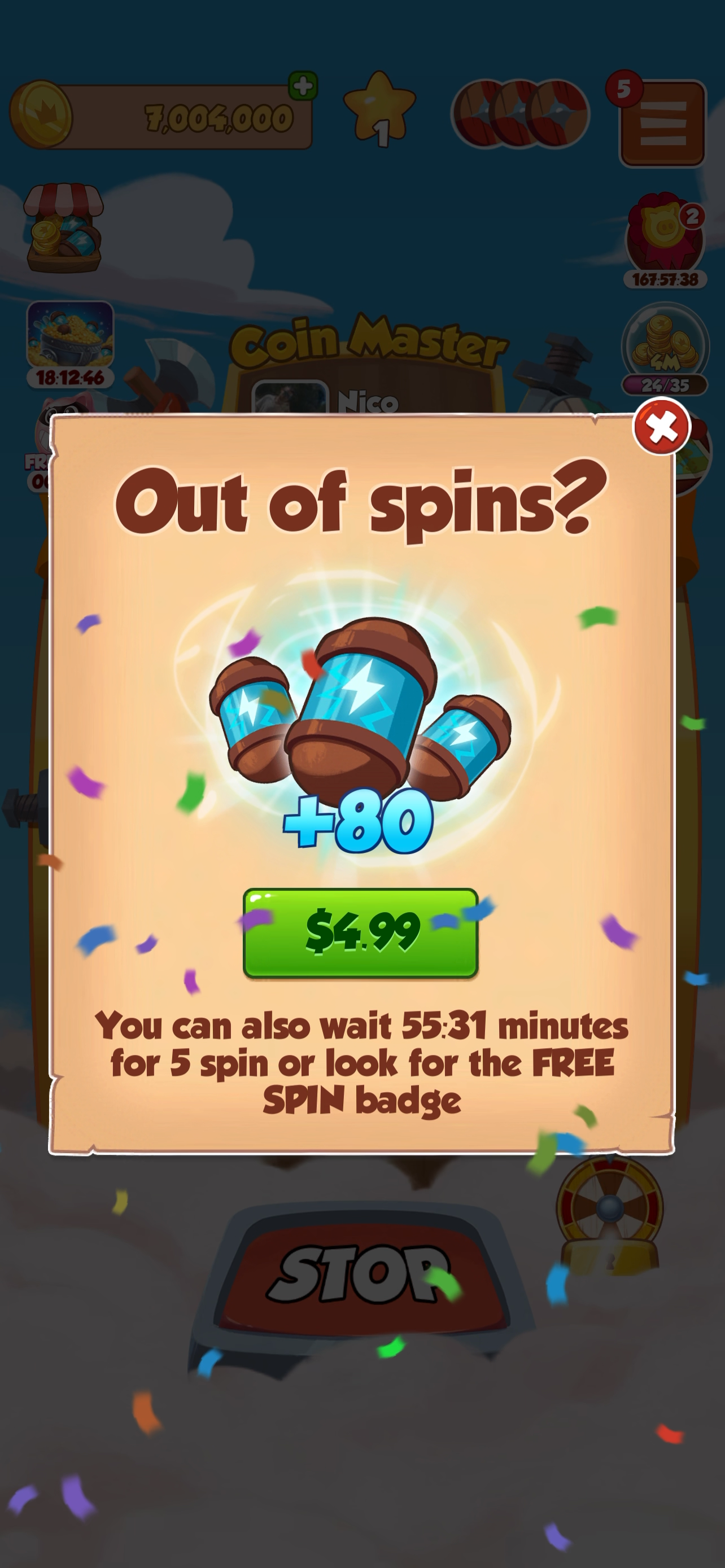
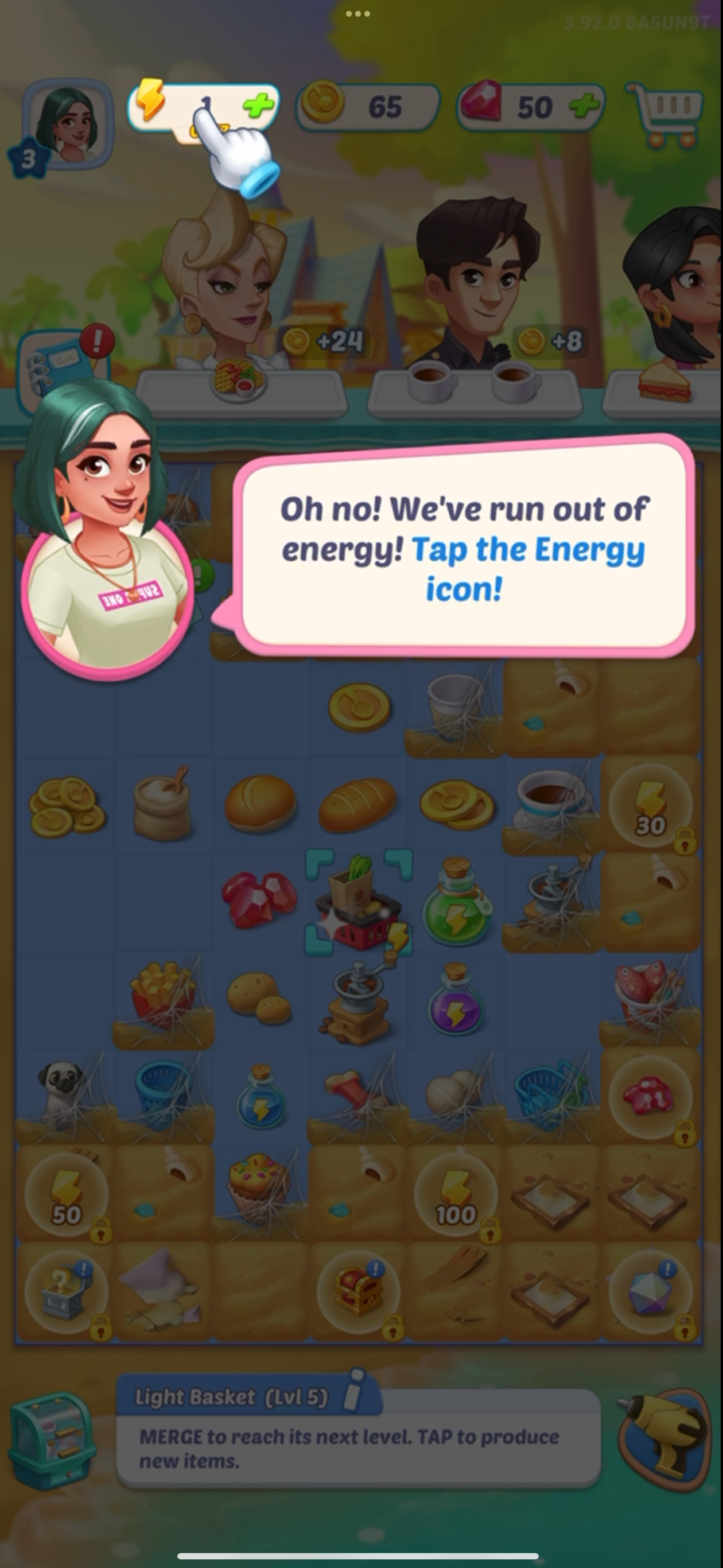
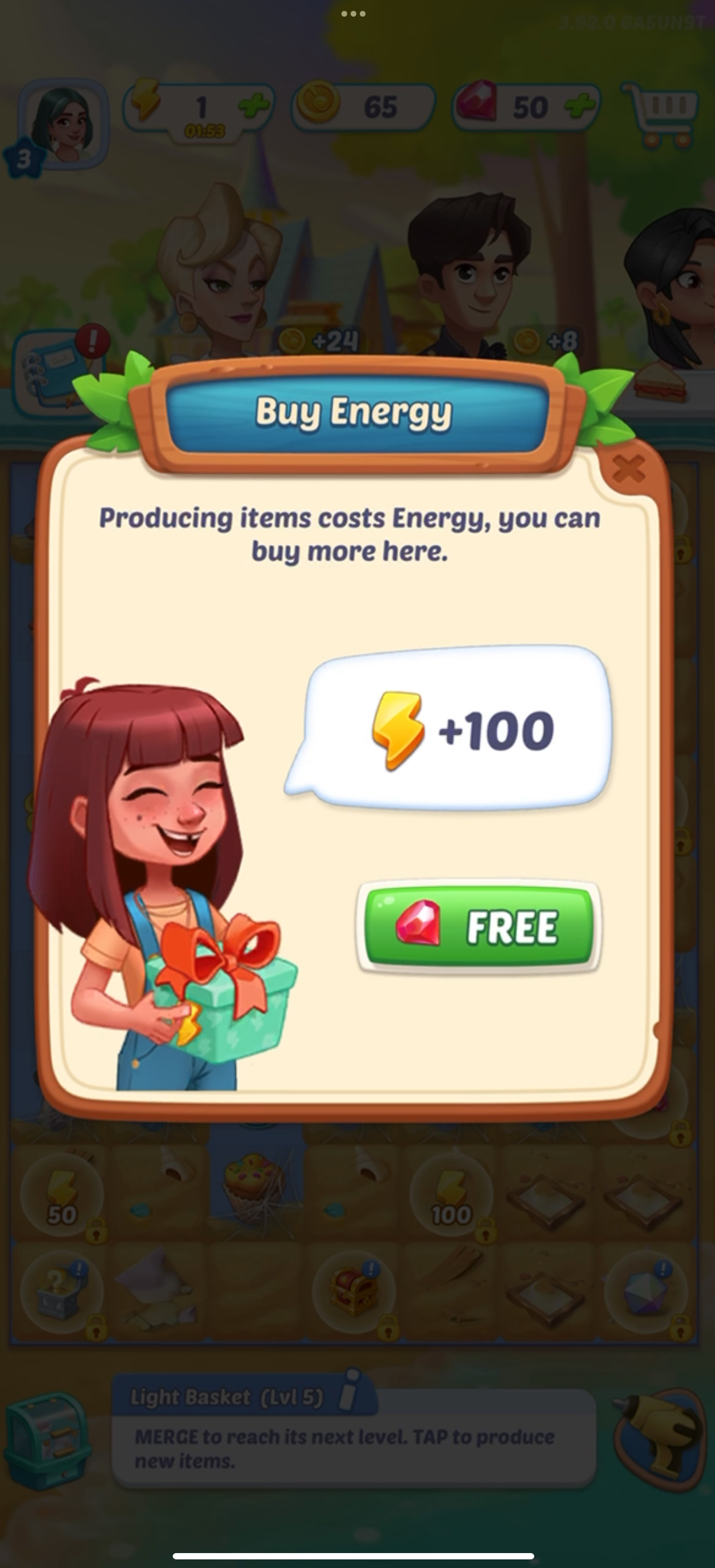
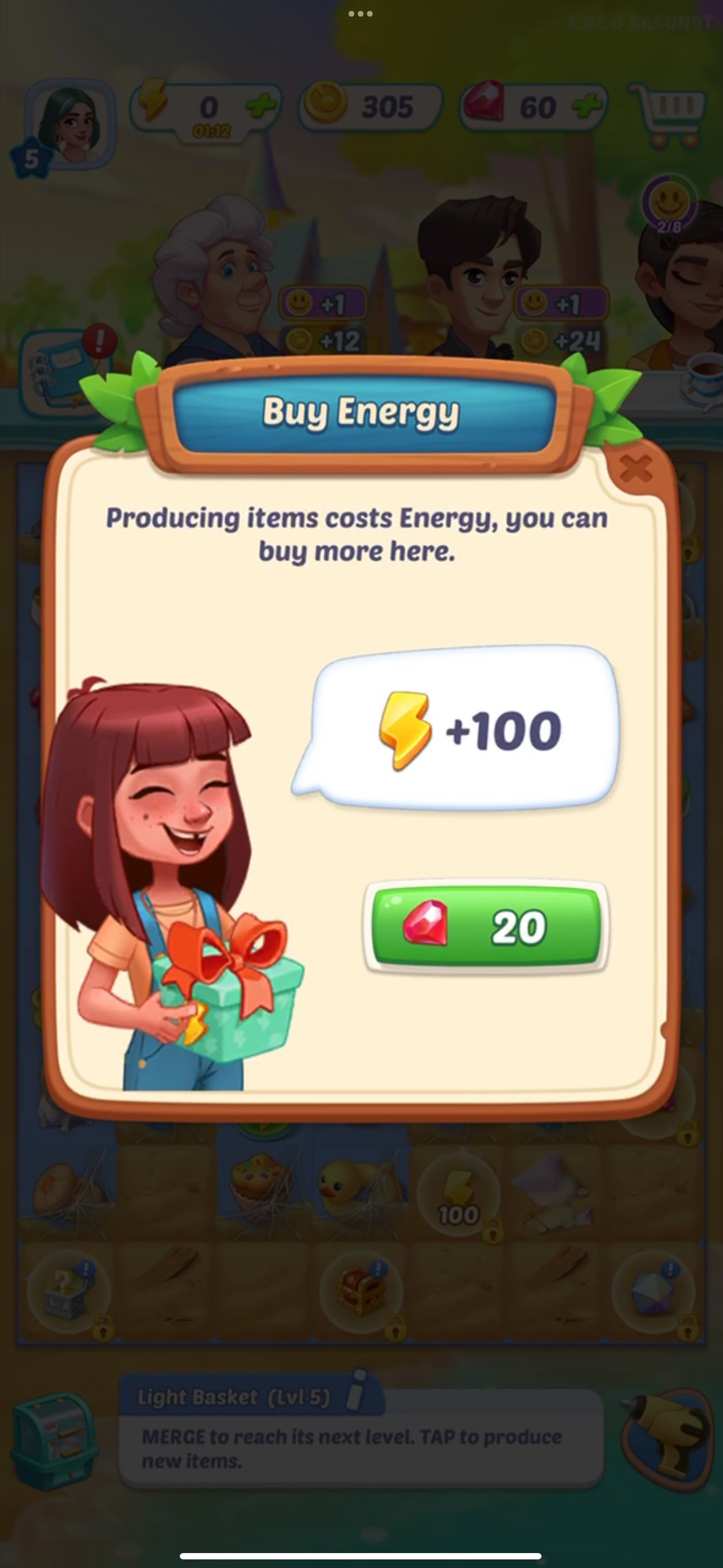
Let People Enjoy Things…?
I want to articulate which parts of these games are an issue now that we’ve gone through basic mechanics. I struggled with having to address potential criticisms as I wrote this—sentiments I saw posted all over Reddit: “Why can’t we let people enjoy things? Can’t people pay to play games that make them happy?” People should be allowed to pay for fun, to support teams of engineers, writers, and artists that create things that bring them joy. As observed in destructive industries—big tobacco, firearms, ultra-processed foods, GAMBLING, to name a few—some Redditors proudly state their hyper-libertarian stance that users are autonomous, with the freedom to make their own choices and thus, be responsible for the consequences (another concept we will return to in a future paper in the series ;) ). “Whales” (industry term reserved for the highest spenders) just happen to have a lot of money and should spend it in whatever way they choose. Hell, it is a man’s god-given right to spend his family’s $30,000+ of emergency savings on a game he loves… right…? Well…
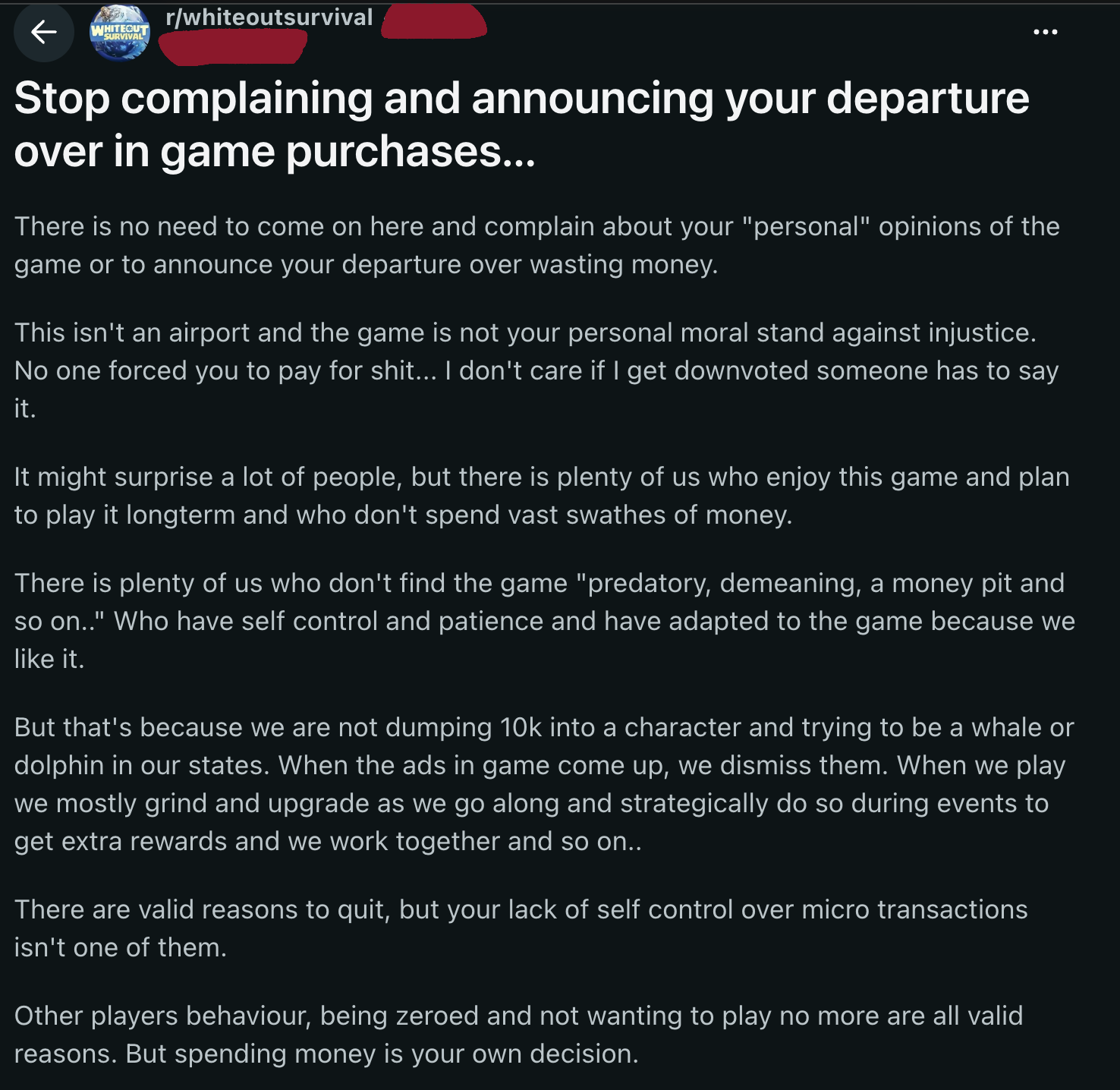
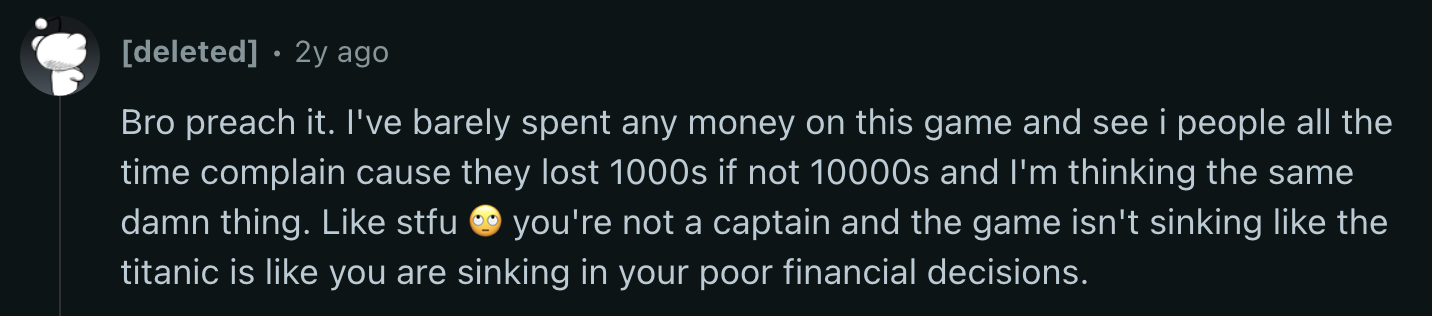
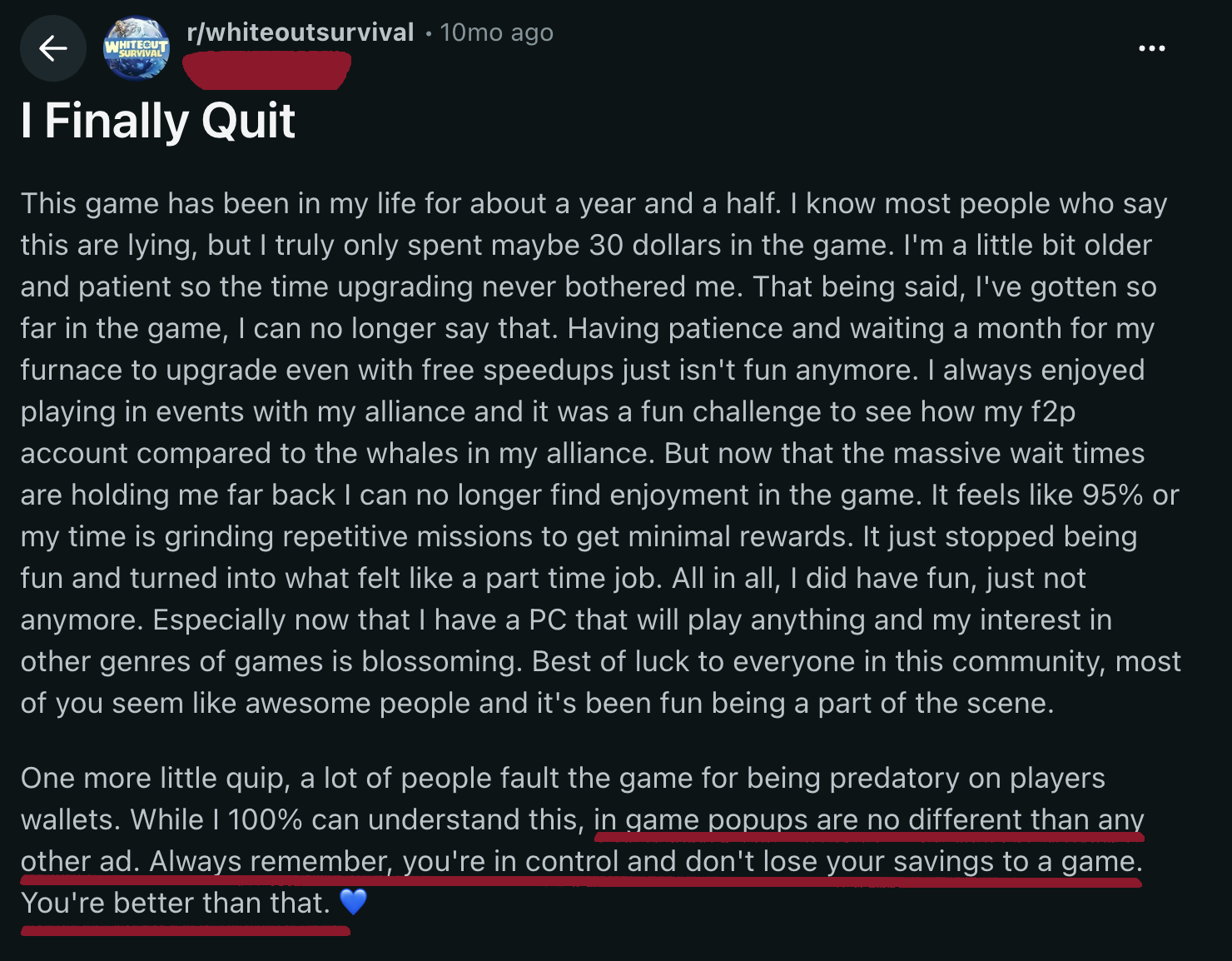
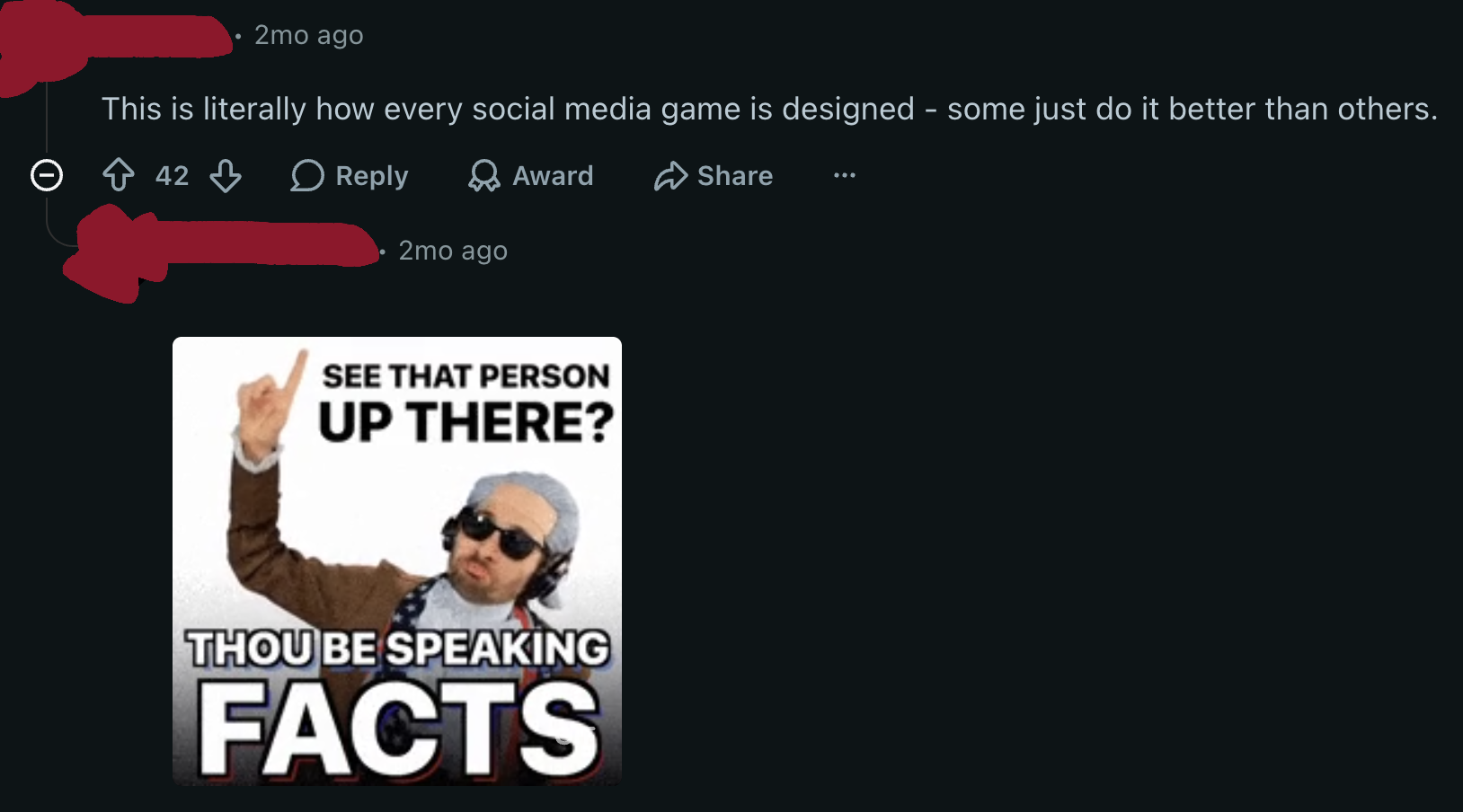
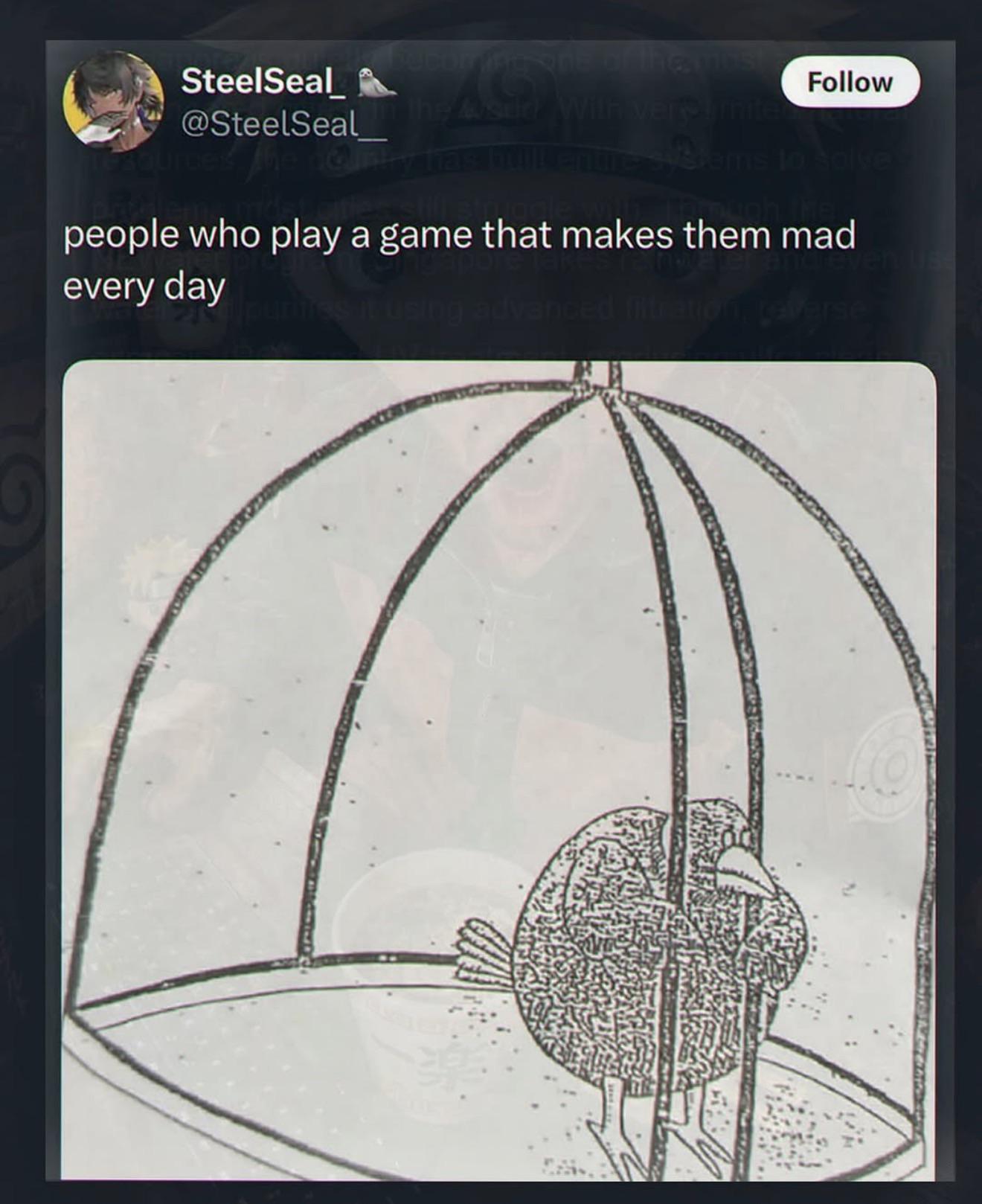
F2P games have a consistent pattern of engineering ultra-positive feedback loops, especially when players are just getting started. The game becomes exponentially difficult the more someone plays; not in terms of greater skill requirements, but rather adding more barriers such as time-gated upgrades, time-gated resources, energy or inventory limits, and so on. Even though the initial product is free, their entire modus operandi is concealing the true costs—financially and temporally—until a player is emotionally and psychologically invested. The current F2P business model depends on, well, dependence. Games will sell to the player ways to bypass friction the game itself created. Gameplay that used to last for over three hours dwindles down to only a few minutes.
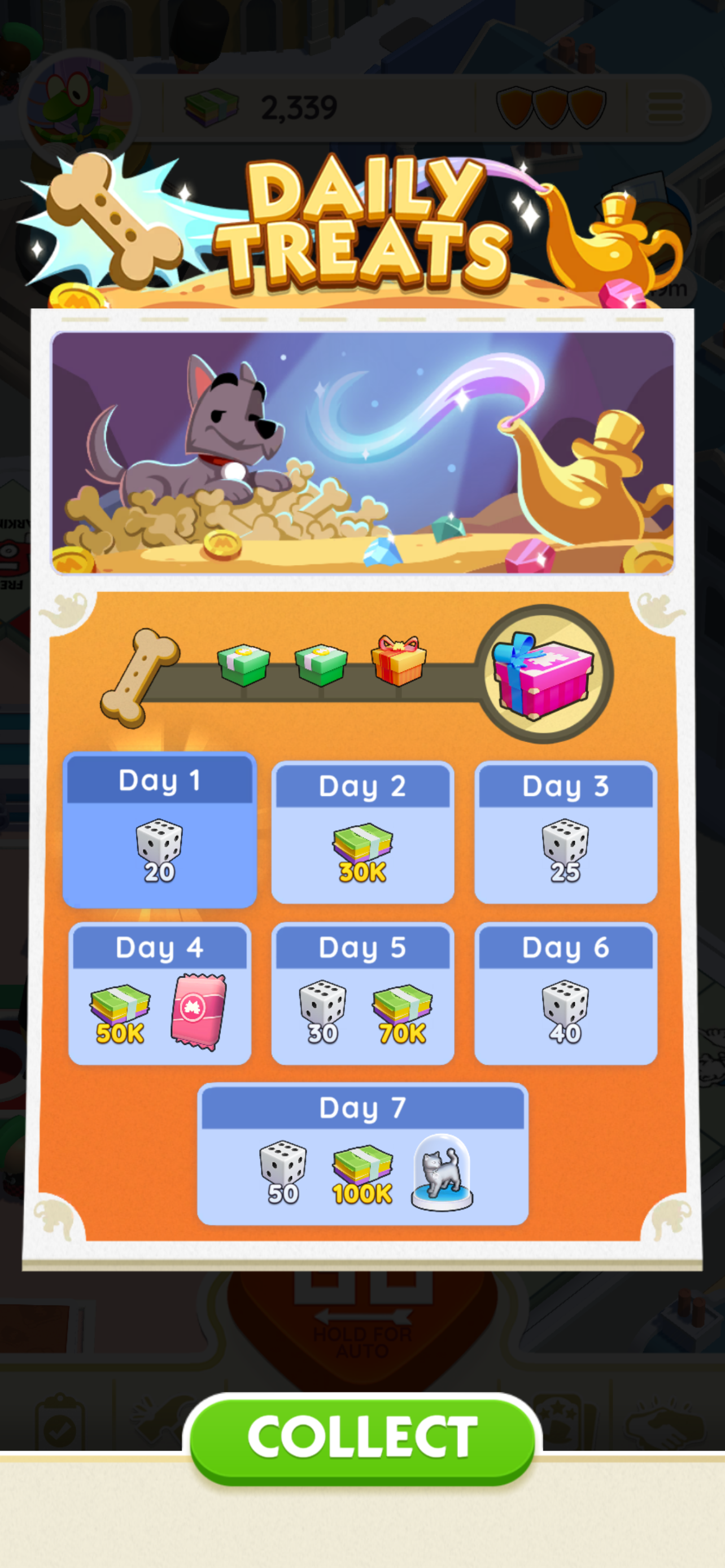
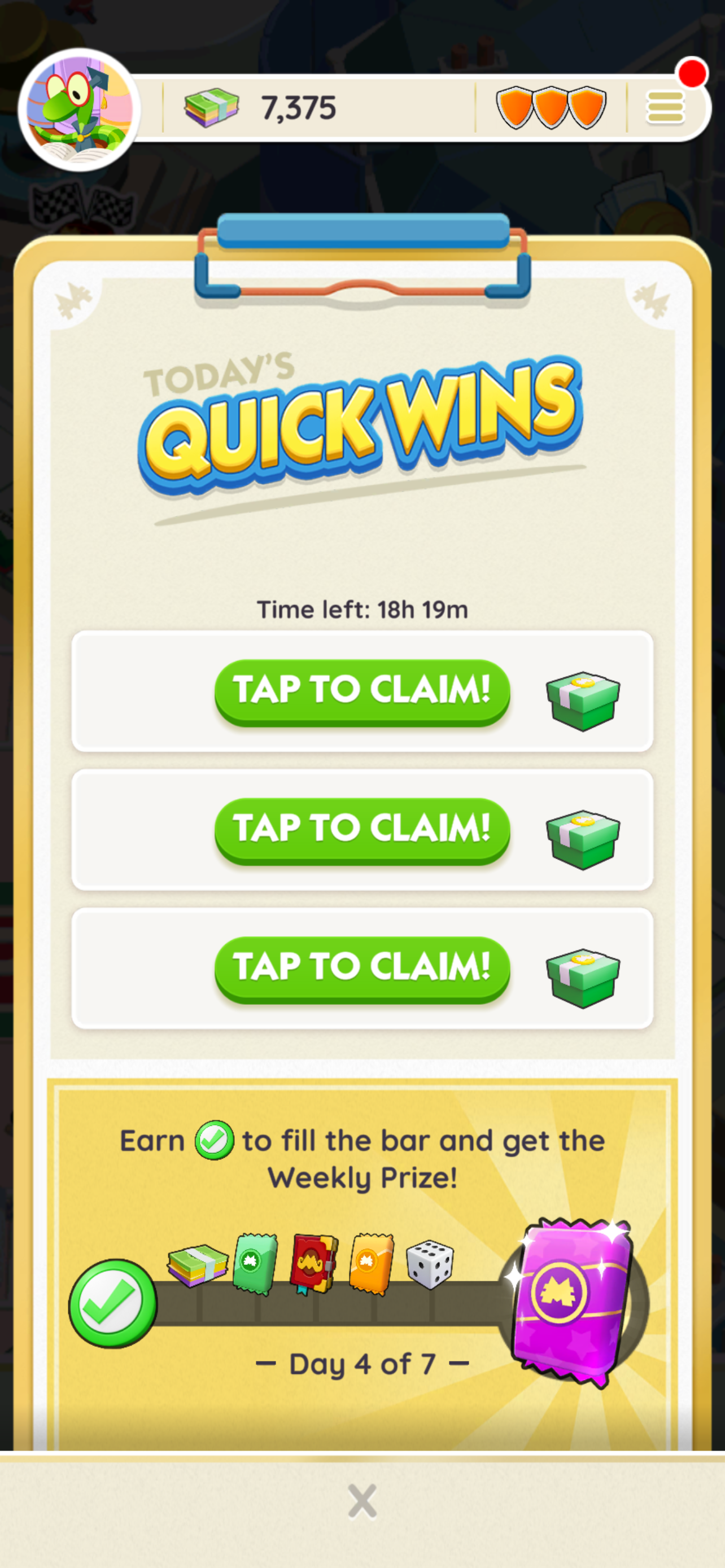
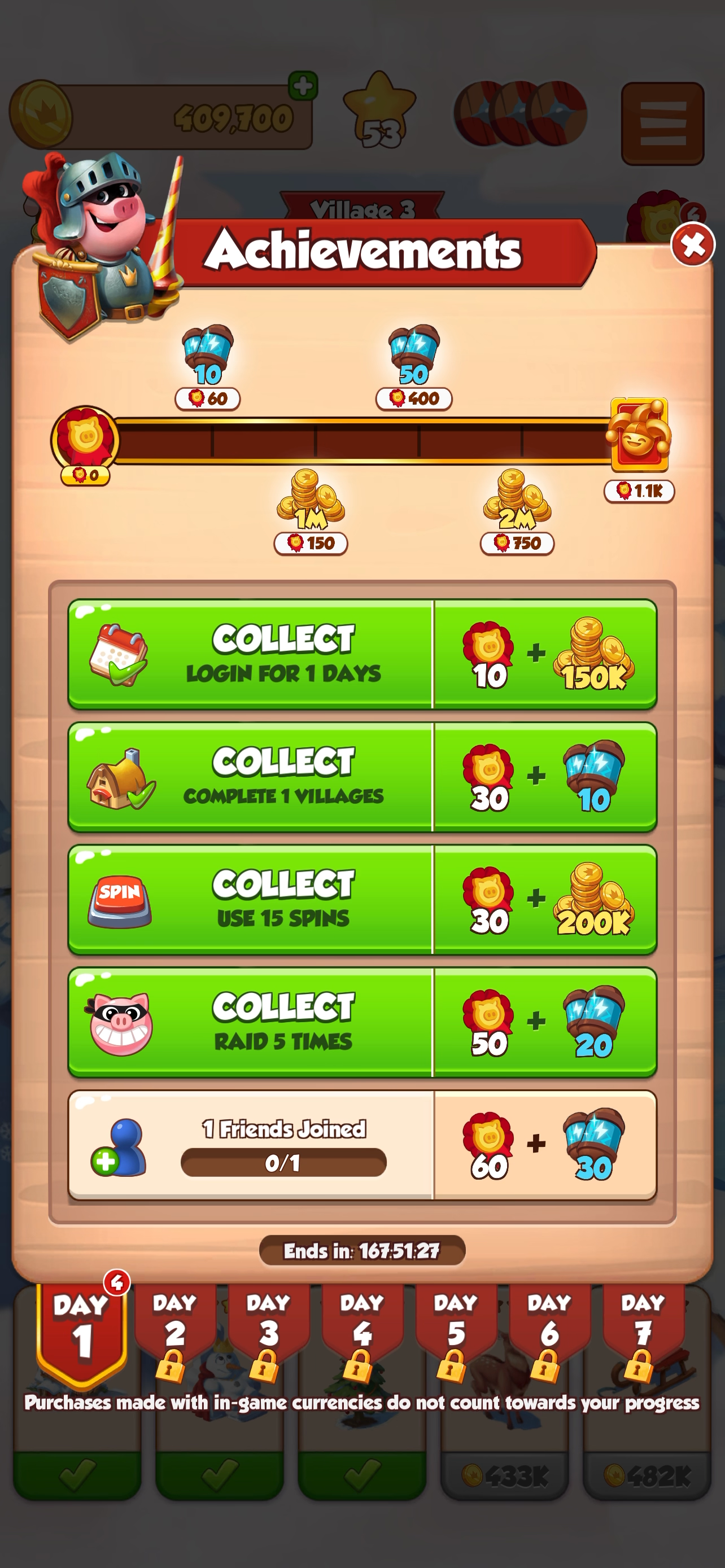
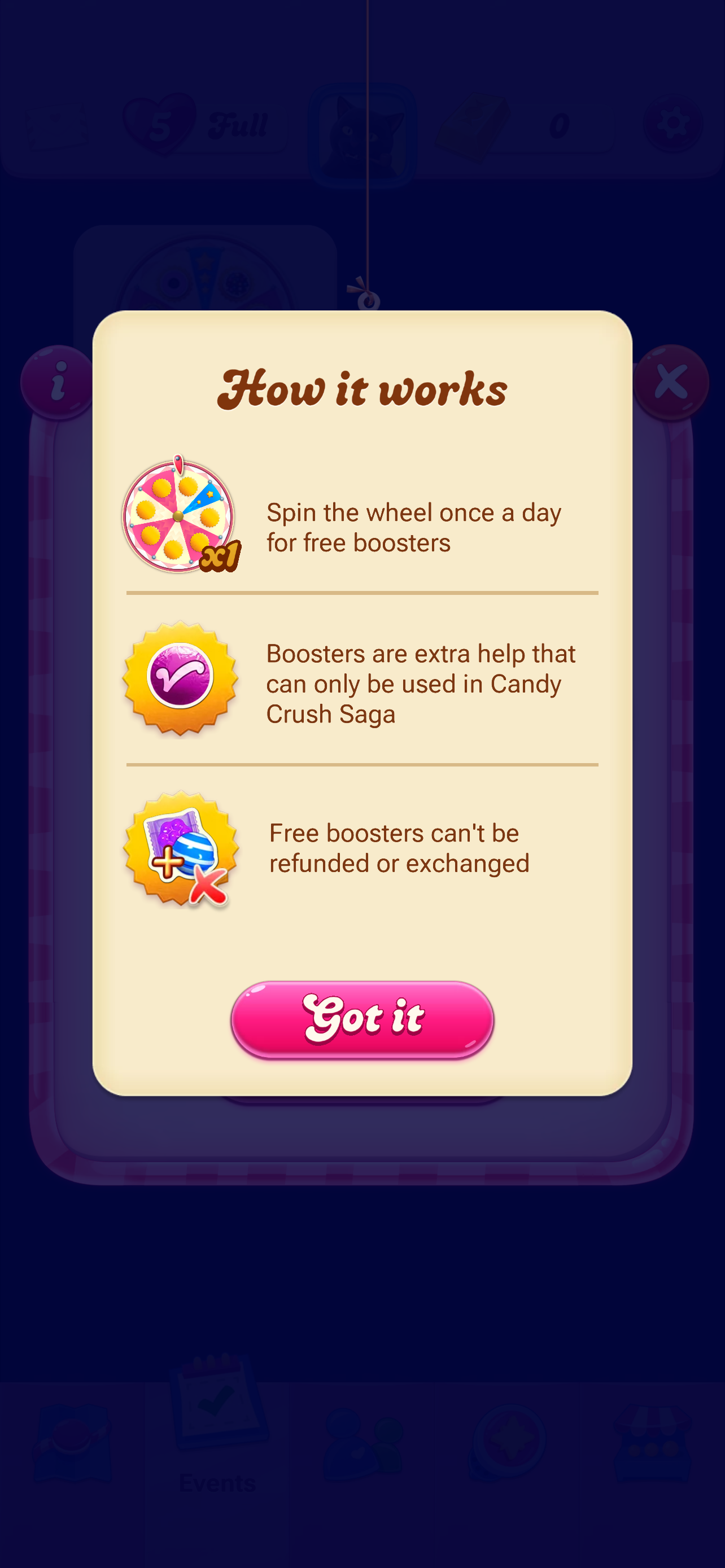
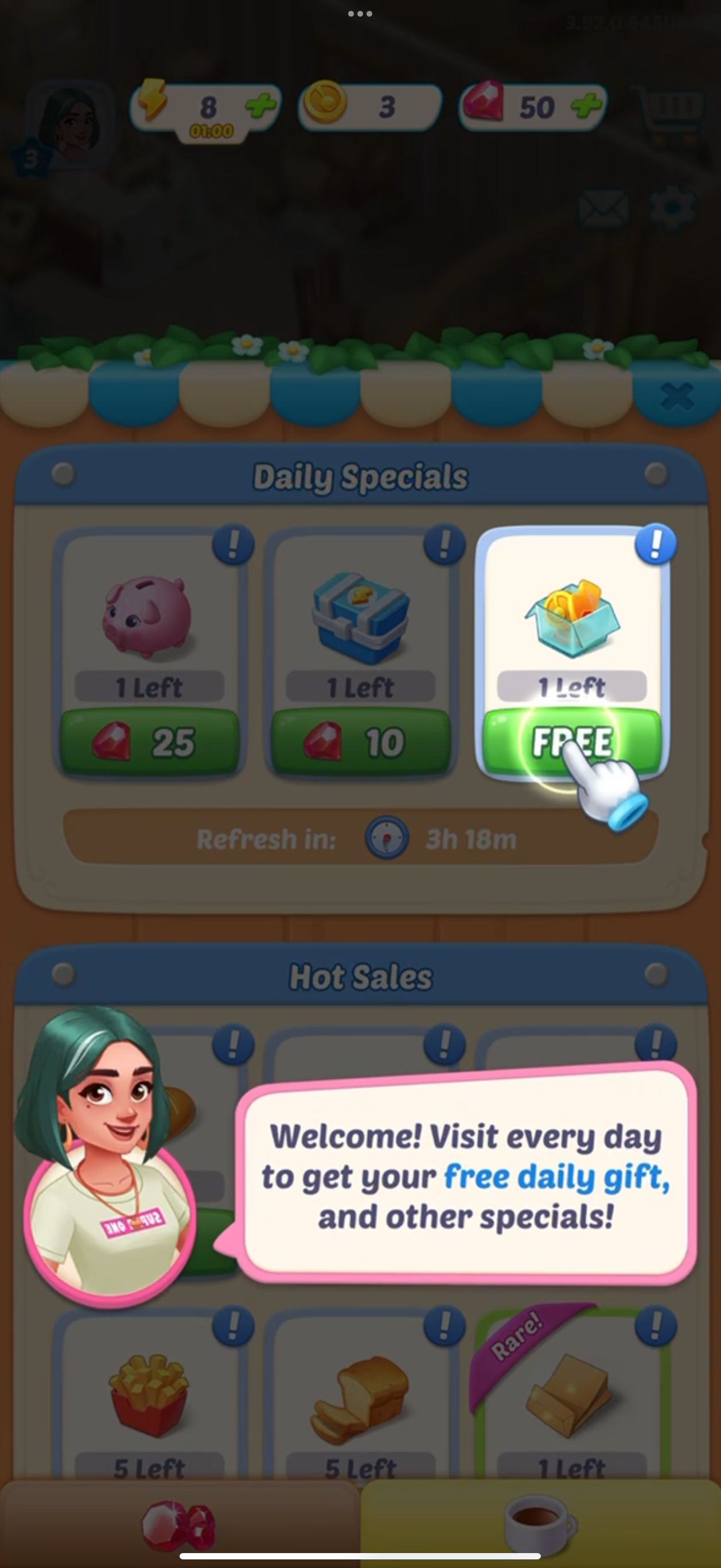
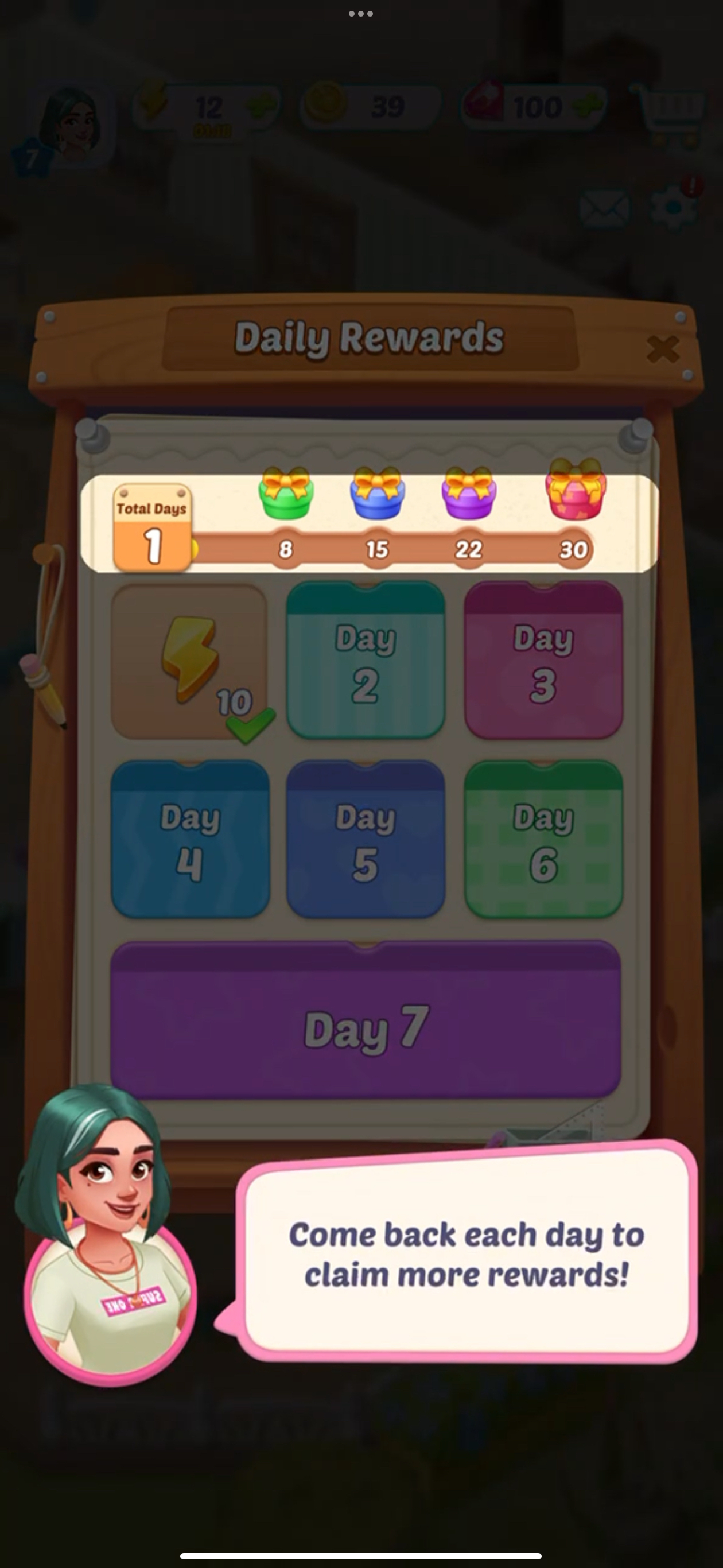
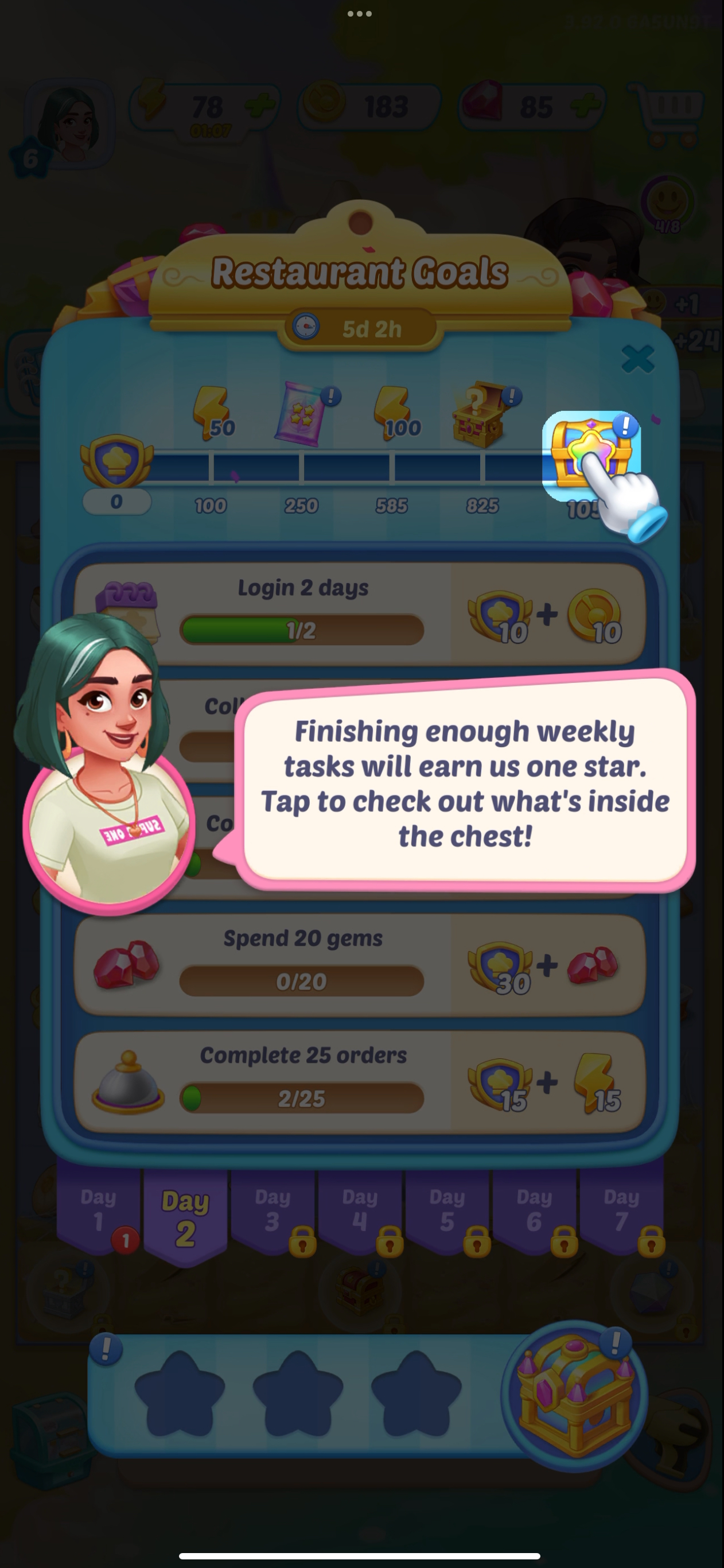
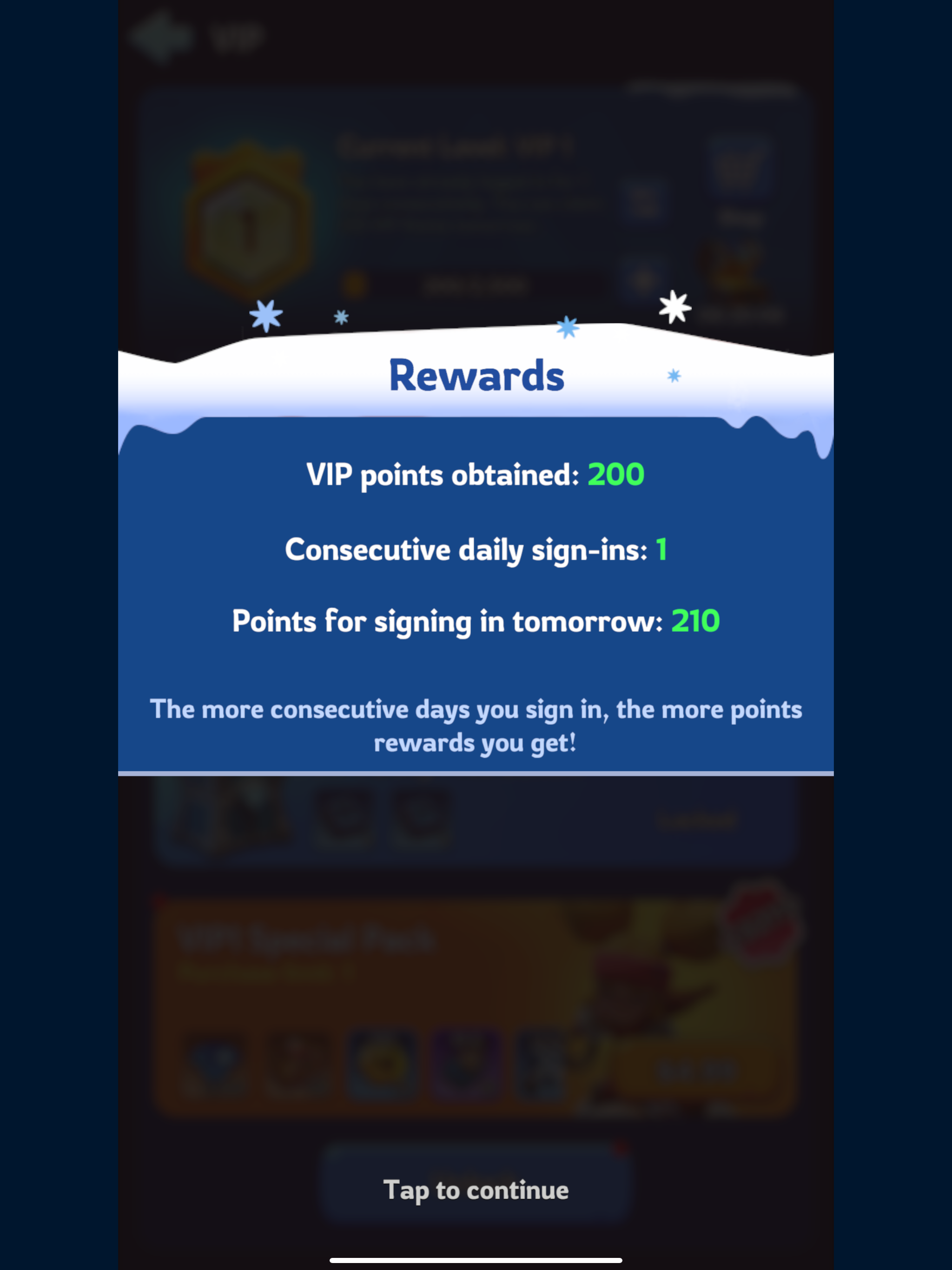
Mechanisms such as hidden odds, infinite “limited-time” offers, and losses disguised as wins loom over the player constantly to create feelings of urgency. Any sort of pause, progression, or error is followed by a pop-up. “Oooh, so close!” “Don’t miss this!” “There’s still time!” These games are full of classic “dark patterns” used to push people into paying money in order to avoid feelings of loss. (More on this phenomenon in the next paper ;) ) In addition to the manufactured loss aversion, these apps utilize the same psychology used in the gambling industry (the variable ratio reinforcement of it all), but disguised as “rewards” and “prizes.” I can’t even count how many times I read the words “prize” and “reward” while playing these games.
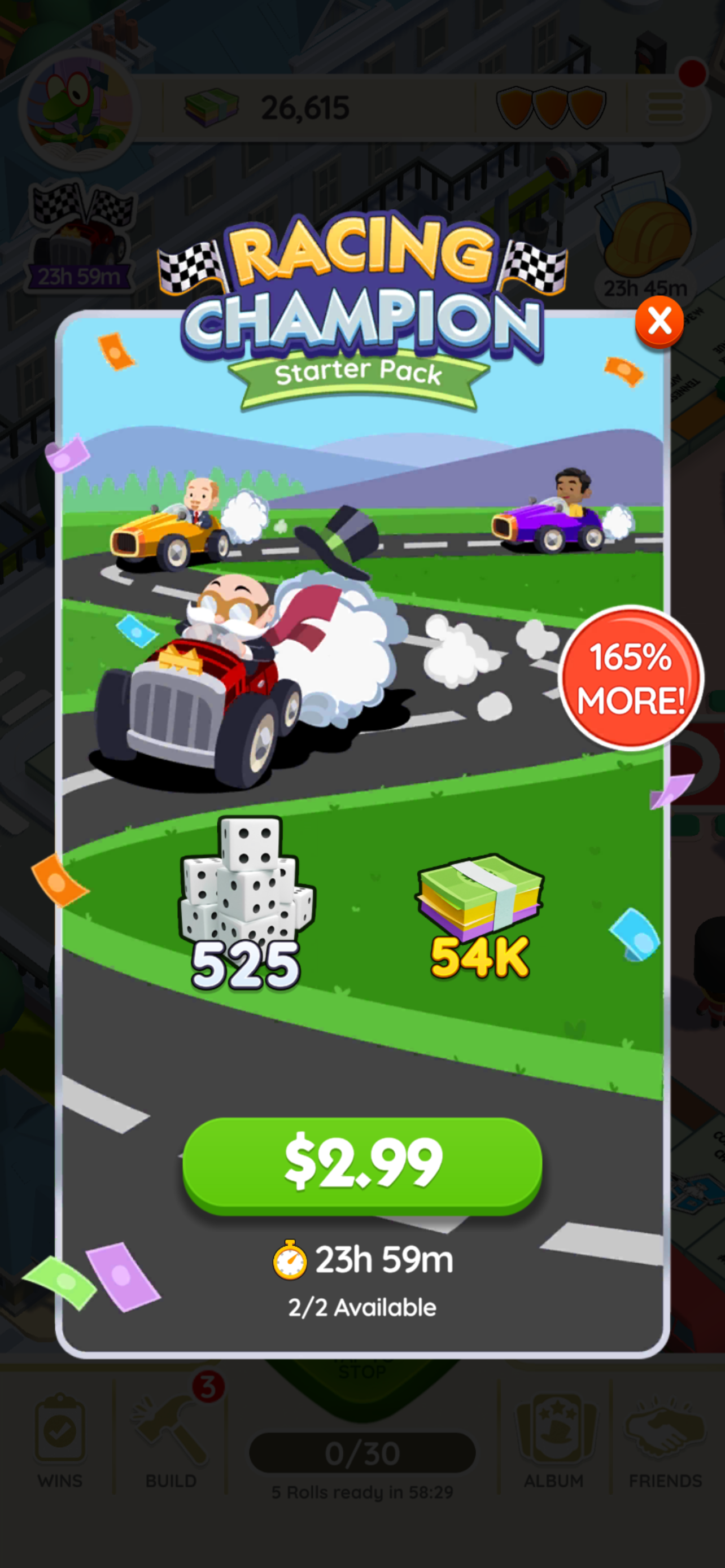
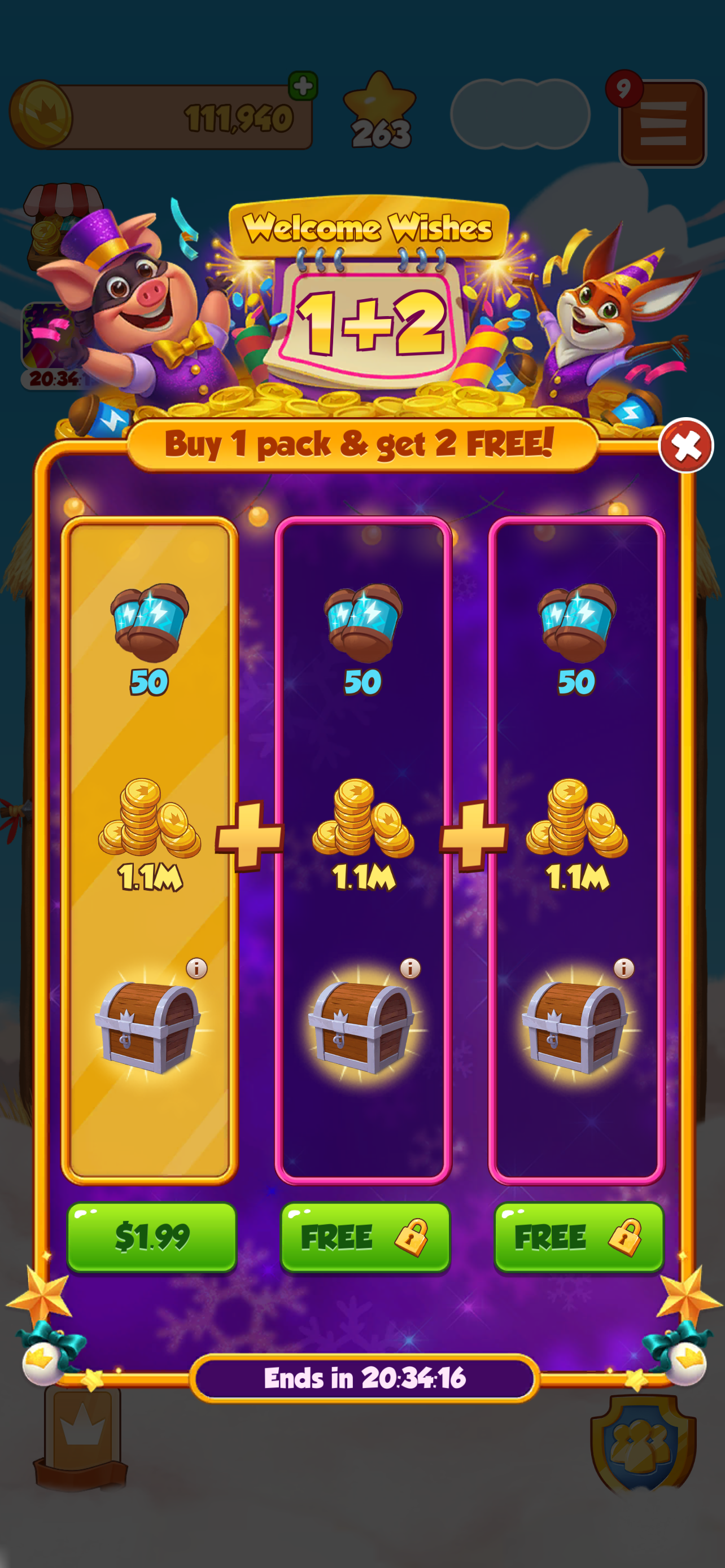
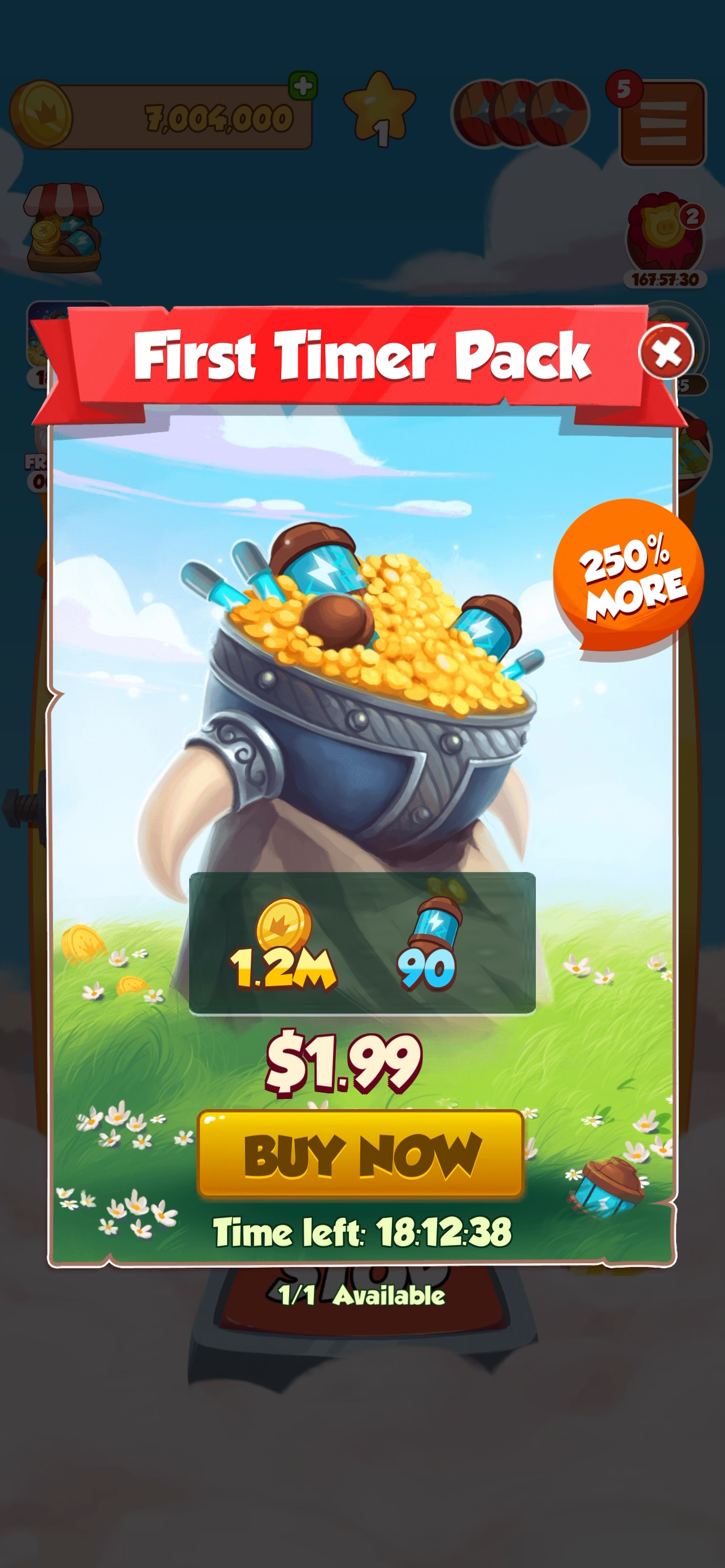
Further research shows a correlation between loot box spending (items where the contents are unknown to the buyer) and higher Problem Gambling Severity Index (PGSI) scores. The authors of this paper explicitly state that this is stronger than or comparable with the relationship between problem gambling and depression or drug use, as roughly a third of high spenders meet the criteria for “problem gambler” on the PGSI. Furthermore, no correlation was found between loot box spending and self-reported annual earnings. About 5% of purchasers account for around half of loot box revenue, while the top 2% account for nearly a third. What this reveals to me is that industry profit is disproportionately made up of at-risk players rather than high-earning individuals. (I want to note that this paper does not outright state harm, but solely points to the correlation between spending habits and gambling severity. The paper is an analysis of pooled surveys rather than one clean dataset and contains self-reported data throughout.)
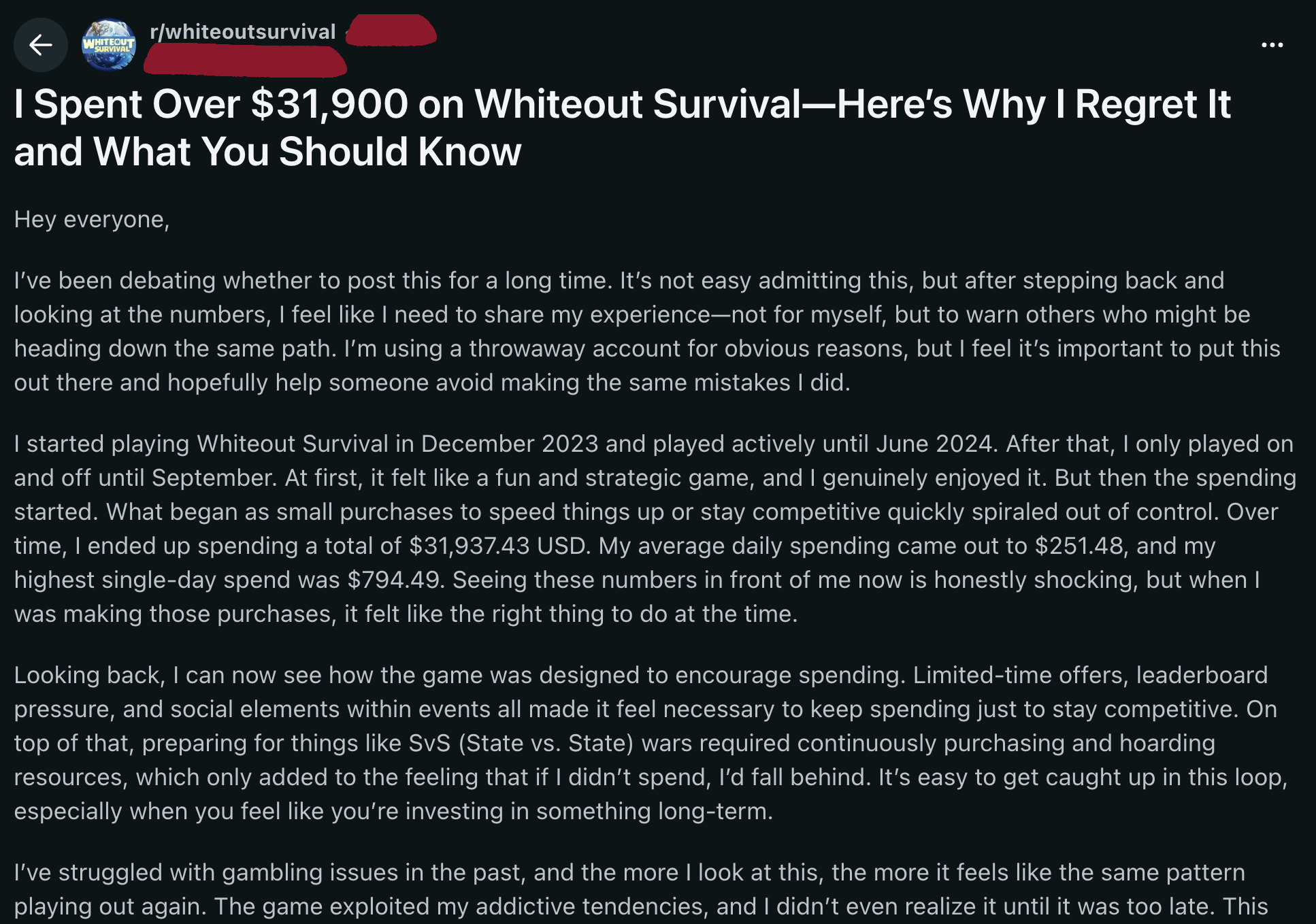
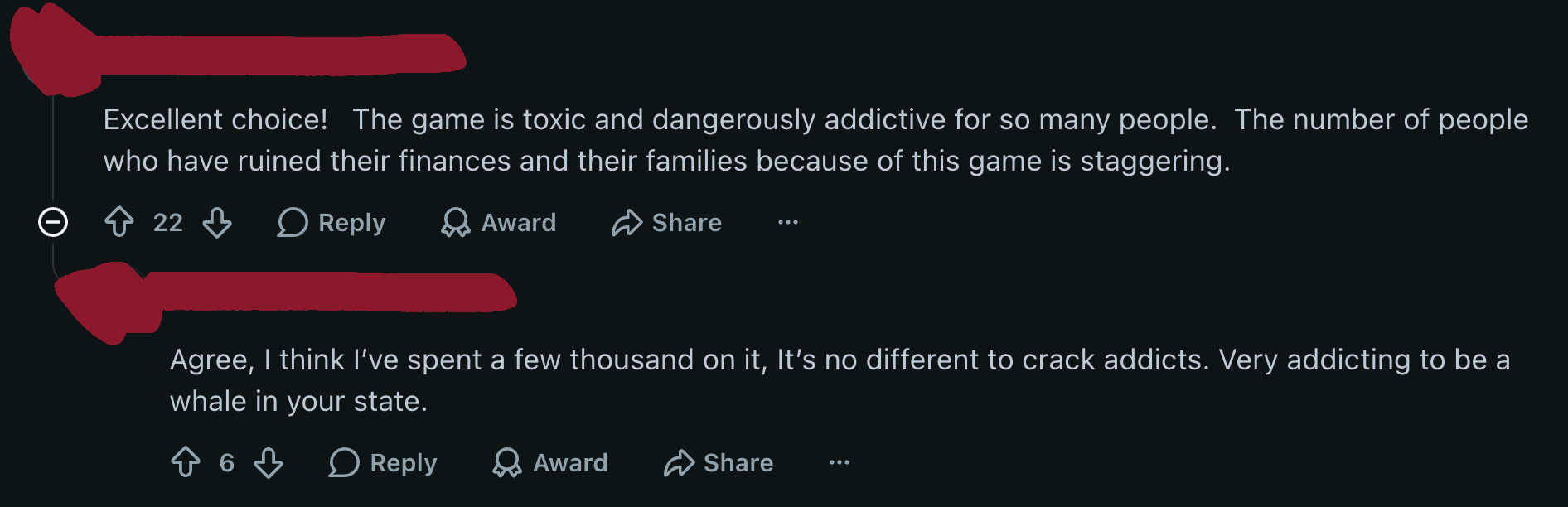
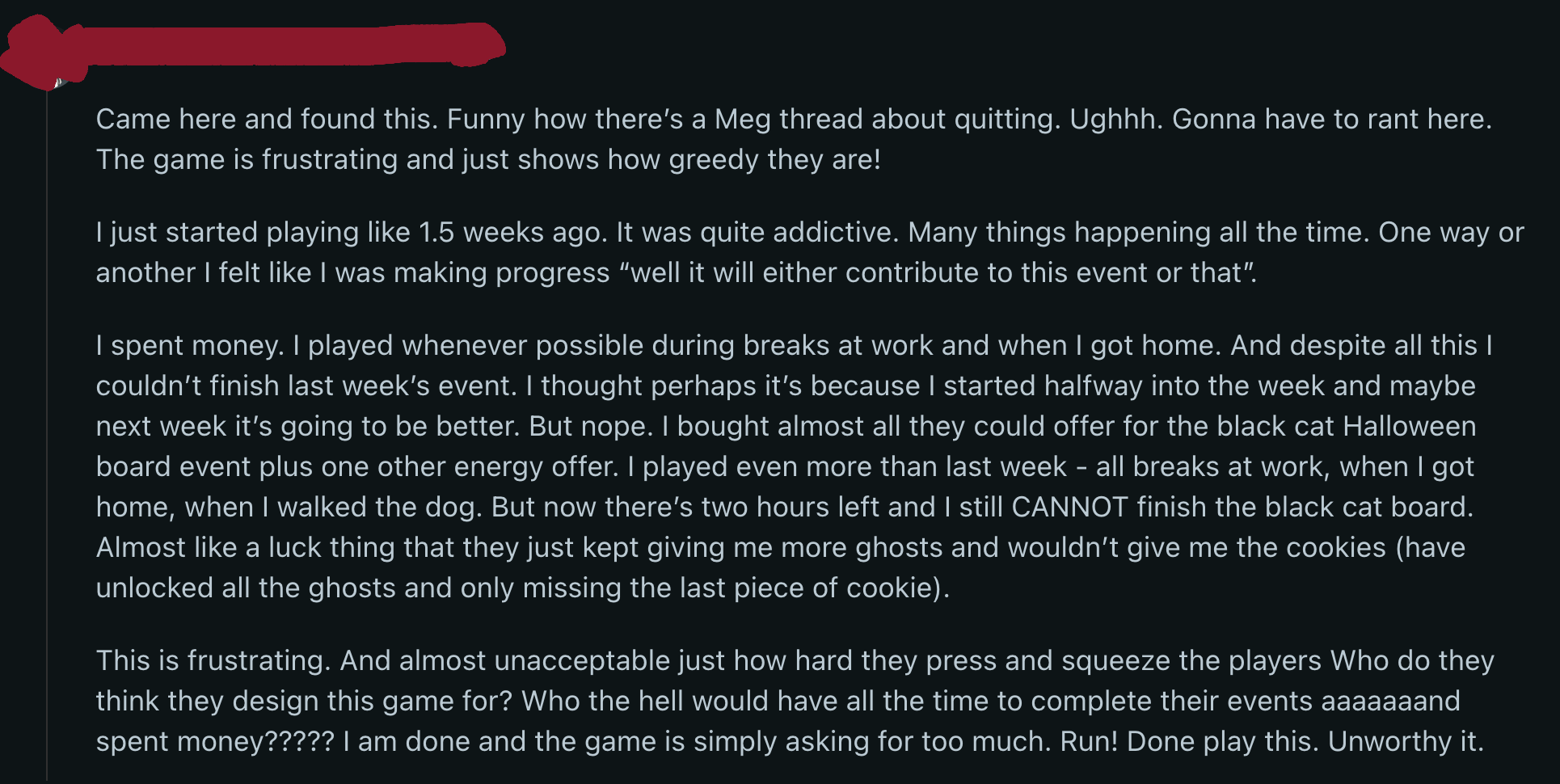
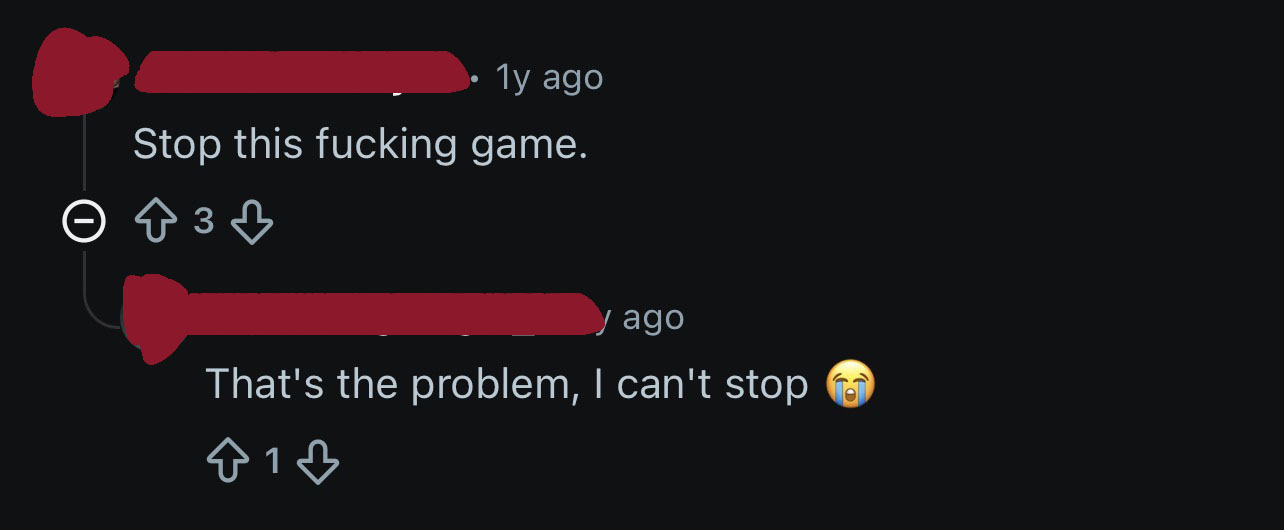
The data shows that F2P is strongly linked to compulsive behaviors in at-risk users. The industry and even the players know that; the question is not “can it be technically, clinically called addiction?” I want to pivot from this line of thinking, as well-intentioned as it is, because it still puts the onus on the player and doesn’t actually get to the bottom of why the F2P business model is unethical. The questions I’d actually like people to consider:
Since companies optimize for engagement/revenue using established principles and biases from psychology and behavioral economics, are consumers truly acting independently?
If companies hire teams of psychologists/economists/UX researchers/data scientists/etc to exploit these cognitive biases, is there a point when responsibility shifts from the consumer to the designers?
When there is such a distinct asymmetry between the information companies have (behavioral data, spending models, A/B testing results, etc) and the knowledge consumers have (wow, game fun) should safeguards be established to justify this gap?
F2P games with mechanics that manufacture compulsion are meant to sell continuation rather than victory/resolution. It is the junk-food of video games, triggering reward pathways and providing little to no nutrition. That’s not to say players are not accountable at all. Personal accountability applies to a degree, but this accountability should assume that one is able to make informed choices free of manipulation and deceit. Responsibility shifts based on the ability to choose freely, but F2P is designed to muddy the waters and erode as much informed consent as possible. I don’t think these games need to be banned, but I do believe in shifting responsibility more towards companies, who, ultimately, control the circumstances in which decisions are made.
Are there not alternative business models that would keep companies afloat? Would they survive without these predatory monetization practices, and if not, does preserving the current business model outweigh the harm it causes? (I have no answers to these.) Well, companies certainly have no desire to find out, as they have fought tooth and nail to prevent any sort of regulatory action.
Regulations Schmegulations
The iOS store has had the Casino category in the mobile games section since about 2010, but you wouldn’t find any of the ones I’ve mentioned in there (not even Coin Master, even though it is a straight-up SLOT MACHINE). Some (me) would say they’re actually worse. Slots give players a CHANCE to see some returns since regulated slot machines have a minimum payout, or Return to Player rate (RTP) and are subject to ongoing regulatory oversight by third parties.
There are no such regulations for F2P because it is not, in a legal sense, “gambling.” 7 There is no opportunity for players to win money, so these games are kept out of the realm of gambling as defined by regulators or the FTC. (in case you haven’t yet, check out footnote #1 from the previous piece to see how slot machines historically turned into “gum machines” to curb regulations.) The odds can be whatever a developer wants. One saving grace is that since 2017-2019, the Apple and Google play stores have required games to disclose their odds. It’s not nothing, sure, but is disclosure—especially when it’s tucked away, out of sight—truly as effective as regulation?
Theoretically, if a game wanted to, they could… I don’t know… look at a player’s session length, behavior, spending history, and change the “difficulty” based on whatever the game thinks would extract the most money. Wouldn’t that be crazy? Well, it’s not entirely out of the realm of possibility—multiple companies actually hold patents for algorithmic systems specifically designed to increase engagement and extract as much money as possible from players. 8
There are many anecdotes from players, including Amanda, speculating that games are able to use behavioral data in order to adjust things such as difficulty, odds, or pricing. (I experienced the last one firsthand)
We can’t read the minds of these F2P execs. But we can go back to 2009 and glimpse into the mindset of a prominent figure from the F2P world. Mark Pincus, CEO of Farmville’s Zynga, had a distasteful video9 of him surface a couple days after a scathing exposé:
“I knew that i wanted to control my destiny, so I knew I needed revenues, right, fucking, now... So I funded the company myself but I did every horrible thing in the book to, just to get revenues right away. I mean we gave our users poker chips if they downloaded this zwinky toolbar which was like, I don't know, I downloaded it once and couldn’t get rid of it. laughs We did anything possible just to just get revenues so that we could grow and be a real business… So by the time we raised money we were profitable.”
Like??? Oh my god, he admit it??? I was a little gobsmacked watching him state so plainly that his venture into social gaming was just a franchise-milking speedrun.
Ten years after the release of Farmville (2019) IAPs (in-app-purchases) came under fire in a very public way. Missouri Senator Josh Hawley announced he was introducing legislation (bipartisan, mind you!) that would have rocked the gaming world… if it had gone through. The “Protecting Children from Abusive Games Act” would have prohibited publishers and distributors from offering loot boxes, pay-to-win mechanics, or similar gambling-adjacent systems to minors. As you can imagine, the video game industry was extremely opposed to any such movement. Its biggest opponent was the ESA (Entertainment Software Association), the trade association that represents every gaming publisher in the United States. ESA CEO Stanley Pierre-Louis called the bill “flawed and riddled with inaccuracies,” claiming that passing such a bill could harm the 220,000 Americans employed by the video game industry.
Pierre-Louis’s comment isn’t completely incorrect. The bill didn’t have the most precise wording and left it a little too vague—the bill was pitched to regulate predatory games and tactics to, as the name says, Protect Children from Abusive Games, but the definitions listed are so broad that, in practice, the regulations would target the industry as a whole. Womp womp.
The Protecting Children from Abusive Games Act was found dead in a ditch after January 2021, perhaps partly killed by its less-than-ideal wording, but also a loss in momentum, as there were a couple other… more pressing matters to address in between. (a whole ass pandemic, an, ahem… certain president and his questionable activities…) Although the bill failed to become law, it wasn’t a totally meaningless effort, as it illuminated the sneaky gambling mechanics in non-gambling games to the mainstream consciousness. That being said, since 2019, Americans have culturally doubled down on their consumption of products where gambling mechanics were a feature, not a bug.

Life, Liberty, and the Pursuit of Fortune
In his book Man, Play, and Games (1958), French sociologist Roger Caillois argued that games are not only cultural pastimes, but they provide deep insight into social institutions and that one can draw certain conclusions about a civilization by examining the games that are most popular. He categorized play into four different elements based on players’ motives: mimicry, or simulation; ilinx, or vertigo; agon, or competition; and alea, or chance; this piece focuses on the latter two. Caillois claimed that modern cultures were defined by their preference for games that involve the strained relationship between agon and alea. Competition and chance are contradictory, but complementary methods of mobility when all participants start out equal.
Yet, the unconsenting participants of the great experiment do not start out equal. In the US, we are sold the idea that agon, the spirit of competition alone, is enough to counteract the circumstances of our birth when in reality, it is, in Caillois’ words, “the laws of chance that reflect the continuity of nature and the inertia of society.” It’s no secret that American absolute mobility has dramatically declined since WW2. About 90% of children born in 1940 earned more money than their parents, whereas only ~50% of children born in 1980 out-earned their parents, and this number remains considerably lower for Black and Native communities.
The ever-growing disparity between classes continues to be a ubiquitous topic in public and private discourse. People have resigned themselves to their given status since it would take nothing short of a miracle to shift one’s family from one economic class into that of a higher rank. It makes sense that people would turn to chance to make their fortune after a life of exhausting labor and determination has proven to be futile. Americans still participate in the same daily Hunt as their ancestors today (if you subtract the deer).
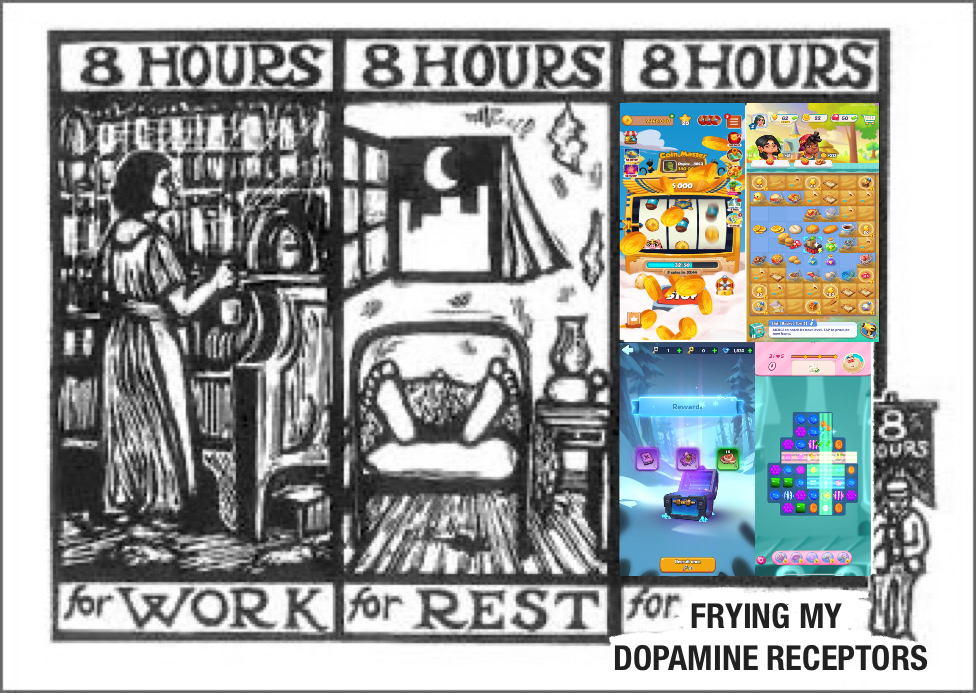
This concept is reflected in the rise of alea-heavy entertainment such as sports-betting, mobile games, and yes, Pokemon card “collecting.” Not only that, but modern America has taken this strain of agon and alea to the next level through “optimization.” DraftKings participants can subscribe to third party services that algorithmically assembles a team with the most favorable odds, removing any semblance of strategy, or agon, there may have been to begin with. Fans and collectors can now outsource the thrill of purchasing and opening a pack of pokemon cards to “Rip and Ship” streamers, who, for a price, will open new packs on a livestream and ship any of the valuable cards to the lucky buyer. Some slot machines have an “autoplay” or “autospin” feature, allowing the game to play itself. And, of course, there’s the autoroll function of Monopoly Go!, which, save for a few events, separates the player from participating.
Companies have long promoted this idea that optimizing our workflow and gameplay will boost our “productivity.” Then again, how do we know which steps to eliminate? Who gets to decide what is and is not essential? What are we losing? When we decrease all friction from work and play, we eliminate the opportunity to pause, to decide, to think, to strategize, and to grow. (also neural pathways lol.)
Our country’s principles are fueled by competition. (I mean, the best selling board game of all time is Monopoly10…) One’s value is based on the ability to pull themselves up by their bootstraps and based on the ability to control and master the self—yet societal and economic standing is dictated by a pure luck-of-the-draw; be born rich, win the lottery, or be chosen by the algorithm to go viral. Americans cash in, but the odds, hardly ever in our favor, are set by the house.
Footnotes
-
Made Overseas
I noticed in my research that the majority of the top ten grossing games are based overseas, yet most of the revenue comes from the US. Dream Games (Royal Match) is based in Turkey; Microfun Ltd. (Gossip Harbor) is based in China; Century Games Pte. Ltd. (Whiteout Survival) is based in Singapore, though owned by China; Niantic (Pokemon Go) and Scopely (Monopoly Go!) are both based in the US, but are owned by Savvy games, based in Saudi Arabia.
Since the US is one of the world’s largest video game markets, it tracks that a significant portion of revenue is from us (“us” as in the US. I am based in the US). The markets in countries like Scandinavia and Turkey are probably too small to sustain a team solely using domestic funds, so it makes sense that they would expand their audience. The US increasingly prioritized AAA console and PC gaming over mobile-based titles, leaving a smartphone-shaped hole in the market.
Believe it or not, some of gaming’s biggest studios are Swedish. Some of their biggest names include King (Candy Crush), Mojang (Minecraft), and DICE (Battlefield). King took the match-3 gameplay and ran with it. They excelled at establishing progression systems, the relationships between resources and timers, social integration, and data analytics. Btw… acquired by Activision Blizzard in 2016 for $5.9 billion, signaling that F2P games were now a significant part of the games industry.
Turkey took F2P games and began to industrialize them thanks to their population of talented engineers and computer scientists. A group left Peak Games (maker of Toon Blast) to found Dream Games (Royal Match) in 2019; Zynga (Farmville) acquired Peak the following year. Both Swedish and Turkish gaming companies assumed from the jump that their primary users would be overseas, so they took that into account when creating their products.
In 2017, after years of honing their craft in F2P game operations, China itself started requiring games to disclose gacha/loot-box odds. Gaming license approvals became slower and more selective the following year due to a change in regulators. China was also capping the time and money minors could spend on games by 2019. I’m tempted to speculate that their specific reach overseas is a response to a perfect storm of tighter restrictions, tariffs (which do not apply to digital products), and a saturated domestic market.
The Chuhai movement—which literally translates to “going overseas” in Chinese—describes the business-directed (not government, to be clear) international expansion of Chinese commerce. Chuhai started around the early 2010s and focused on mobile games, apps, e-commerce, and fintech; another phase was initiated around 2017-2018 as a response to regulations, pushing developers to seek customers abroad. This phase is more focused on digital products designed for globalization; some recent examples include the explosion of Shein, TikTok, Temu, and of course, mobile gaming in the US. ↩
-
Monopoly Go!
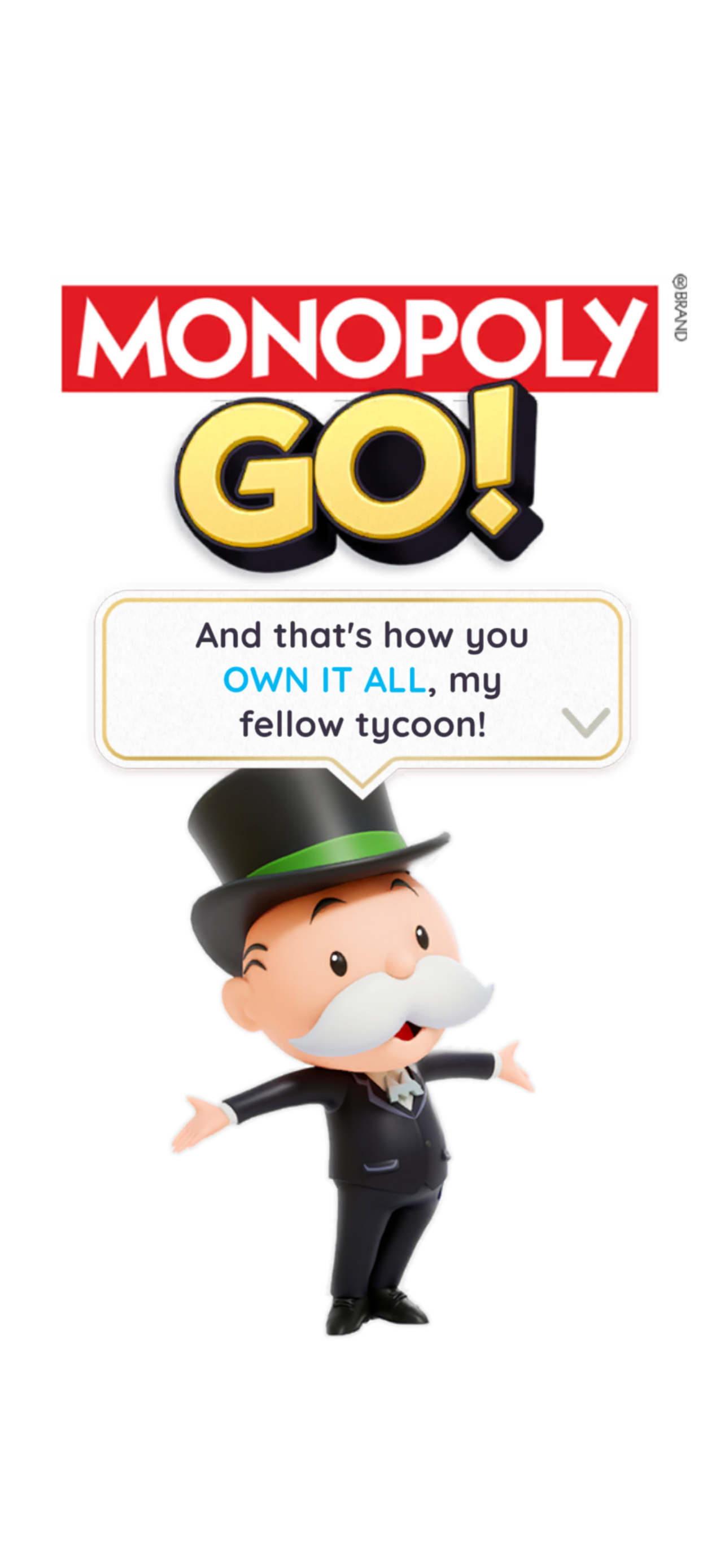
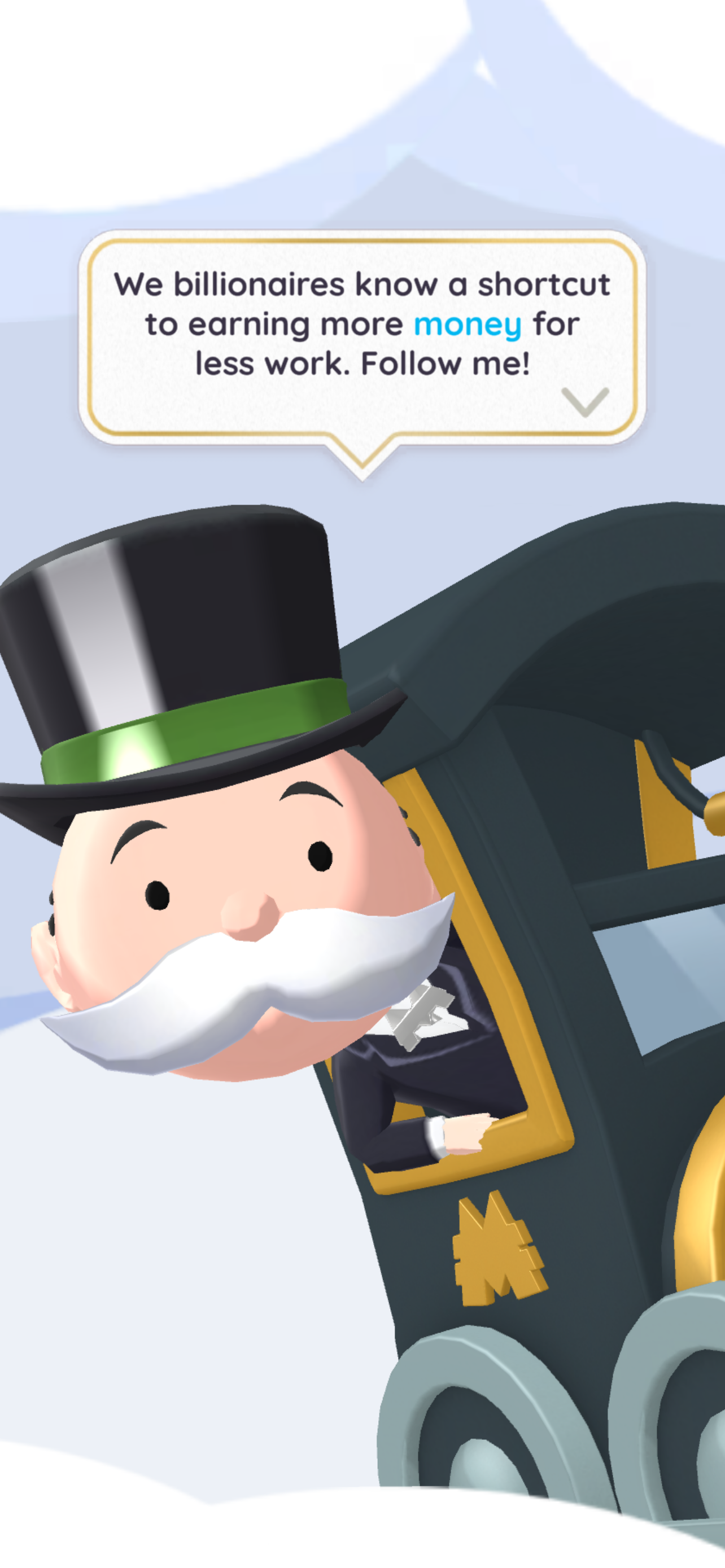
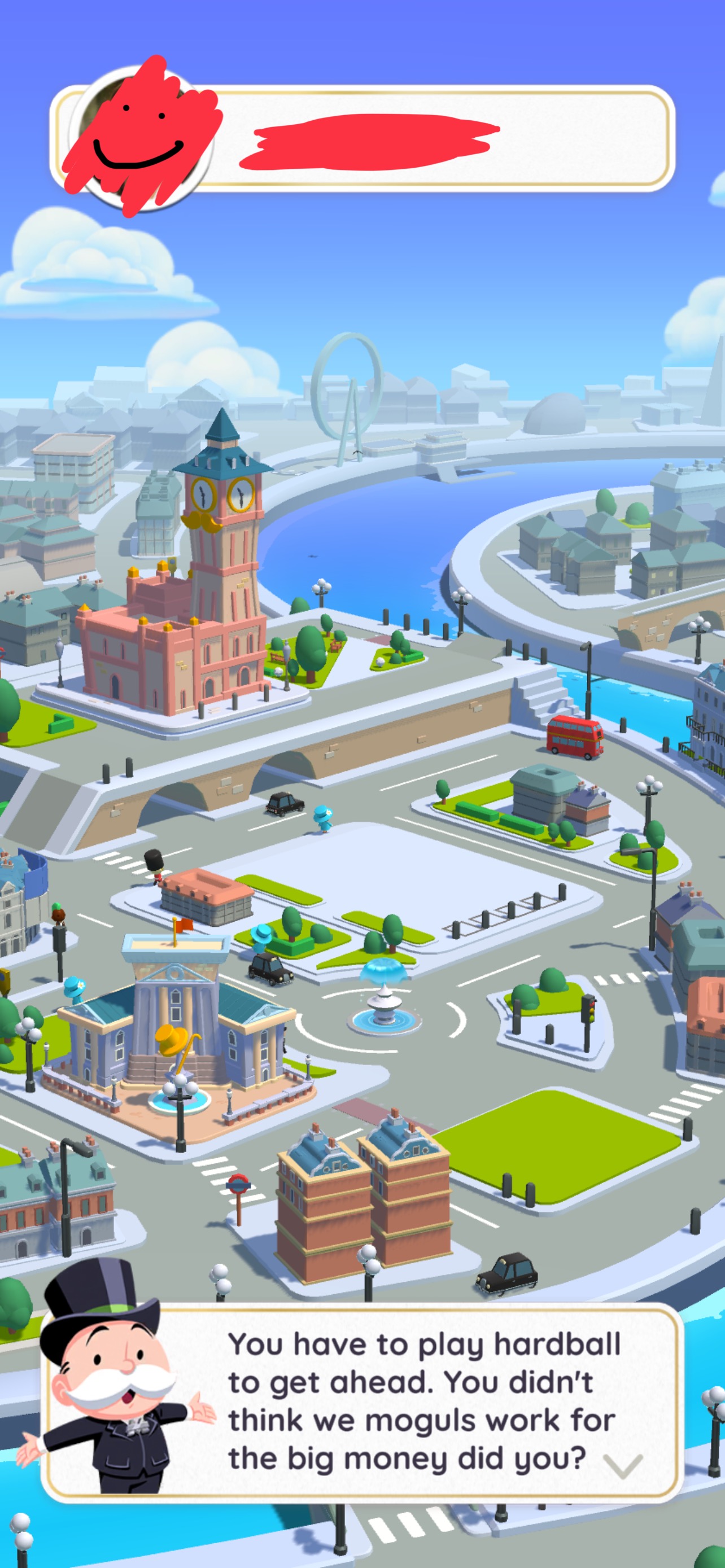
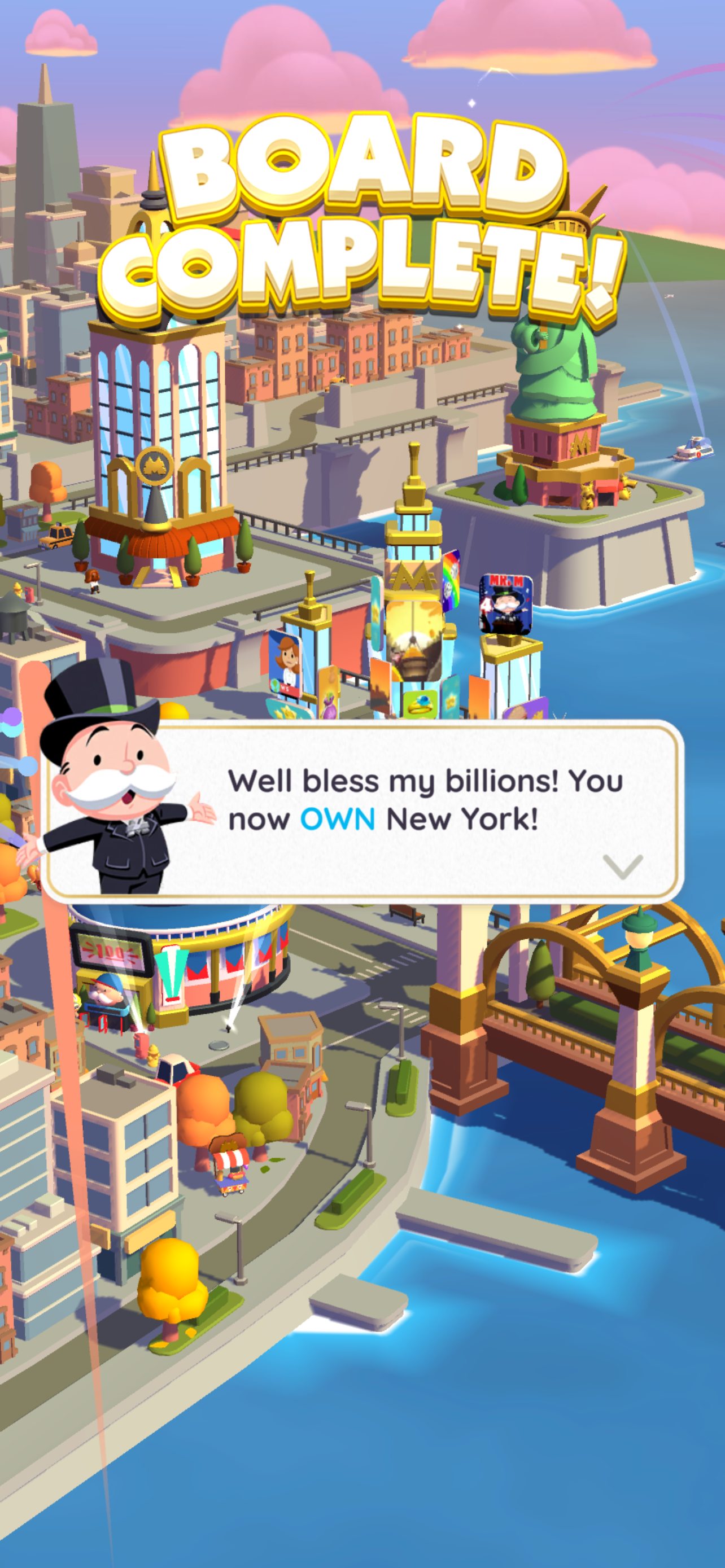
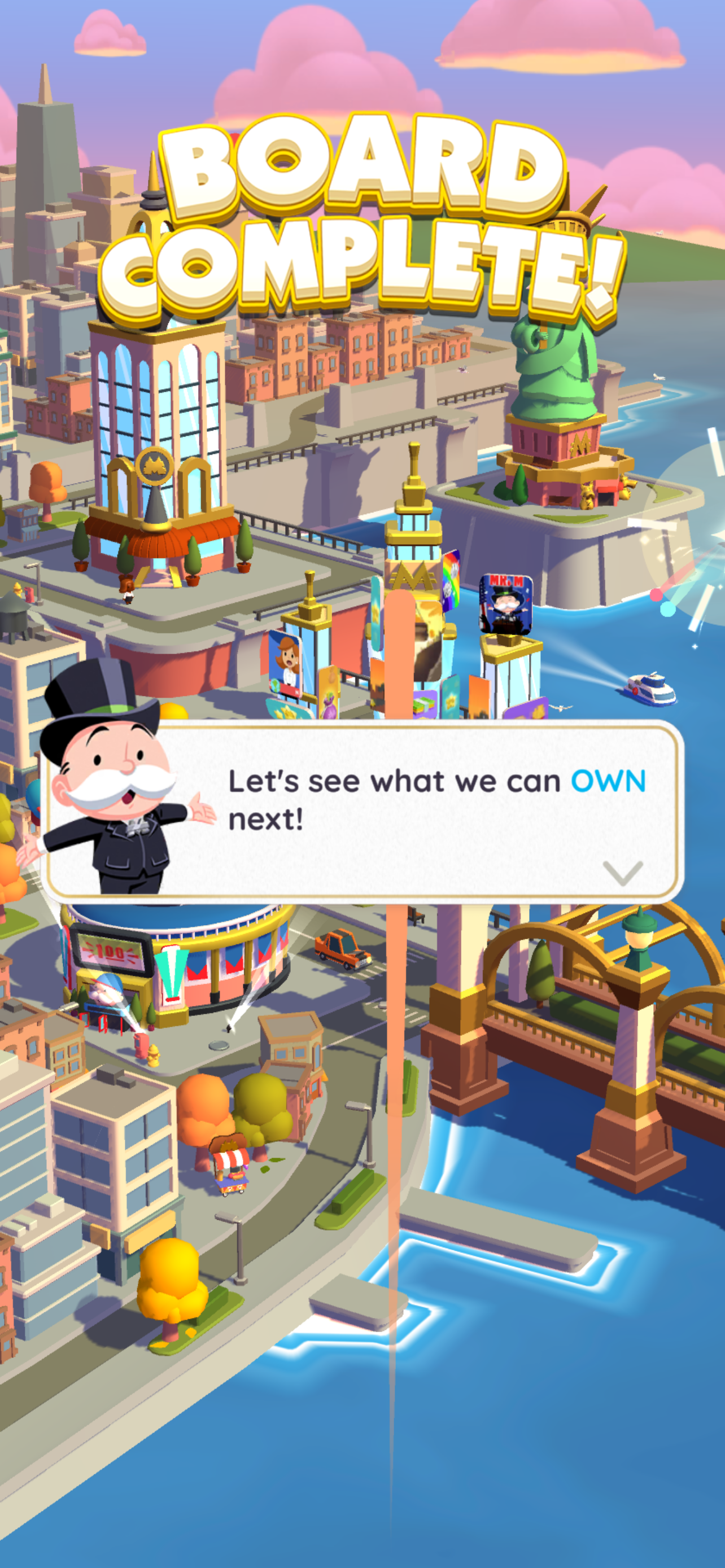
The game opens with a silky smooth cinematic animation featuring Mr. Monopoly himself. The objective is to conquer cities by accumulating revenue to erect and upgrade buildings while completing sticker packs along the way. You receive Net Worth Rewards (NWR) with every build or upgrade. You roll the dice, and depending which tile you land on, one of X things happen:
- collect cash
- pay rent/taxes (boooo)
- draw a chance card, collect $X, lose $X, or multiply $X
- go to jail
- Trigger a railroad event (demolish other player’s cities or rob their bank)
- Collect event items
- Land on free parking, pass go, etc etc
I noticed right out the gate that the NWR upgrades allows the user to, essentially, play the game “more efficiently.” One could even say these upgrades expedite player productivity… In fact, the second upgrade removes one of the already-few sources of player friction: the user no longer has to tap the screen to take a turn by automating dice rolls. Autoroll allows the user to sit back and watch this little bald imp rake in the dough. It’s like pulling the slot lever once and the game goes on autopilot.
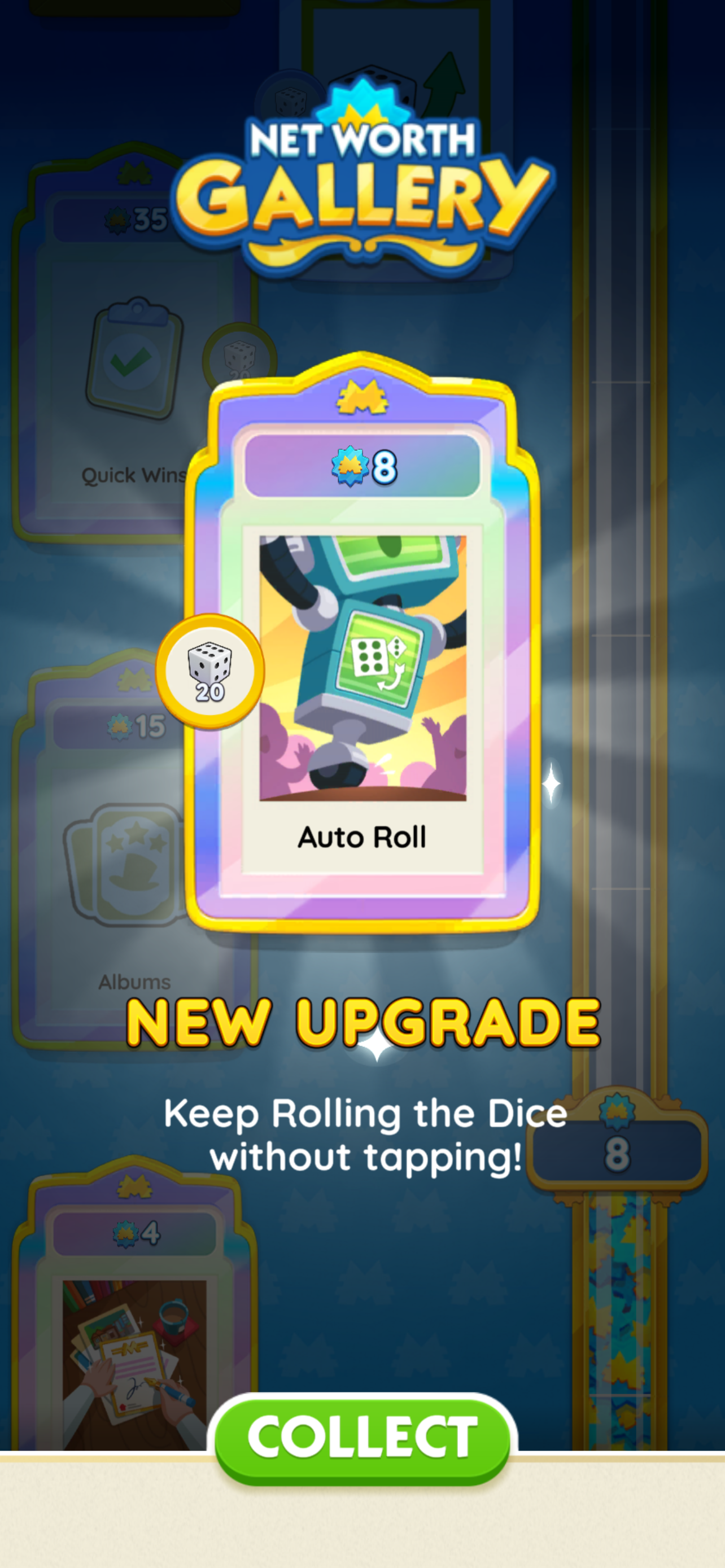
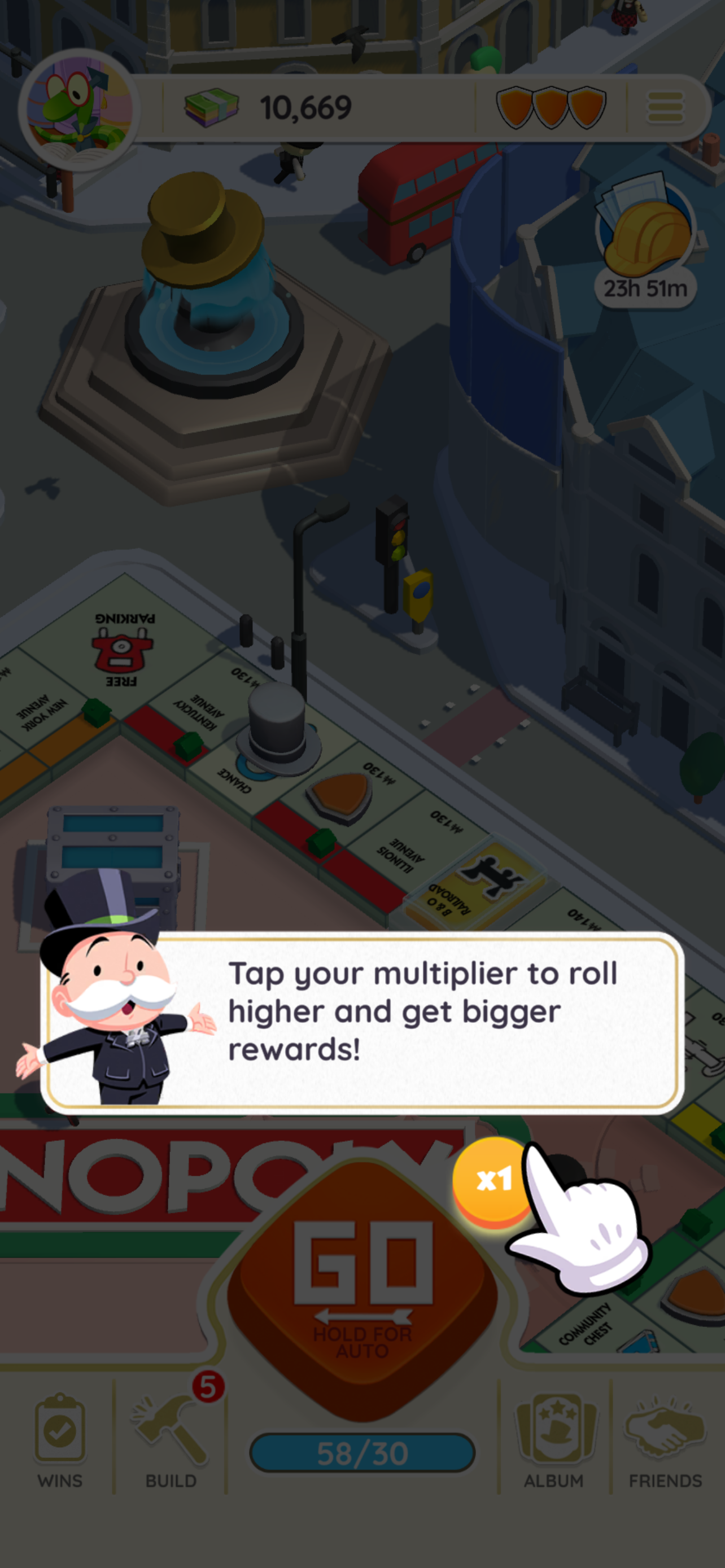
The Multiplier upgrade allows the player to double or triple their winnings but their dice rolls deplete at the respective rate.
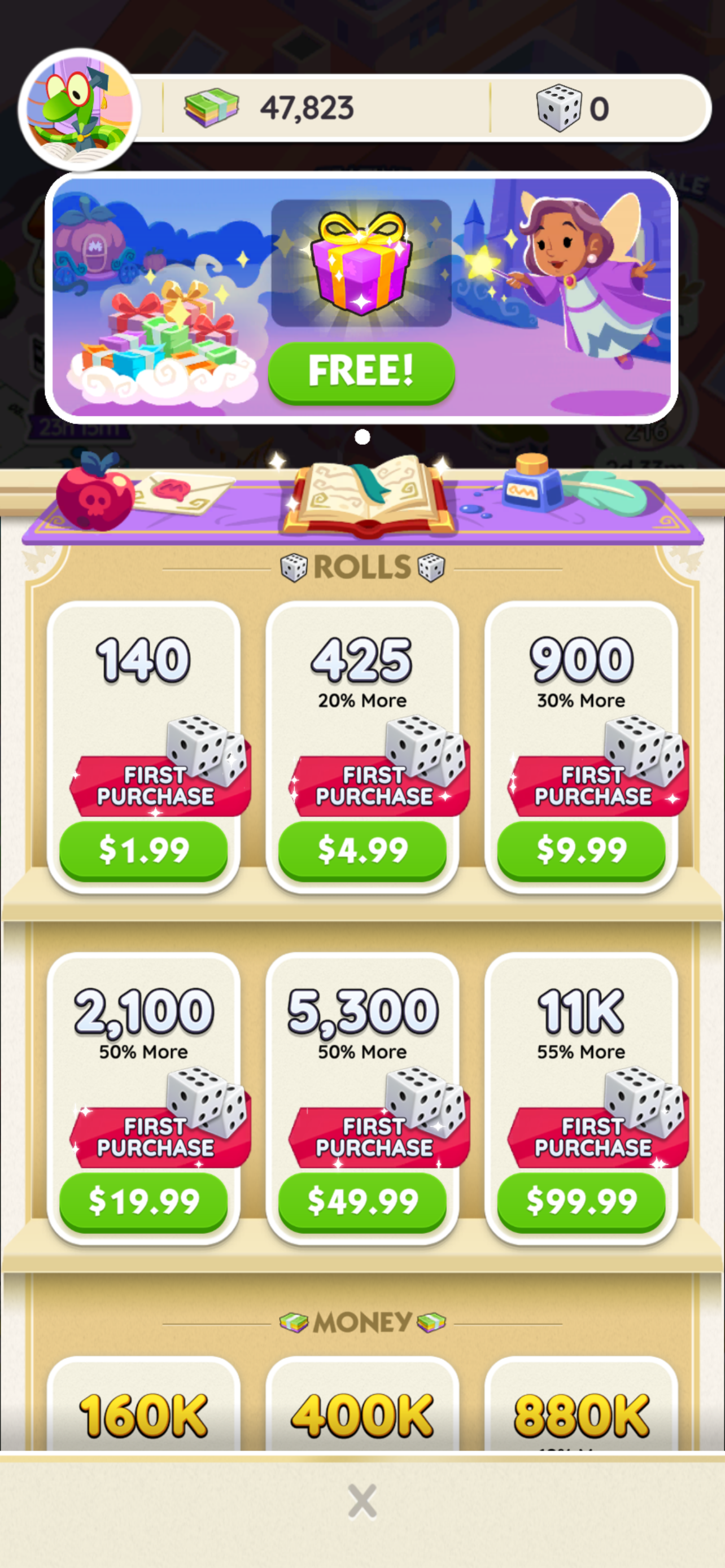
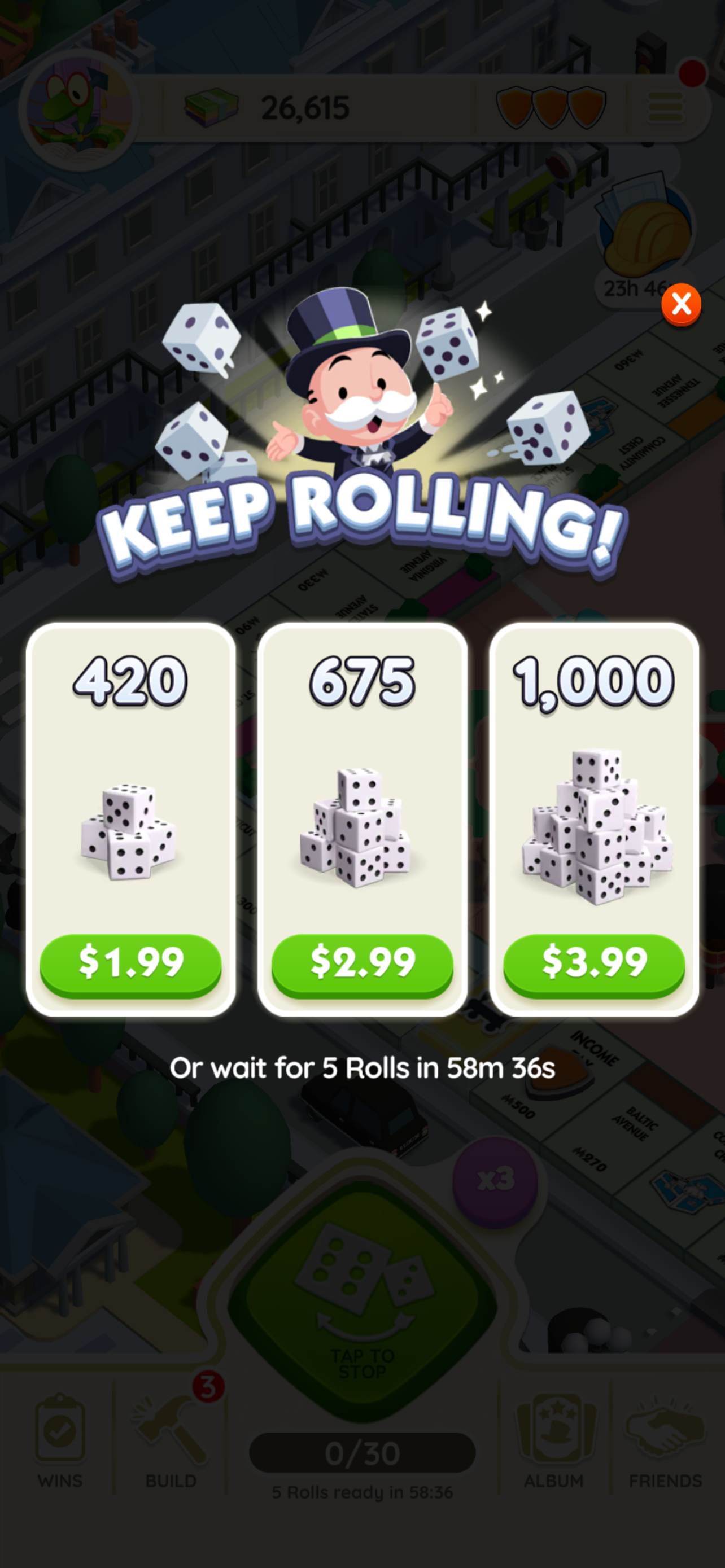
I wanted to see how long my run would last until the game asked me to pay to play more (It took about 1.5 hours). Like most FTP games, the number of turns or lives are time-constrained. In MG! in particular, the user gets 1 roll every 5 minutes, or 12 rolls per hour (which is about 2-3 minutes of gameplay TOPS). A slew of promotions pop up on the screen the moment the user runs out of dice rolls. When I ran out of rolls, the game prominently displayed a button: $1.99 for 420 additional rolls. That would be 35 hours of waiting for turns gone within just one tap. I could see why it would be tempting to pay $1.99 for 240 more rolls when in a flow state—that’s about 30-60 minutes of more gameplay.
I opened the shop after running out and had a gift waiting for me: More rolls, more rewards, free of charge!! Incredible. My journey was not over yet. Instead of exiting, I continued browsing, and now, $1.99 would only get me 140 rolls instead of 420! Rude!!! It could have just been a limited-time promotional bundle or progression-based store changes. Some have speculated that MG! changes the cost of their goods based on their perception of the player’s willingness/eagerness to play more… it certainly felt that way… who knows…
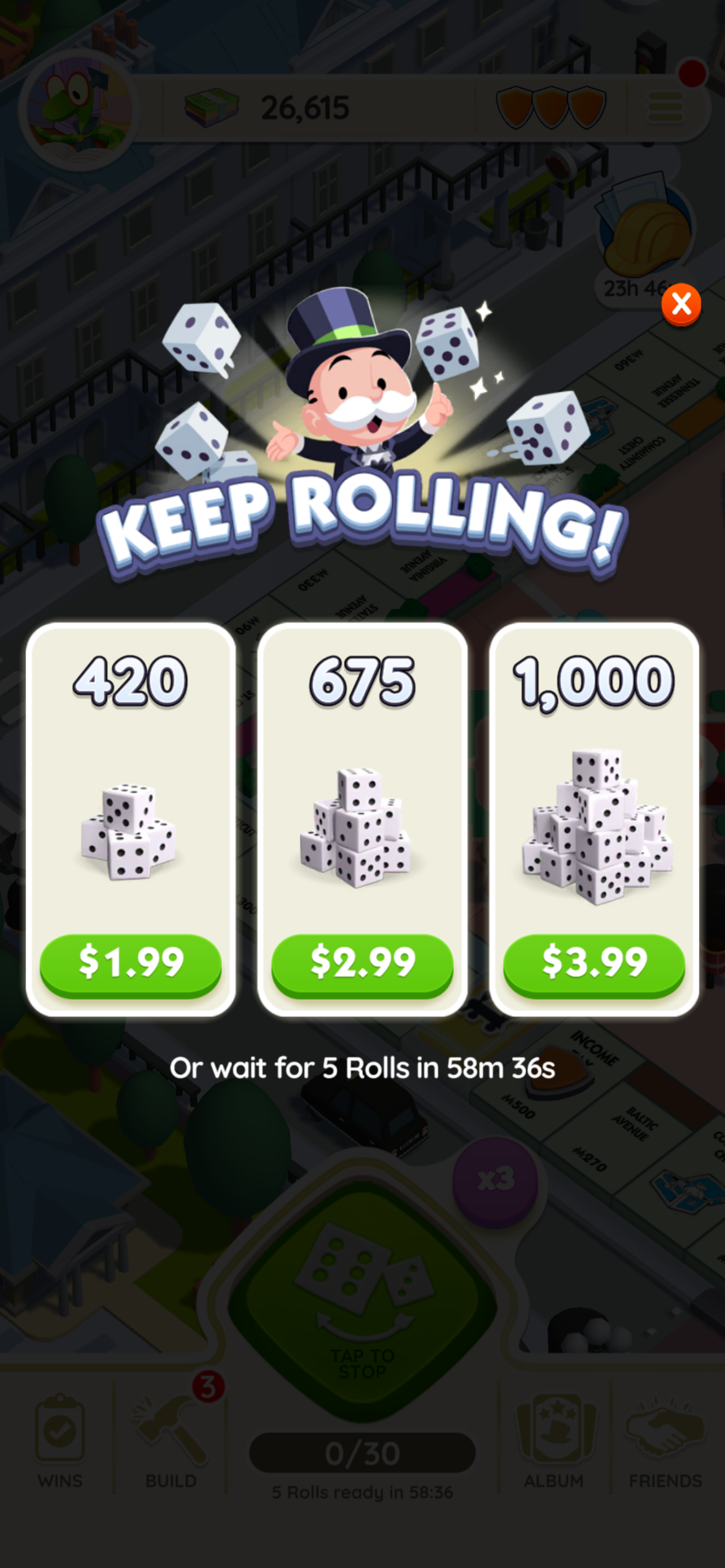
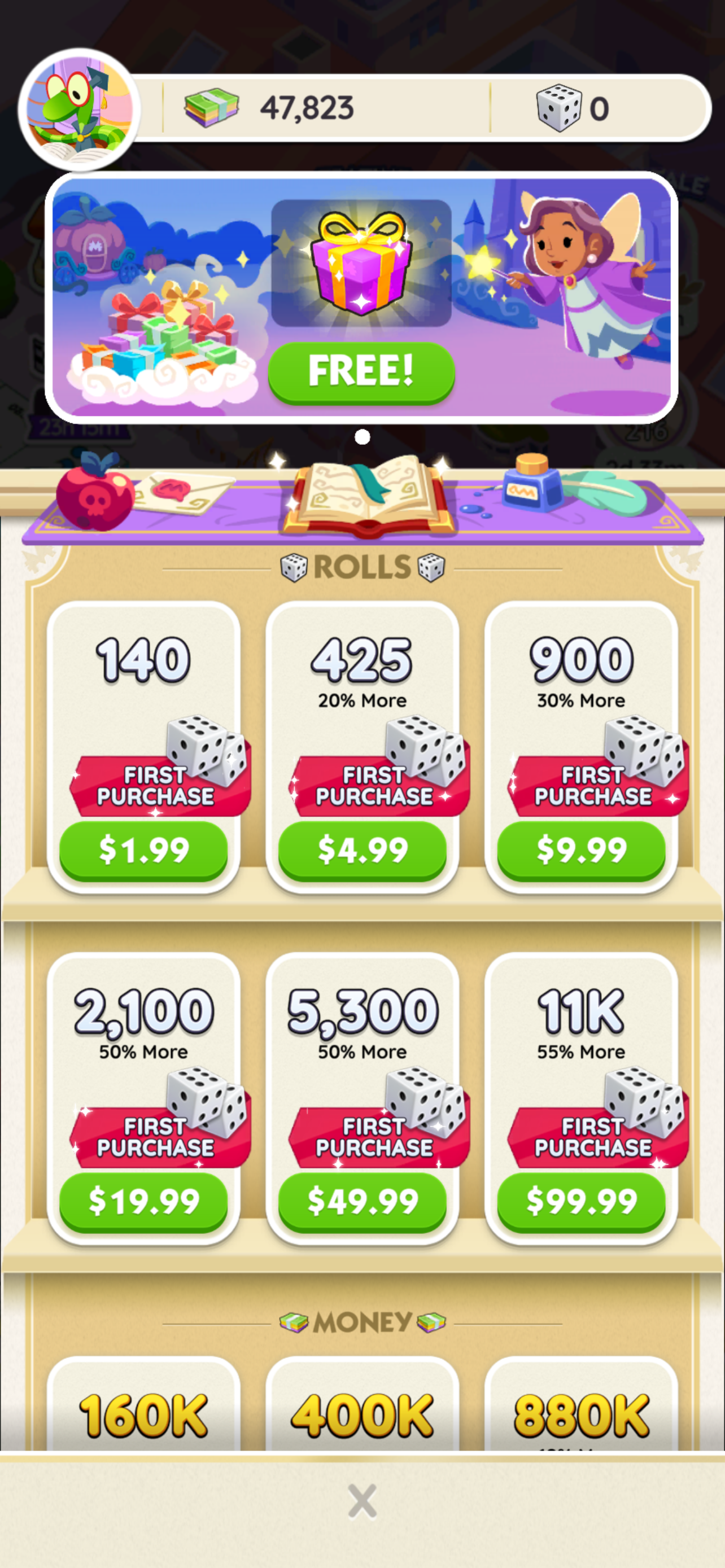
Why in the world would someone pay money for this? Good question. Let me describe a scenario:
Monopoly Go! has a limited-time offer: if you reach X amount of points within X amount of time, you are rewarded with bonuses beyond compare. If you have only an hour or two left on the promo timer and are very close to meeting the criteria, what’s the harm in spending two bucks in order to meet the goal? If reaching said goal leads to more rolls, then you’re basically getting rolls for free… right?
Btw… There are at least 5 different points systems in the godforsaken game.
- Dice
- Monopoly dollars/cash
- Net Worth points
- Stickers
- Event points (temporary scoring systems)
- Tournament Leaderboard Points
My page became littered with icons displaying limited-time challenges and promotions with the timers ticking away. The number of icons and points systems became so innumerable that all moves lost meaning. The player doesn’t win or lose. There may be interactions in which one delays others’ progress, but they’re not even competing against them. There is no skillset required to participate in this game (other than extending your dice rolls to maximize your time playing), but any barrier can be crossed for as little as $1.99.
I would hesitate to call it play, as the player in question has such a passive role. By design, one does not play the game, they allow the game to happen to them. One does not develop any new skills and there are no new mechanics introduced (cannot speak for limited-time events, though! I could easily be wrong!!). One does not progress, they continue. Endlessly. I don’t even think there’s a way to COMPLETE MG!. As of February 2026, there are over 1800 levels and counting (as far as I can tell). ↩
-
Candy Crush & Royal Match
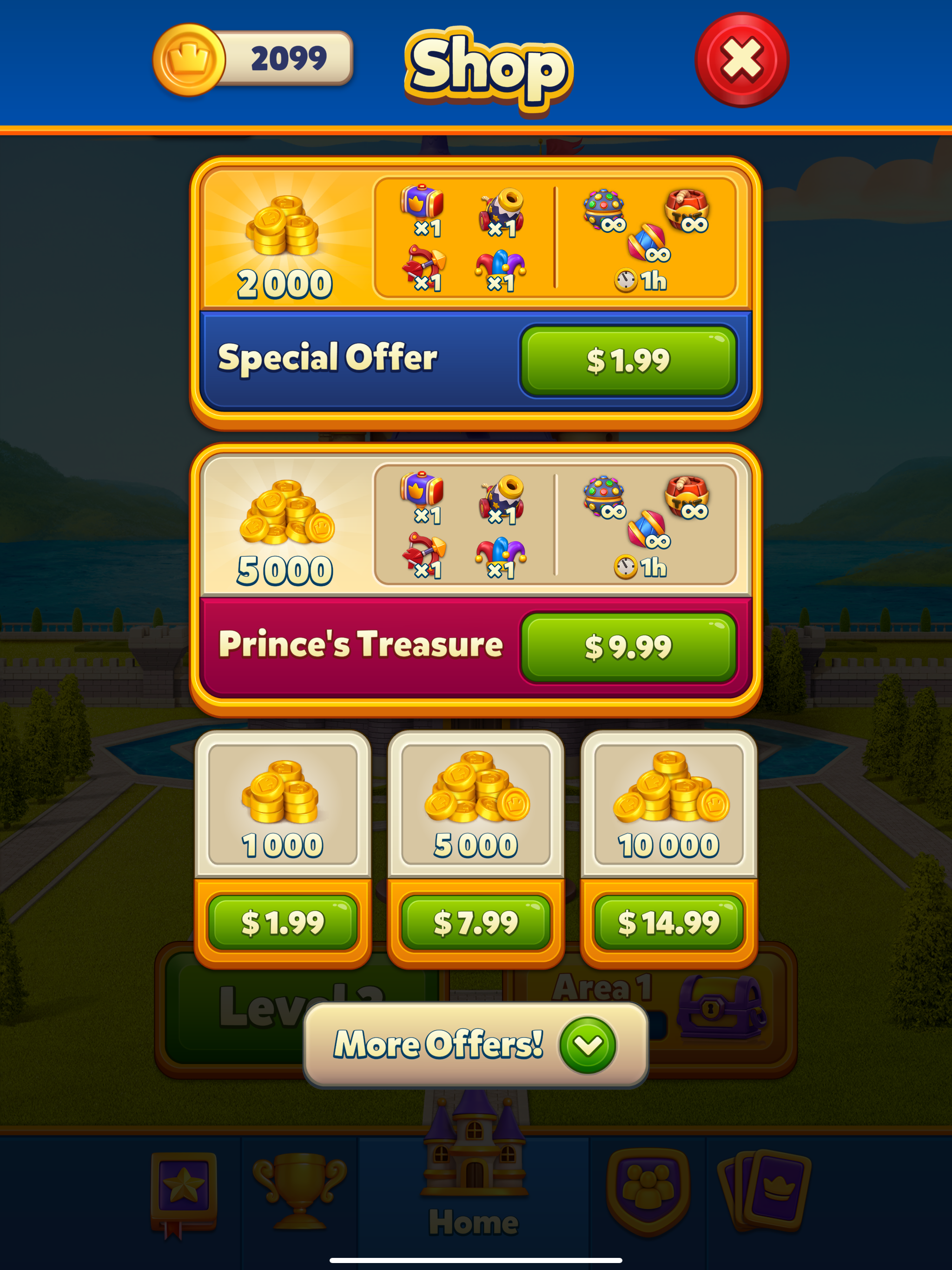
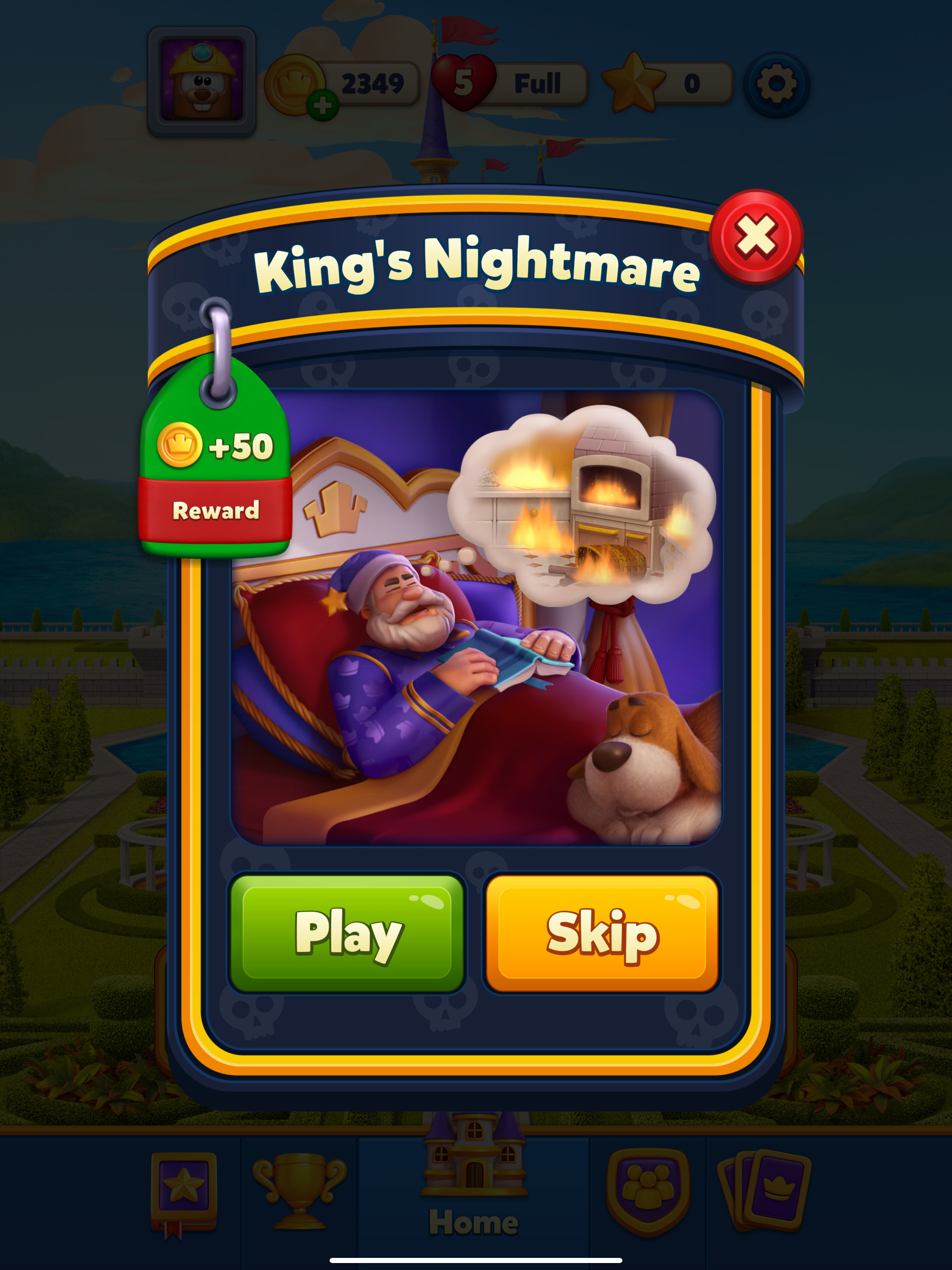
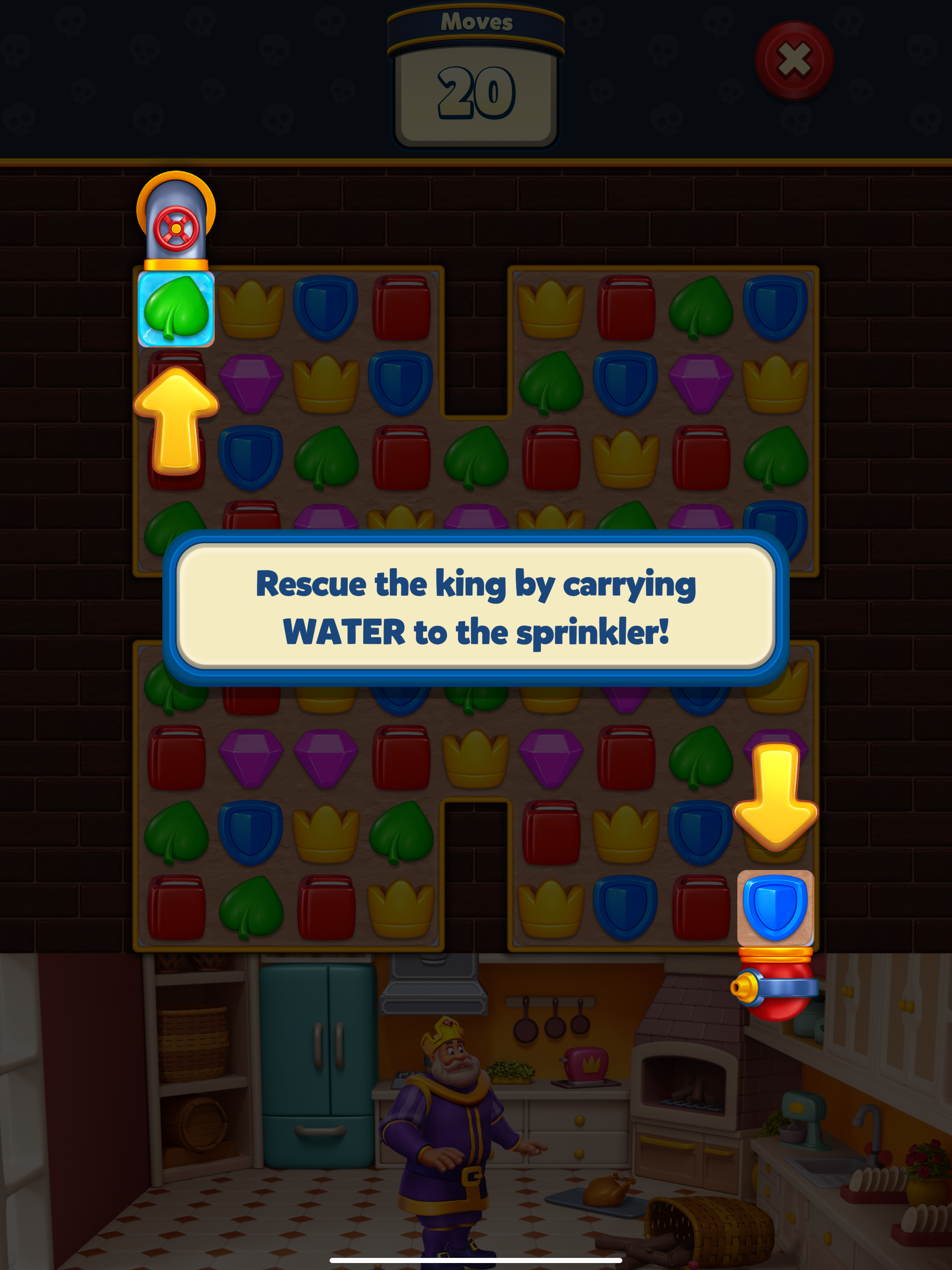
Candy Crush Saga (CCS) and Royal Match (RM) are two powerhouses in the F2P arena that come from a large family called Match-3 games. They require the player to swap or align three or more identical tiles on a grid to clear or refresh the board while having a fixed number of moves or amount of time. Making certain matches, such as ones with 4-5 tiles or forming an L or T shape creates tiles with special properties. As players progress through the world maps, levels increase in difficulty through obstructive objects/tiles. Both games utilize social and competitive features to host events or introduce team/friend mechanics that can aid the player. A player losing a level means losing one of their “lives” which regenerates once every 30 minutes, maxing out at 5 (with the exception of special events/rewards), which can be replenished in exchange for in-game currency, which costs real-life currency.
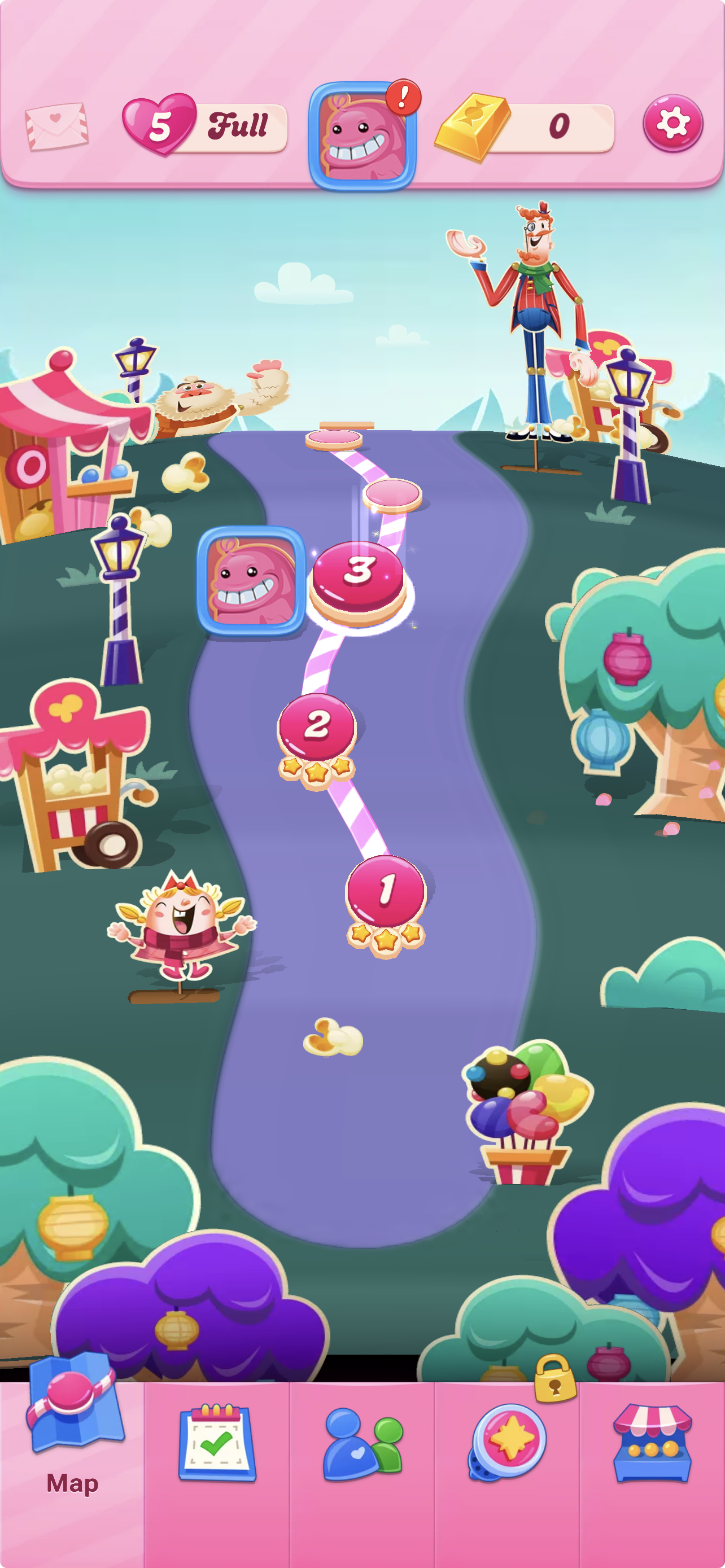
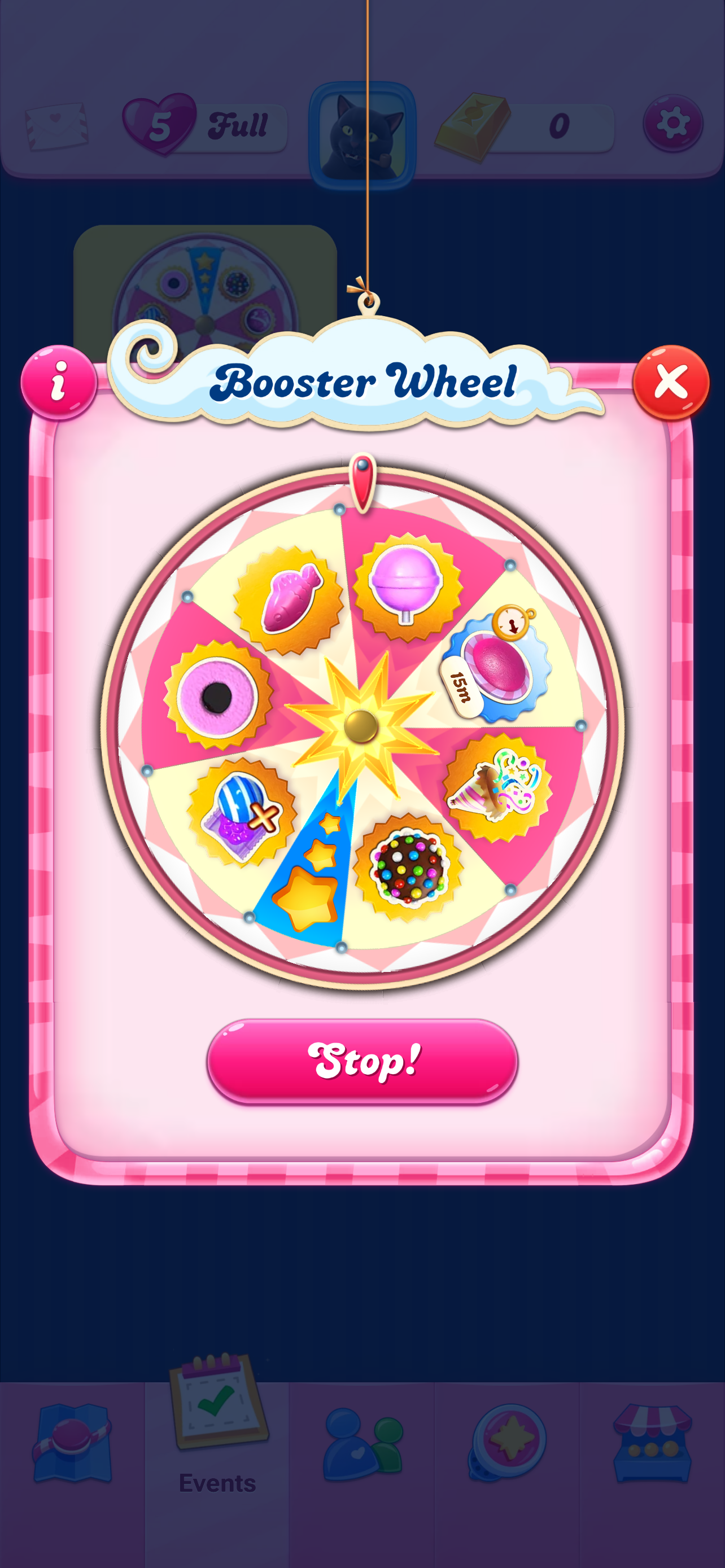

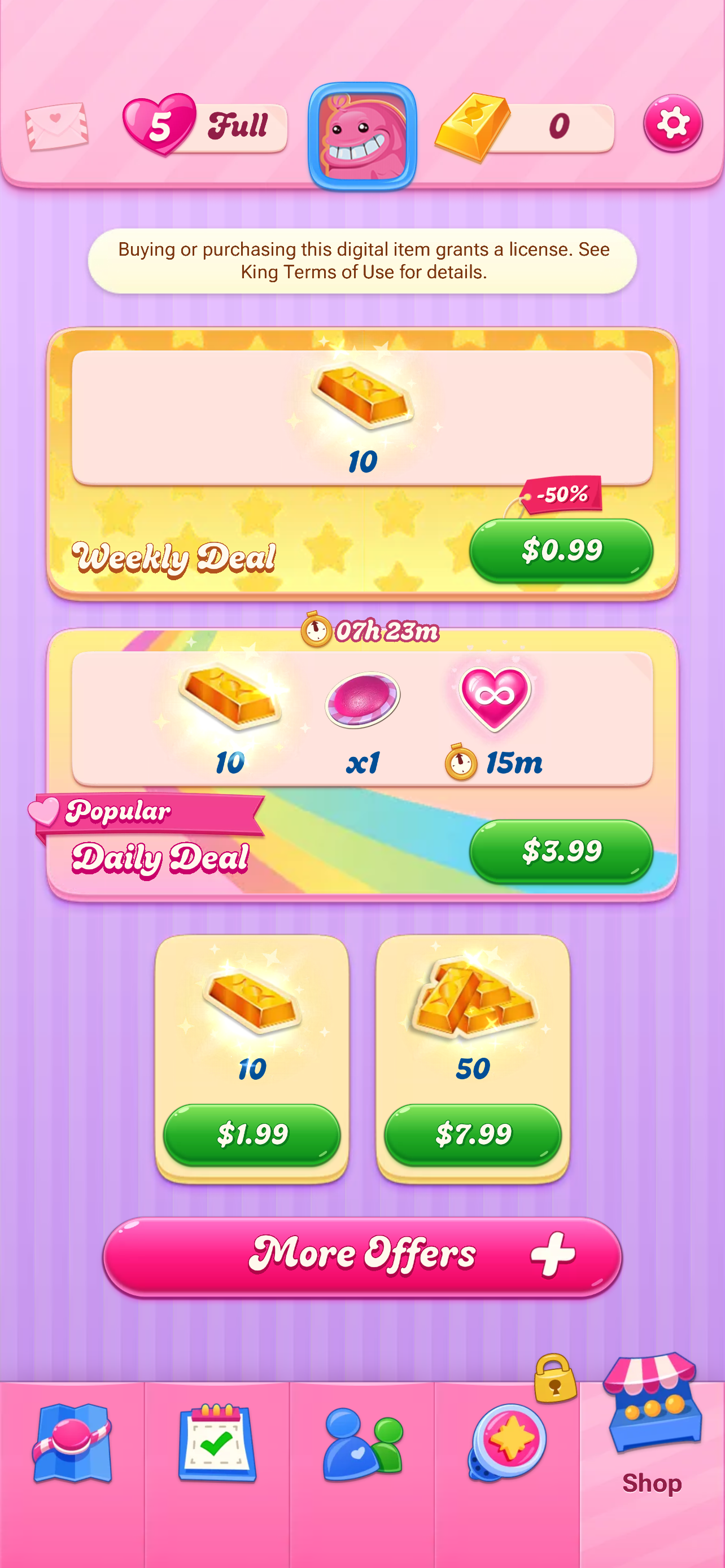
Candy Crush has long been considered the GOAT in the mobile F2P world; at my big age, I vaguely remember playing Candy Crush a few years after it first came out. It originally started as a small browser-based game on King’s (the original developers before their acquisition by Activision) website and was later rebranded as Candy Crush Saga (CCS) in 2012 and released on Facebook and through the iOS/Android app stores. One thing I found really frustrating during my CCS experience was that it didn’t give me the time to really strategize on my own. Less than 2 seconds would pass and it would provide a hint for a possible move (not necessarily the most optimal one, I don’t think), leaving no room for my brain to strategize to its fullest capabilities.
I think one of the primary reasons CCS has remained one of the big dogs in the F2P world is that it sits at the perfect intersection of strategy and chance. The cascading candies vary with every turn. Experienced players will consistently look past instant matches to create stronger movements, they may prioritize matches on the lower half of the board (causing larger rearrangements because gravity impacts the pieces above), and preserve powerful items for just the right moment. However, even the perfect player can’t predict which colors spawn or form a chain reaction. Skill improves the chance of winning, but the random elements keep even the most seasoned players coming back for more. Even mathematicians are fascinated by the complexity and randomness of the system.
CCS is the blueprint, but Royal Match is its biggest rival as of today. It too has a level-by-level format, but it also has a sort of meta-game outside of the Match-3 gameplay. The player must help King Robert restore and decorate his castle. RM hosts seasonal events, team competitions, tournaments, and hands out additional progression rewards. (though it seems that events are coming to CC soon?) Some describe it as more polished, easier to visually read, and more spectacular in its display of chain reactions. Many report a smoother early progression rather than hitting a sharp difficulty curve like that of CCS. Both games are able to look at player behavior analytics so developers can change and “rebalance” levels if difficulty curves become too steep. Gamers much more experienced than myself report RM feeling more skill-based than CCS, but both rely on the same fundamental Match-3 mechanics people know and love.
↩ ↩2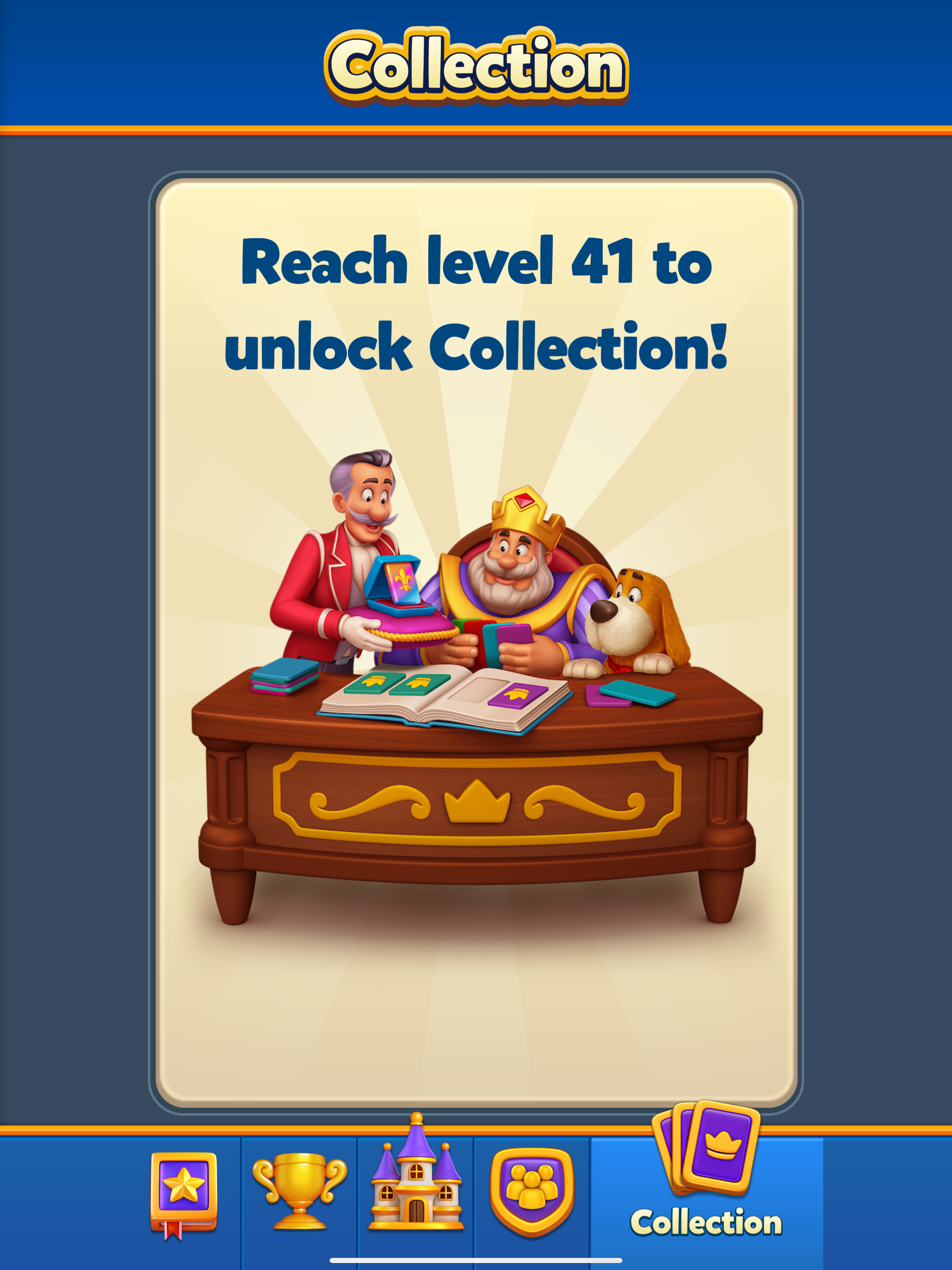
-
Gossip Harbor
This game opens with a Disney-caliber 3D animated scene of a man playing poker with two absolute baddies at his side. His wife, Quinn, crashes the party in a huff and throws his own poker chips in his face. Cut to: the couple standing in divorce court with their small child tugging at his shirt, whimpering “daddy…”
The following scene depicts the mother and daughter walking back to the diner that Quinn owns only to find it burned down! By rioters! (her words, not mine btw) Who were poisoned by only-god-knows-who! Now? It’s up to us to get to the bottom of the conspiracy; was it her ex-husband who poisoned the customers in a retaliatory rage? Or perhaps the kooky old man down the street? Or maybe it was the driven girlboss entrepreneur with the struggling chain of food businesses…
Gossip Harbor is referred to as a “merge puzzle” game. The actual gameplay is simple: merge matching items in order to create an upgraded item, and then upgrade those upgraded items until they reach the form requested by customers, who give coins in return for the completion of their order. Coins in turn are then used to progress the story through dialogue exchanges and fixing up the diner.
Producing each item costs “energy,” which is the time-regenerative element in this game. Because nothing in this world is free!!! Each generator produces an object, and the objects may vary in value or type. The strategy in this game to extend the TOD (time-on-device) is to do simple math. Each object requires merging two of the same, so the energy cost of each item grows exponentially. 2^(level number−1)
- Level 1: 1 energy
- Level 2: 2 energy
- Level 3: 4 energy
- Level 4: 8 energy and so on
Each energy takes 2 minutes to generate with a strict 100 energy limit. Within a few hours, one reaches the point where customers are requesting level 7-8 items, which can take a couple days to accumulate. GEMS can be purchased in the shop which can then be exchanged for more energy.
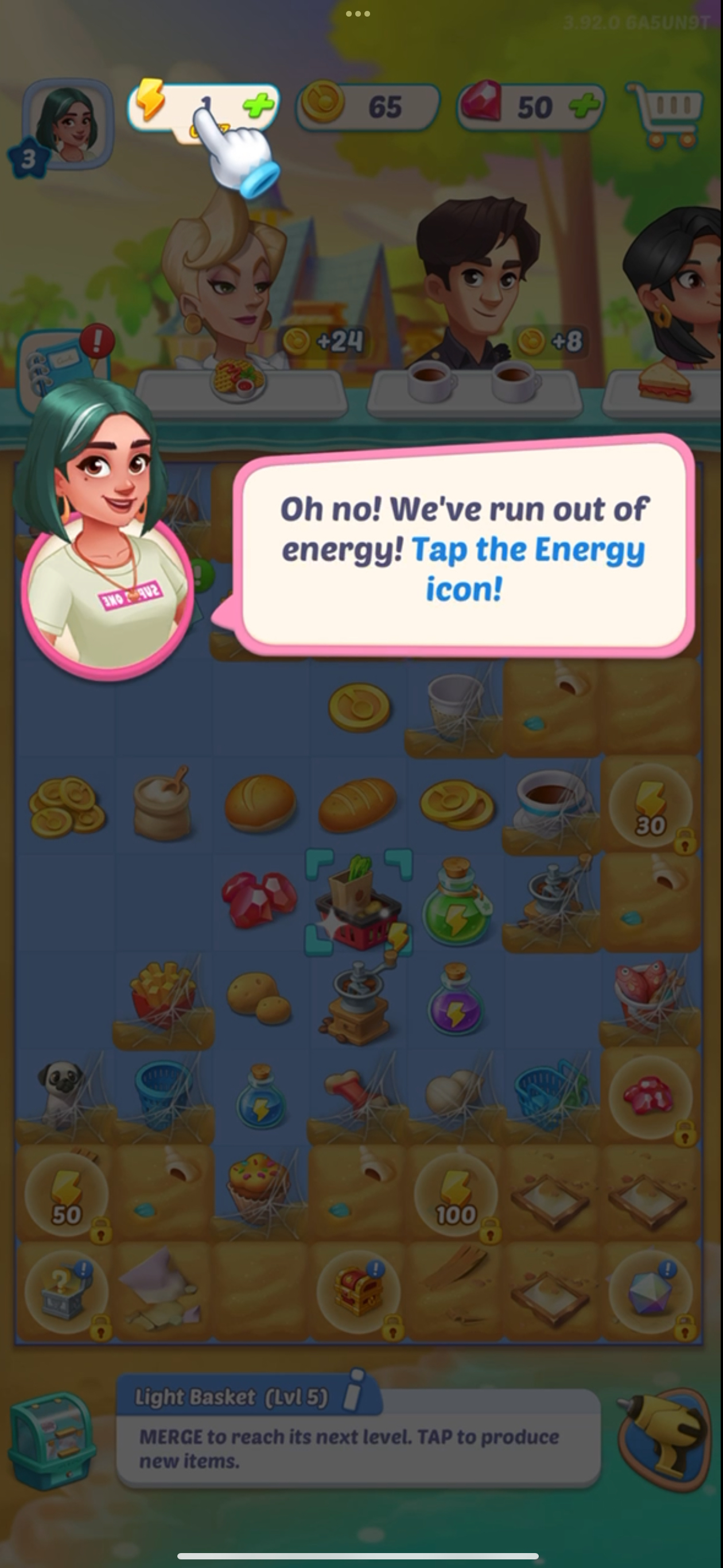
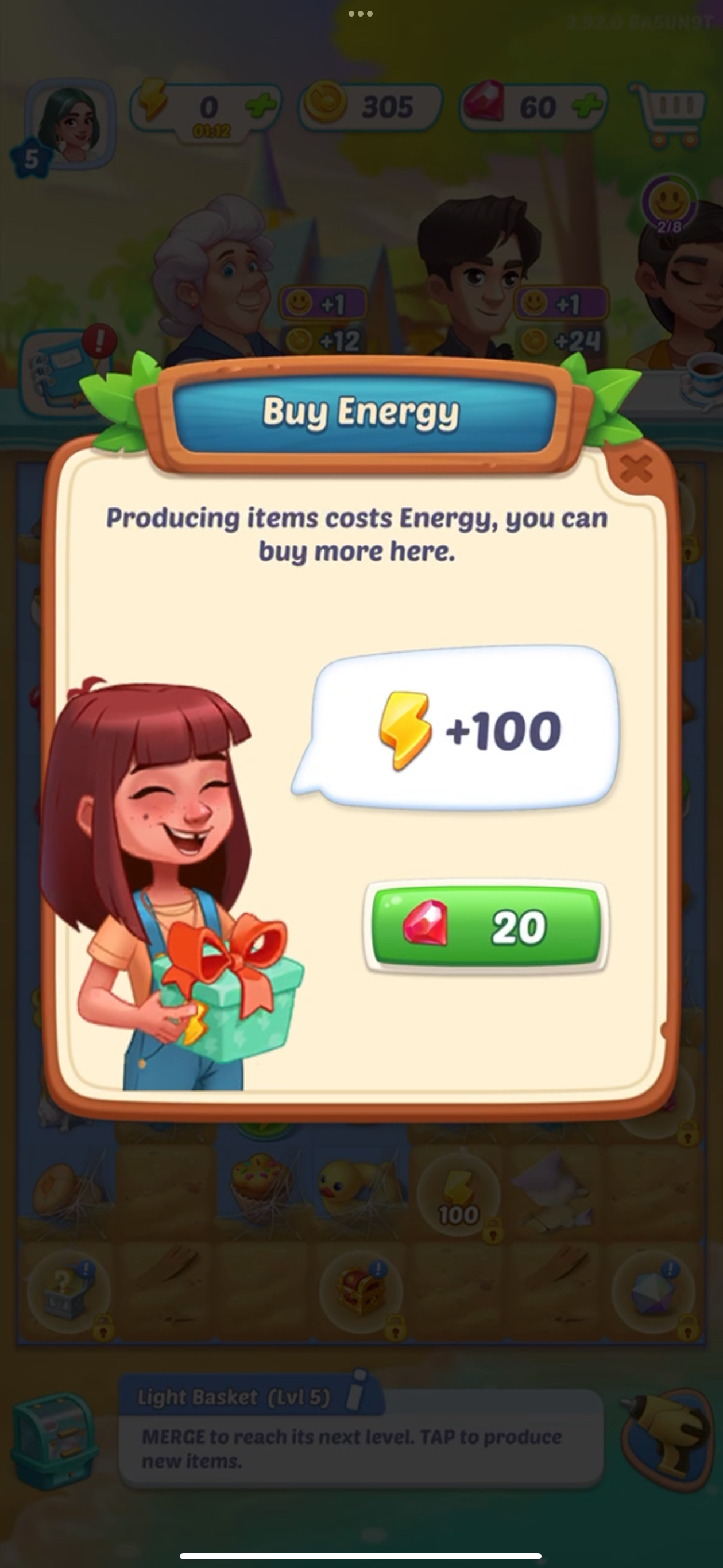
Generators produce a limited amount of items before they need to take time to “recharge.” Players can randomly be rewarded with booster items such as chests (locked by a time limit).
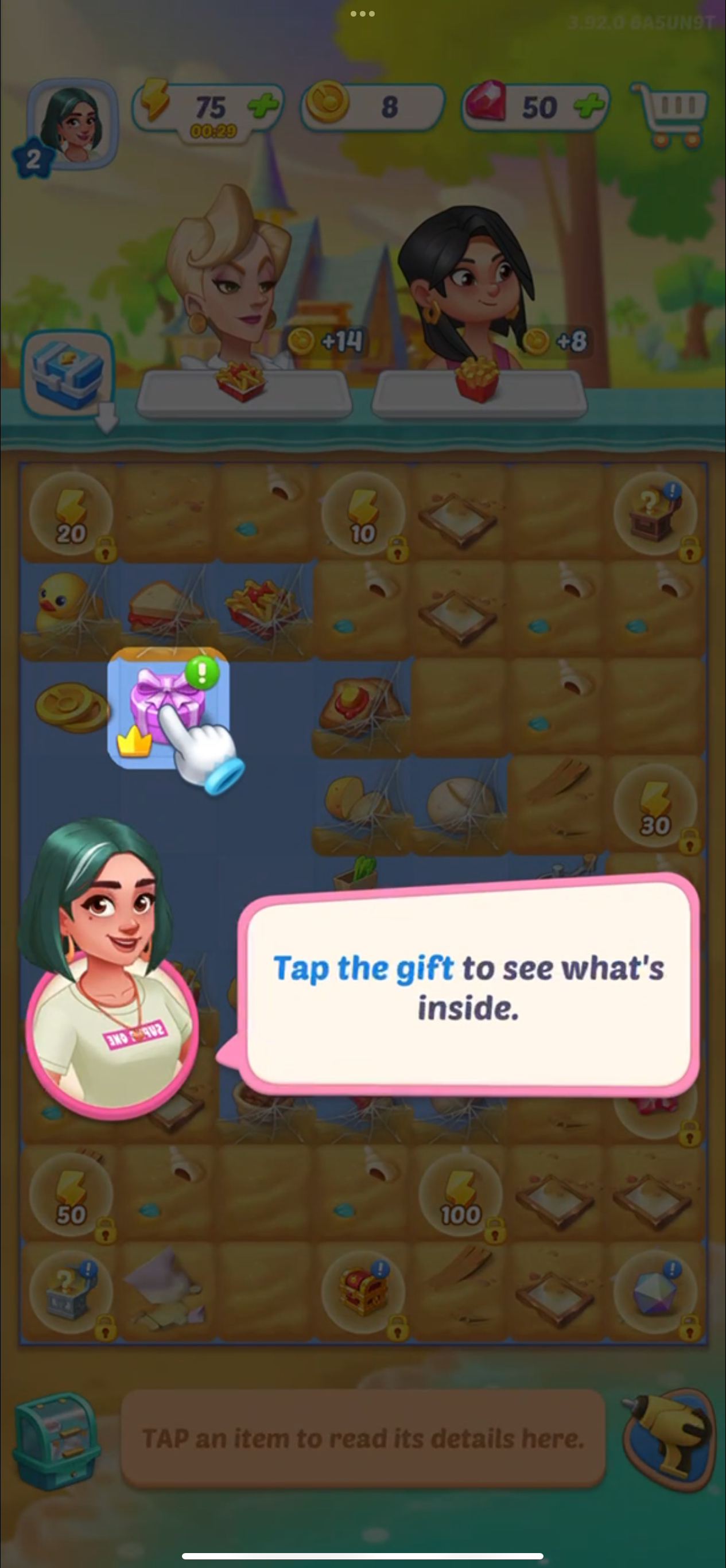
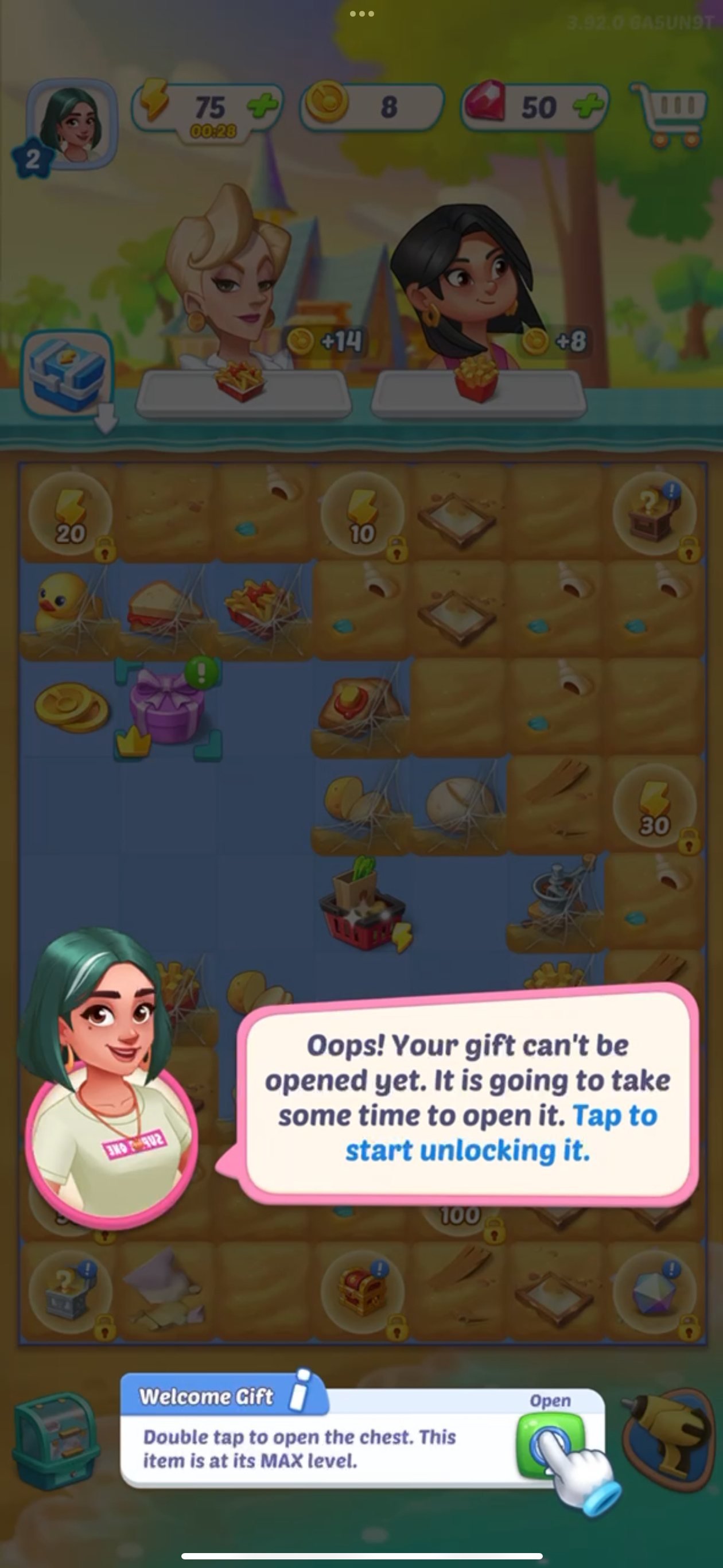
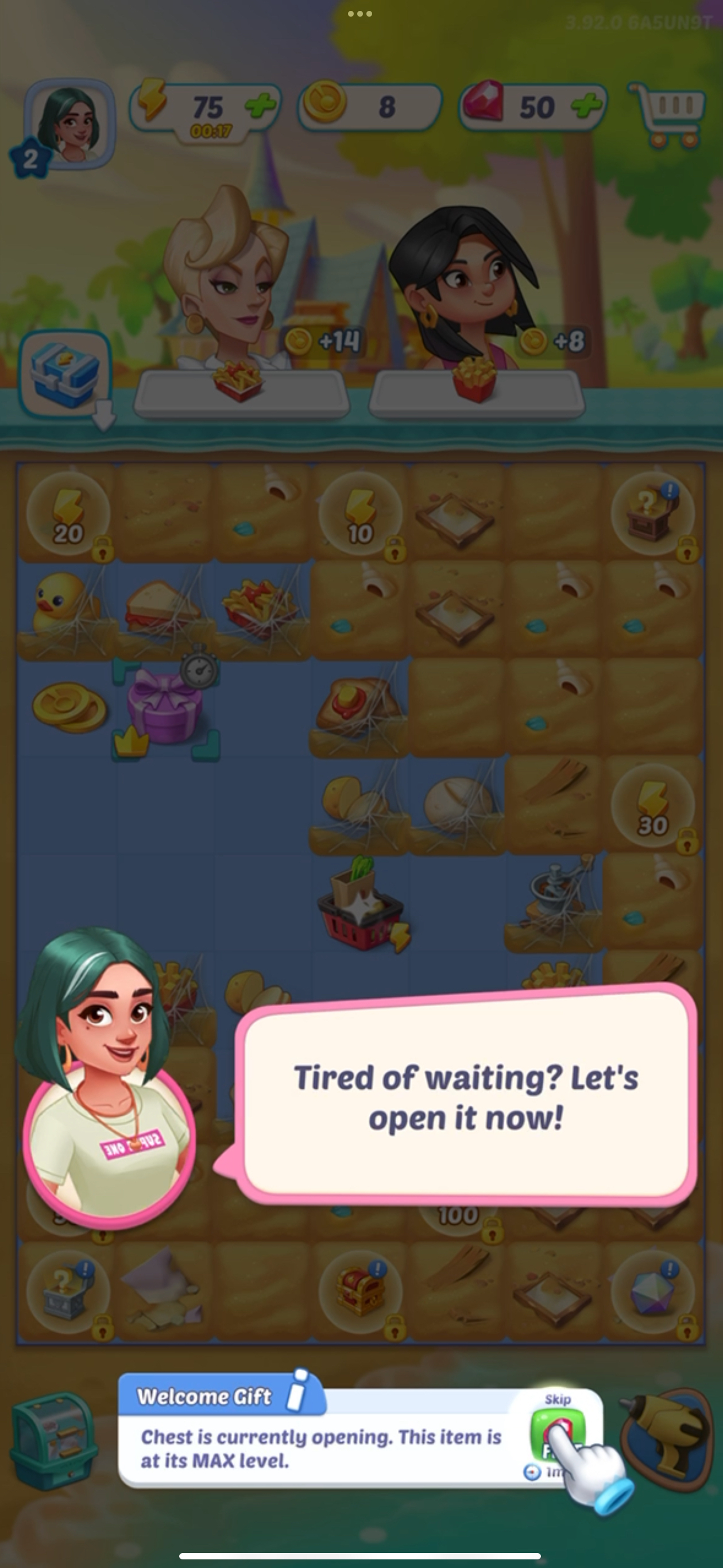
I played the limited-time side merging games while I waited for little scraps of energy to regenerate. There were also time-limited challenges, even ones where players were pitted against one another: whoever could make a specific number of merges within the time frame would be awarded with additional energy, gems, and other loot. Also there were fucking card packs. Everything is card packs now!!! JESUS CHRIST!!!
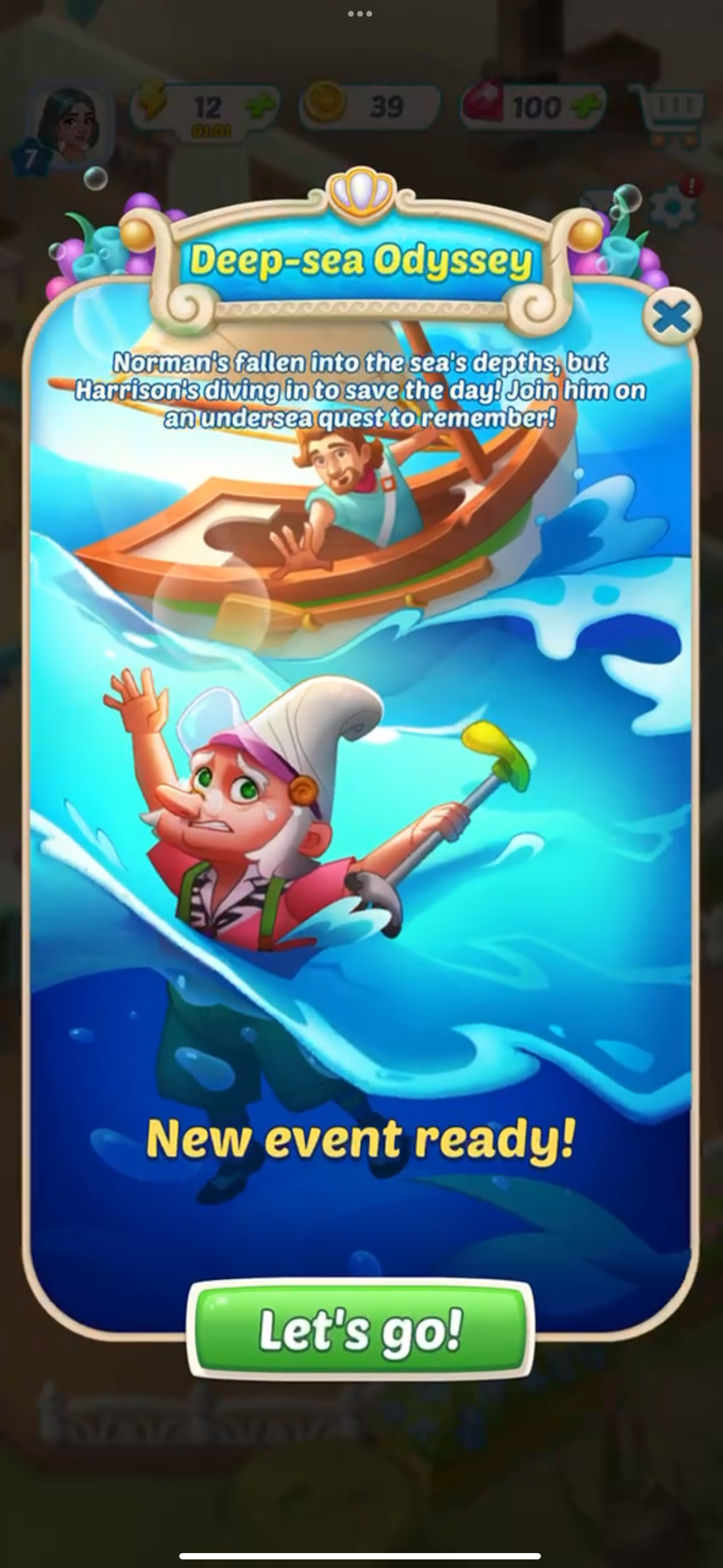
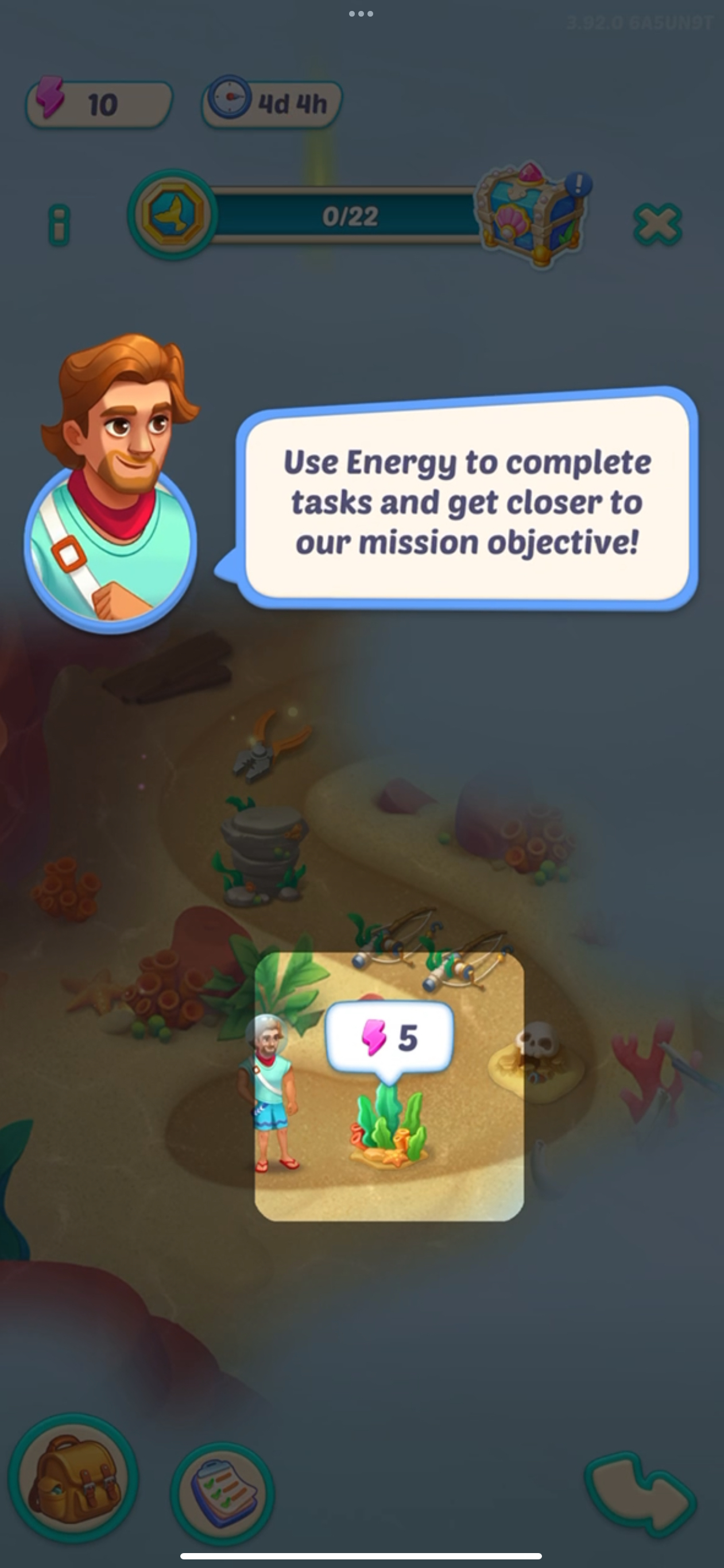
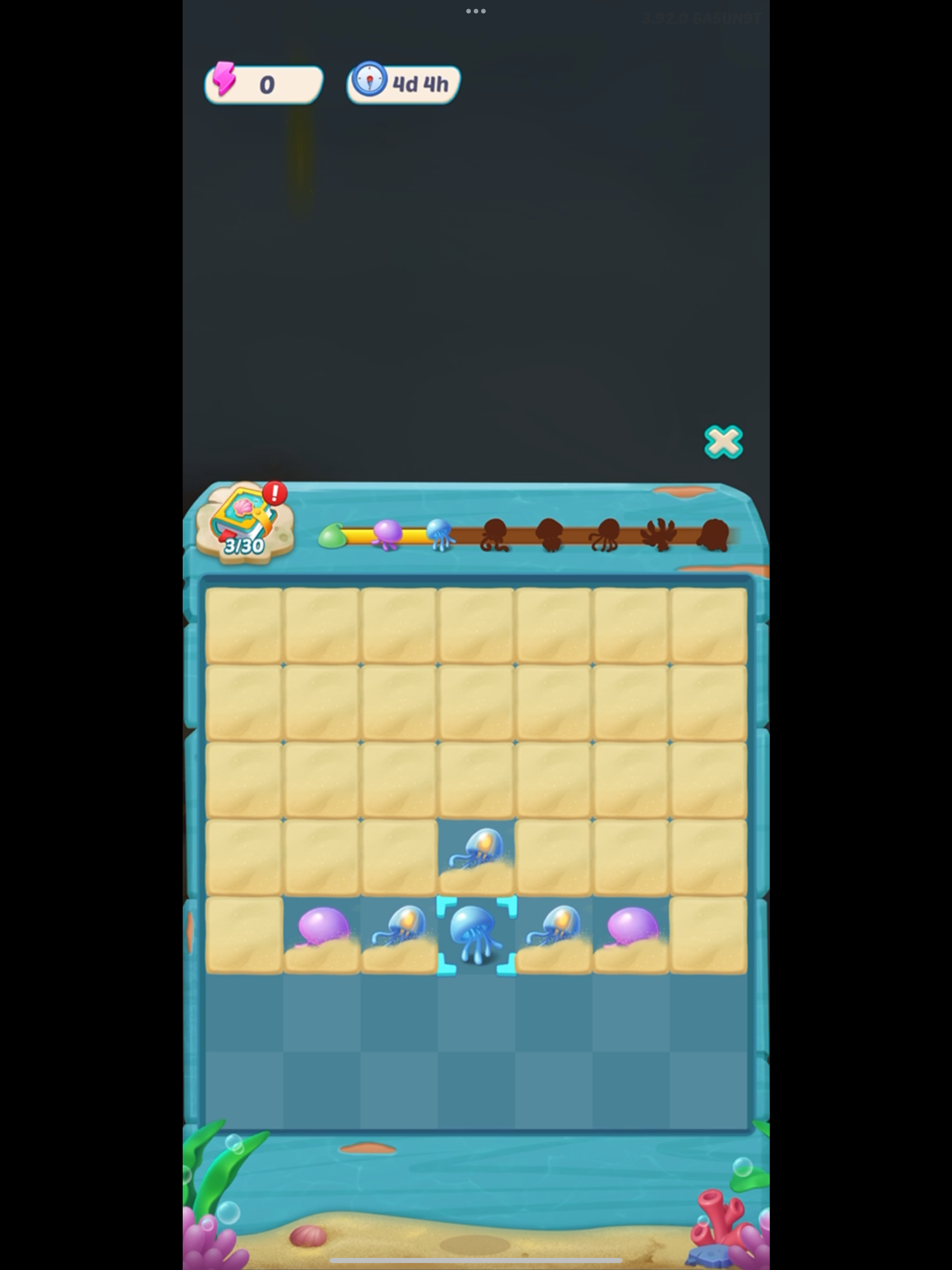
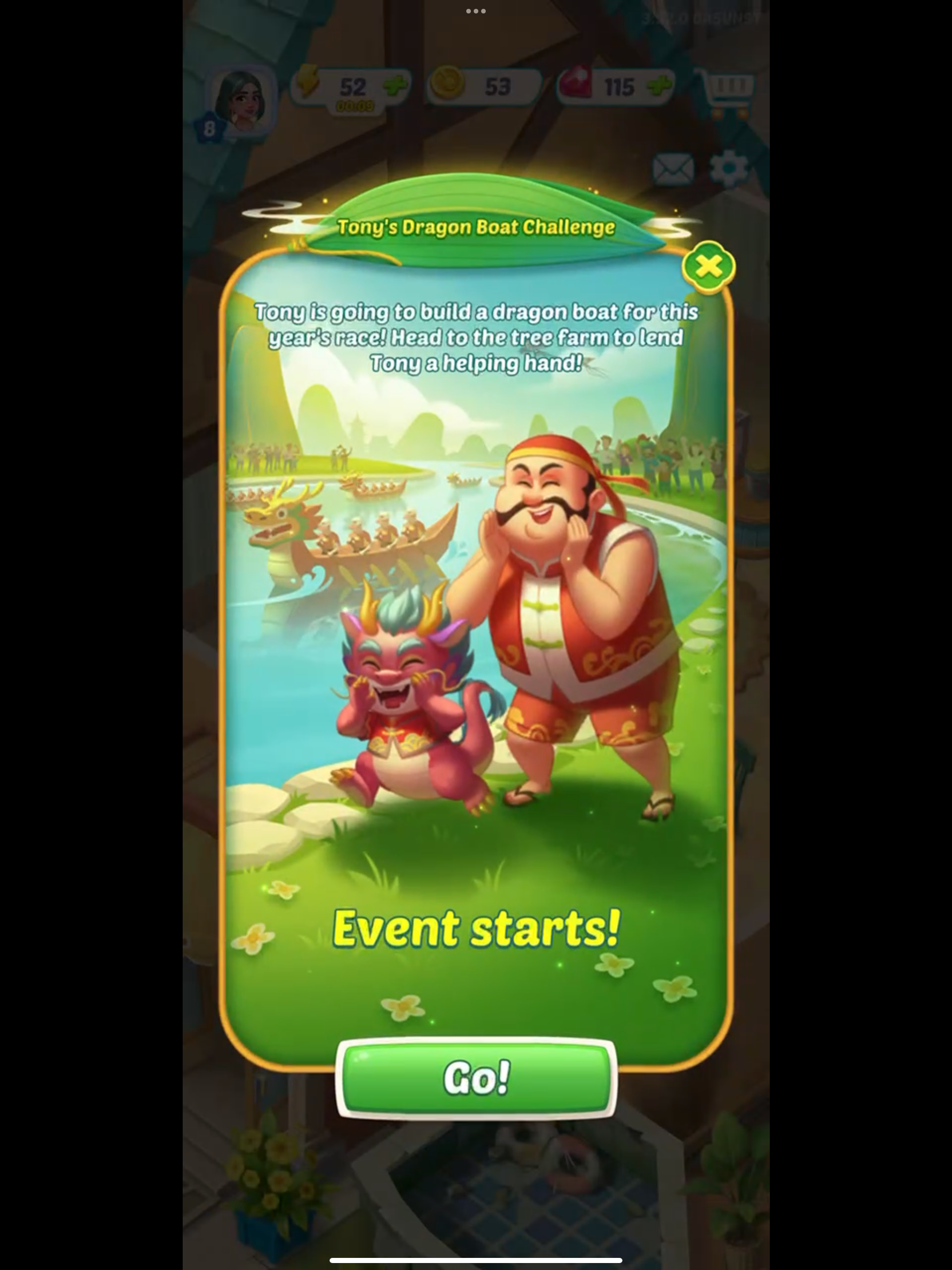
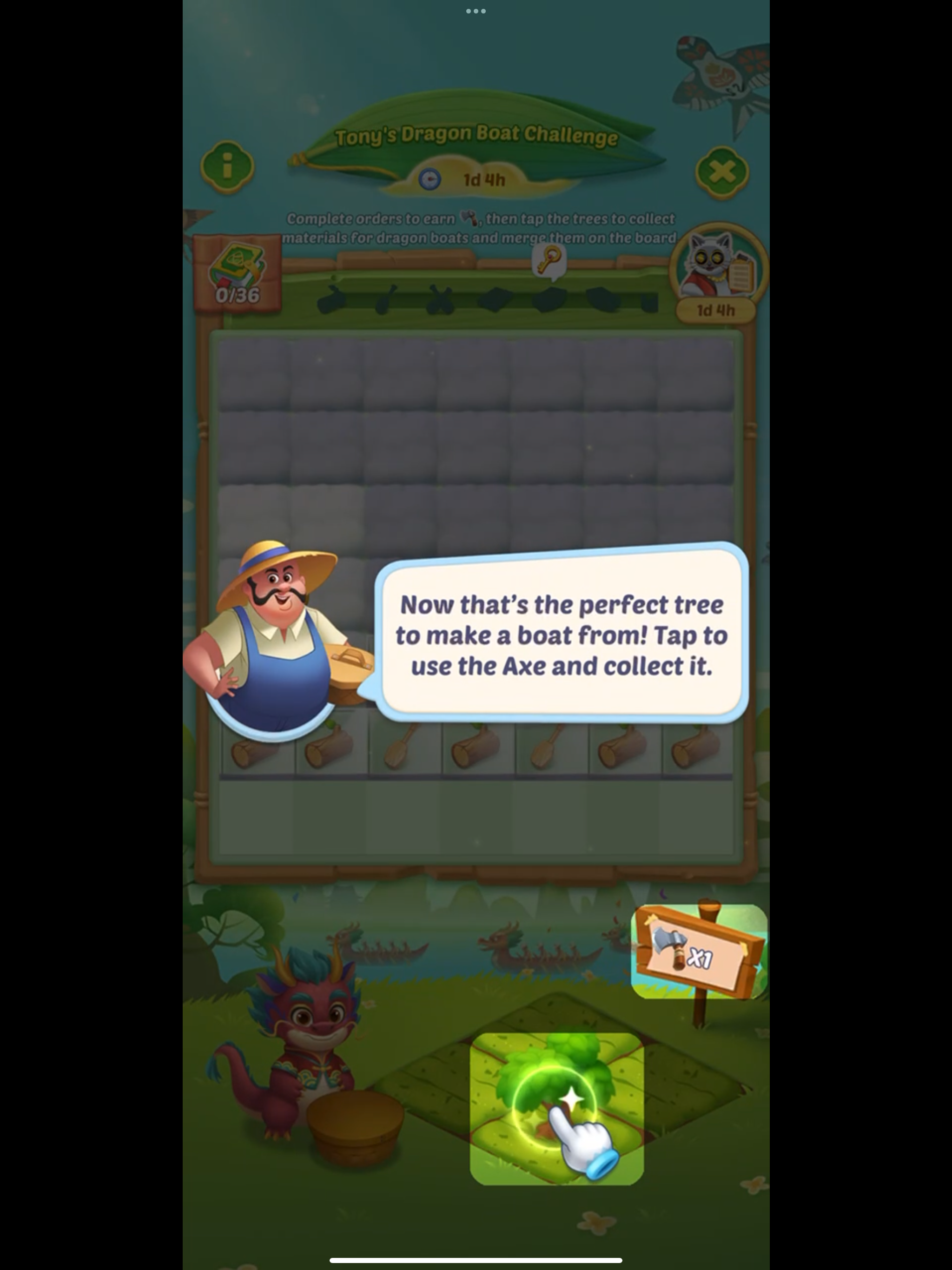
The highest level items cost at least 1000 energy. If energy replenishes at 1 per 2 minutes, then one would have to wait over three hours for their energy to reach 100 (which maxes out after this point), making the highest costing items cost a player at least 33 hours of waiting to obtain—that is, if they play their cards right. The cost of energy goes up if item generators produce variable outputs.

Players in the subreddit have been aware of GH’s predatory mechanisms for some time now, with some even calling for a boycott. (not to stop playing, but to stop making purchases) Some believe that once you make a purchase on GH, the game becomes more demanding, although it appears to be anecdotal…
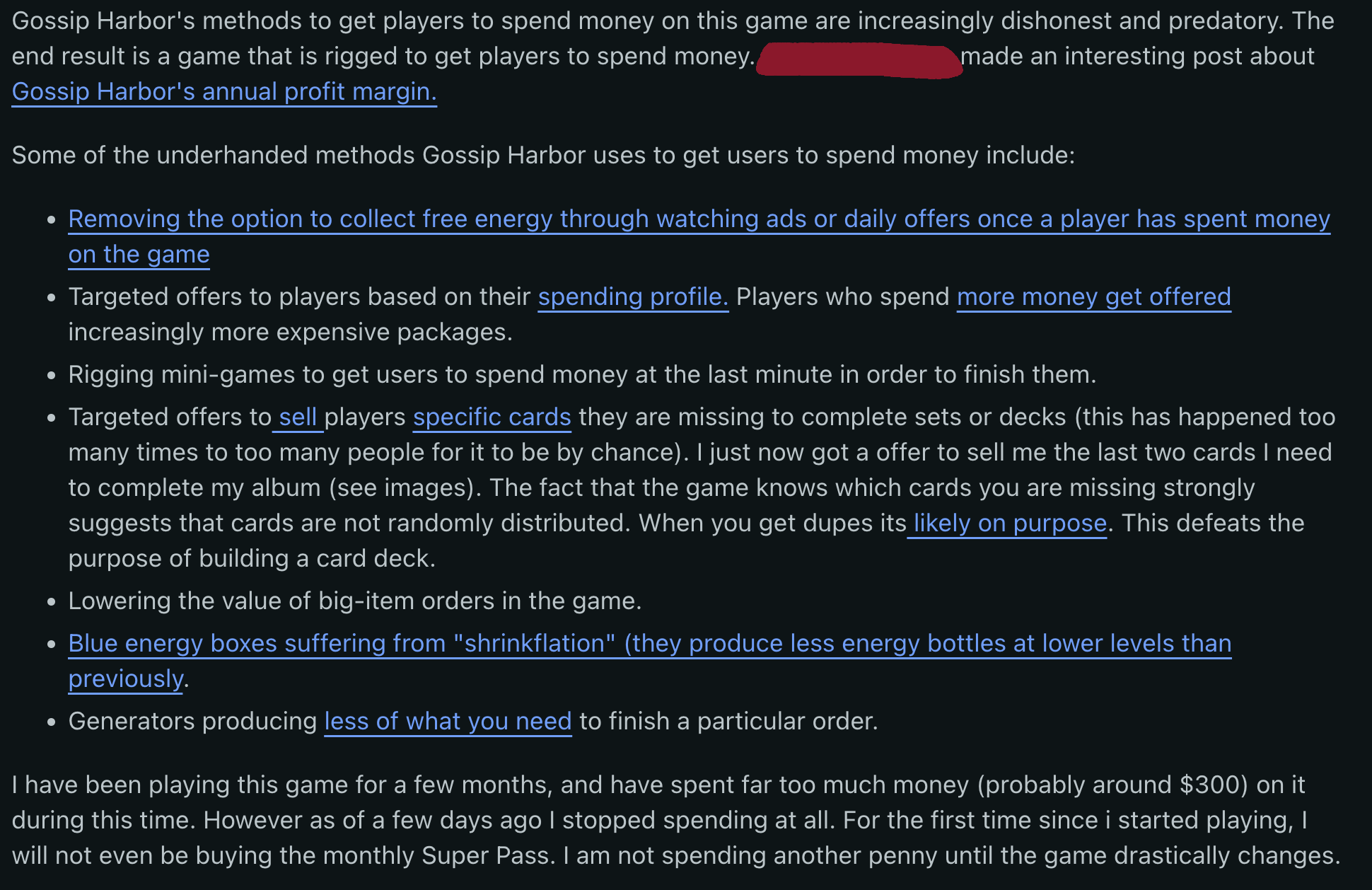
I must confess… this game was the most difficult for me to let go of. Because there was at least an element of strategy and skill, I found myself impatiently waiting for timers to go down so I could progress. Whatever the merging was doing to my brain was working in a major way. The writing was terrible, but I was invested in the story and characters. I could give a fuck about this mom, but I was interested in the development of the love “quadrilateral” between Quinn/her ex-husband/a male childhood friend/her only female friend, and her gay handyman bff and non-binary IT person. (ok allyyyy✊) ↩
-
Whiteout Survival
Personally, I found this game extremely difficult to get into. Tried it/walked away/decided that this one is too insane enough to not explore/watched someone play through it/tackled it again. One thing that separates this game from the others is that—similarly to Red Dead Redemption 2—it is a slog at the very start, but necessary because the rest of the gameplay gets really complex really fast. I’m going to try to not get too in the weeds, but I do want to cover the casinofied/chance-related elements, dark patterns/urgency manufacturing, and stuff that I find just plain interesting.
WOS is a type of 4X game: eXplore, eXpand, eXploit, eXterminate. So fun! The player is appointed Chief of a band of global climate catastrophe survivors. The game itself has multiple systems to track: town building / survival management, resource gathering / army building, and lastly, hero combat. The game and its narrative revolve around building a furnace, the beating heart of the town. Upgrading it strengthens its warming radius and allows the player to unlock new buildings which, in turn, unlocks new features and resources. Constructing and upgrading buildings costs resources AND time that increases the requirements with every upgrade. Each chapter contains specific tasks and provides additional rewards upon completion.
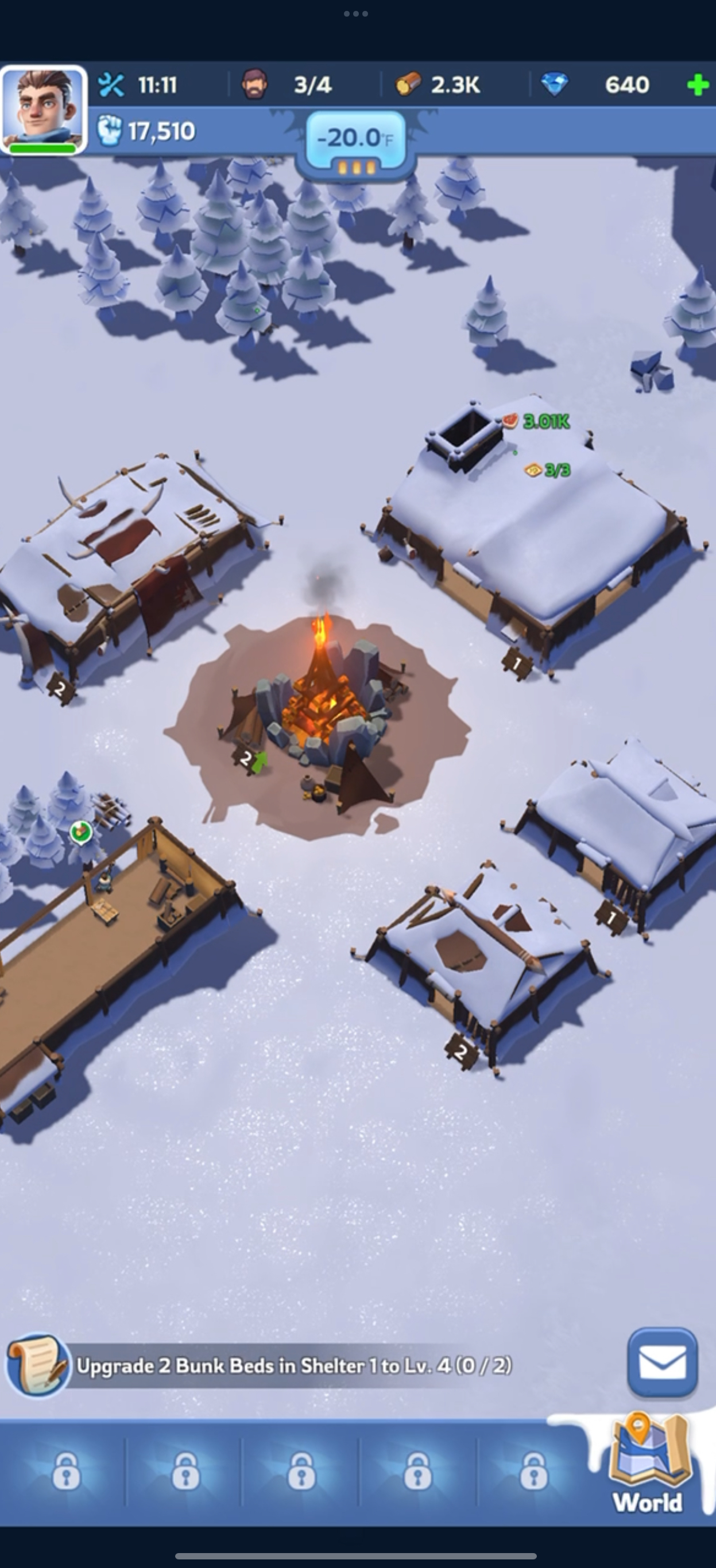
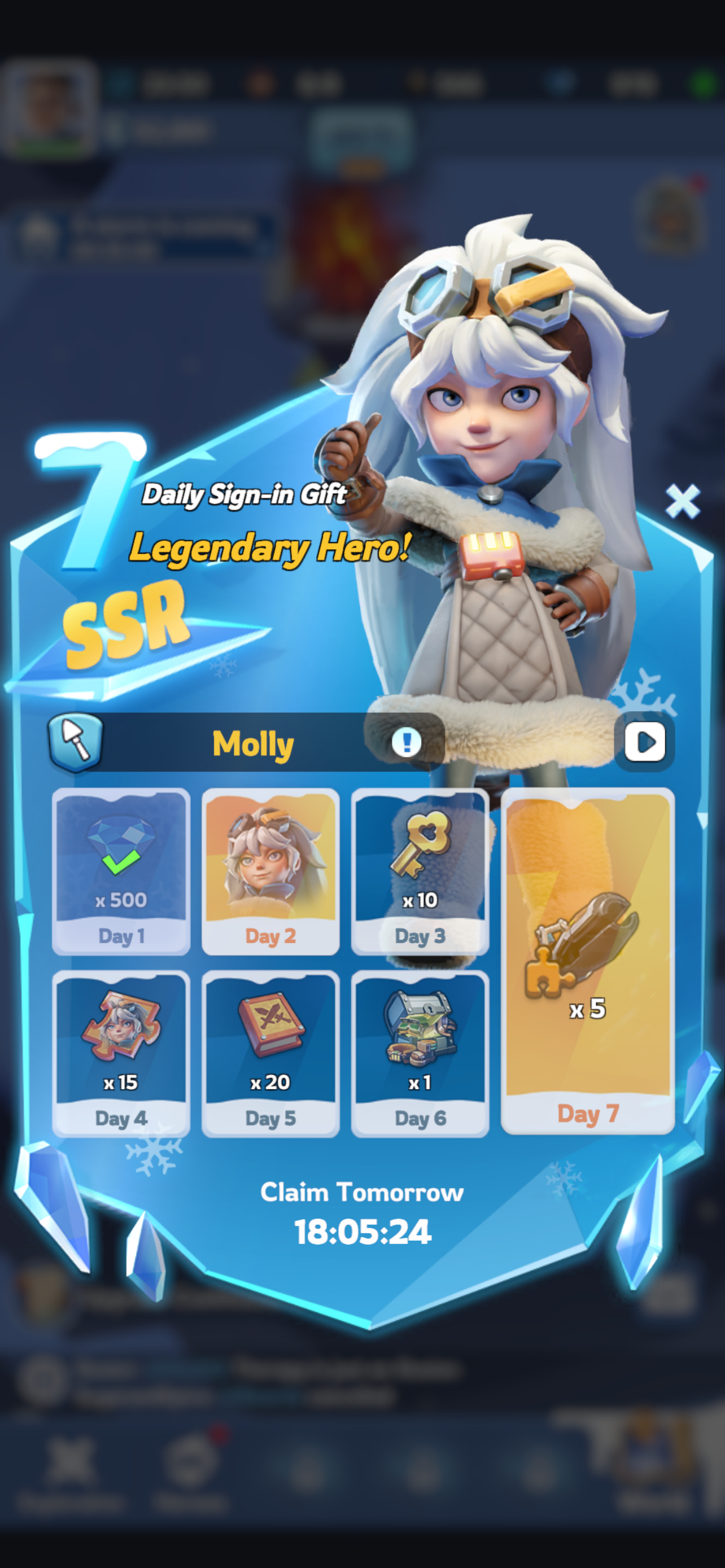
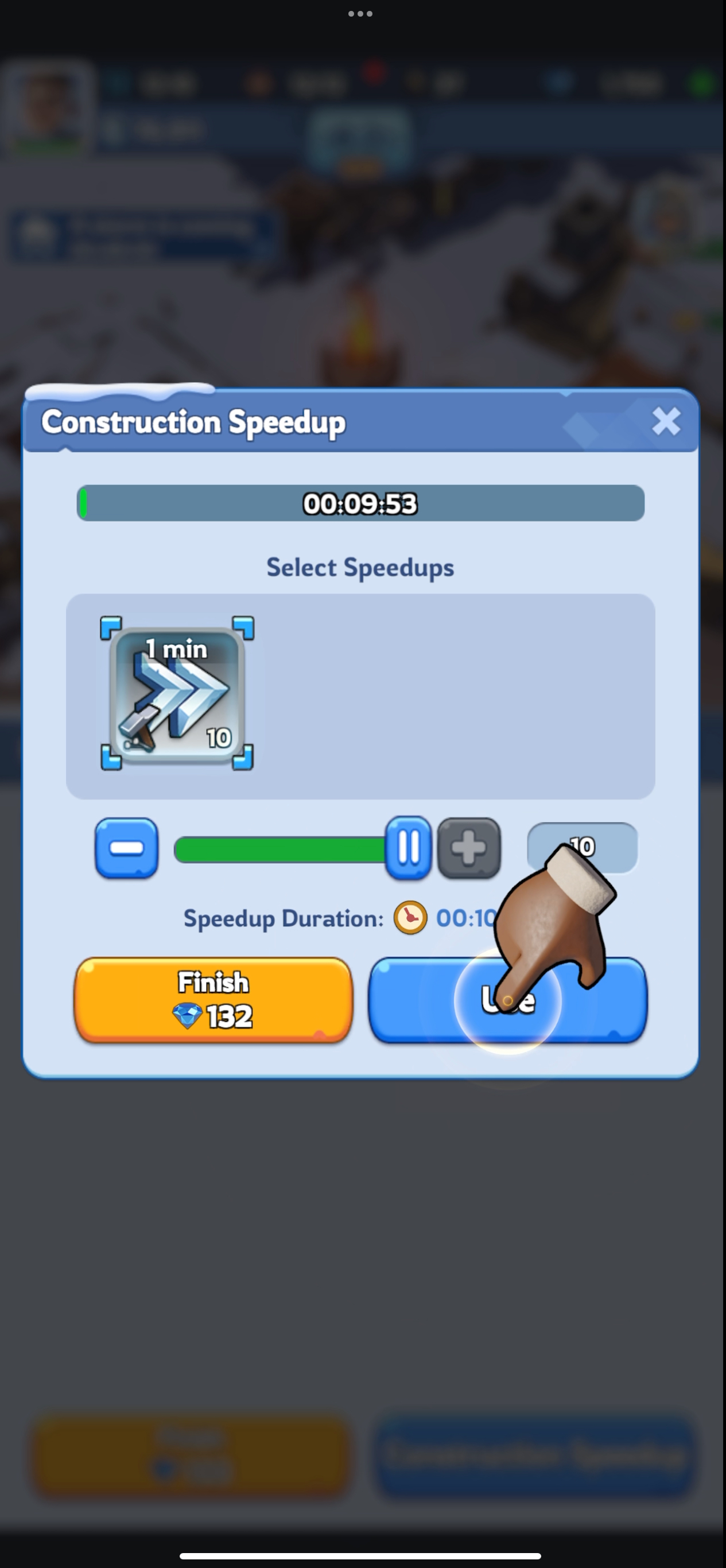
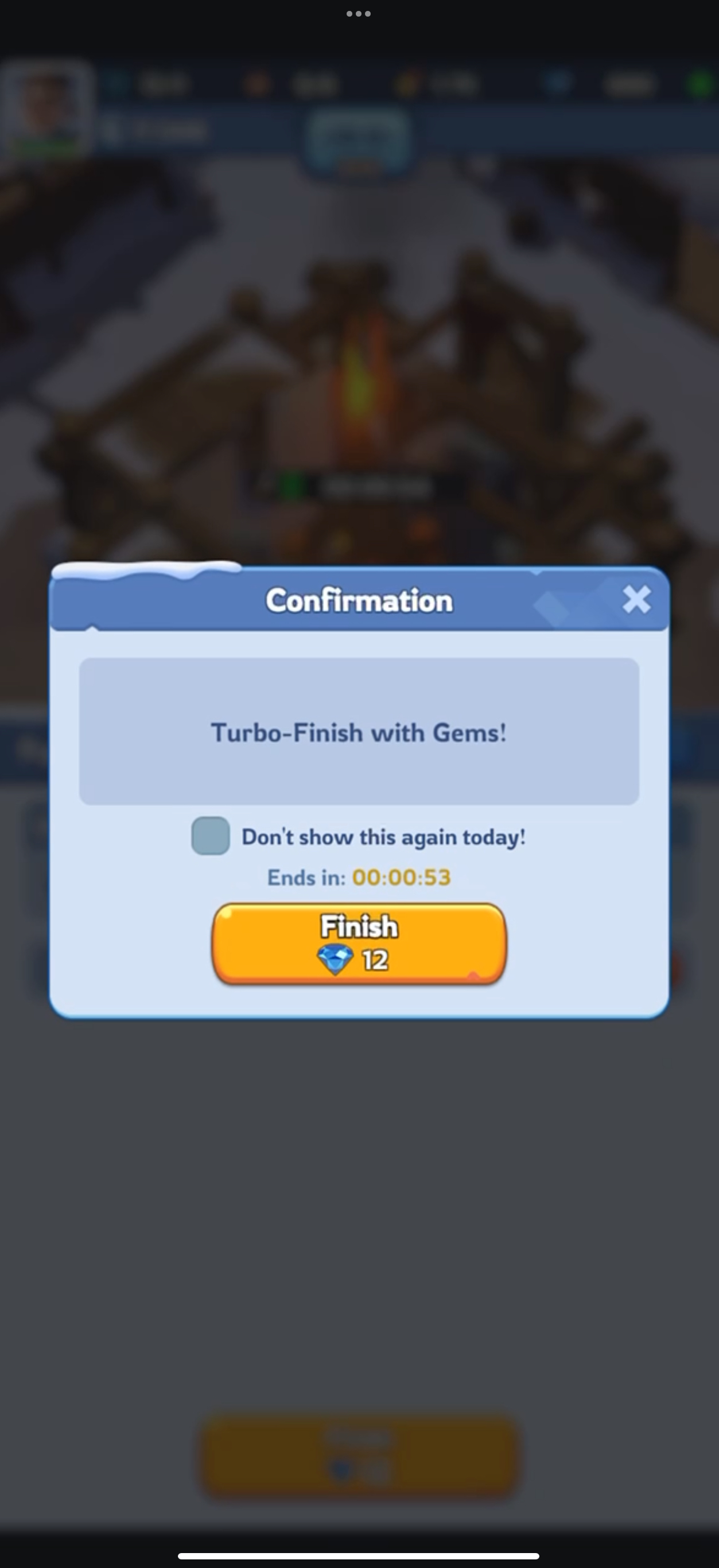
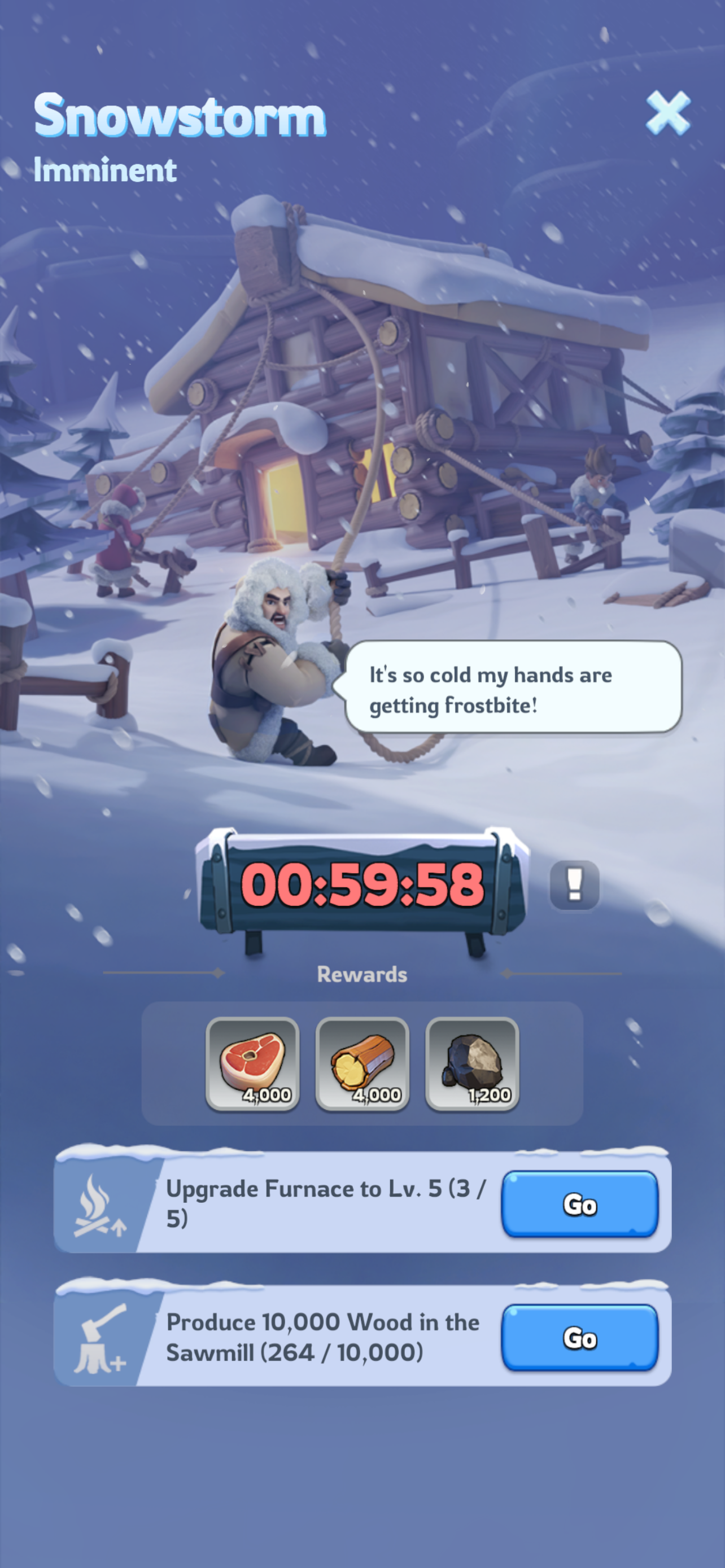
After getting the hang of building and upgrading, another character stumbles into camp in a panic. The player is given one hour to complete tasks to prepare for a wicked storm rolling in. Within 7 minutes of starting.
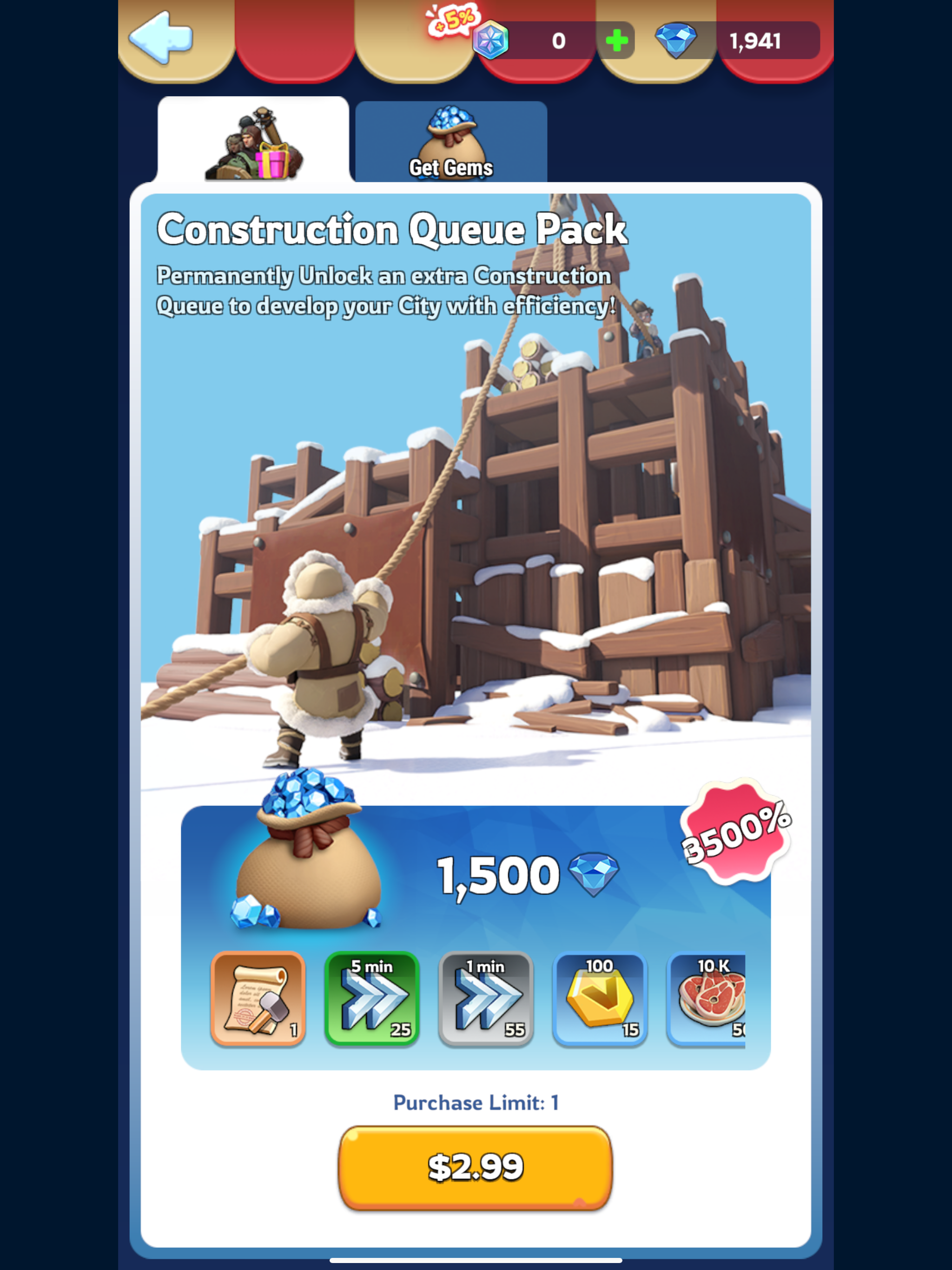
The player is gifted a 15 minute trial for an Extra Construction Queue that allows them to build / upgrade multiple structures at the same time.
Our first Hero rolls into town, saves the player from a polar bear attack, and joins the clan. They are then introduced to Hero Combat mode in which they select specific characters and their formations to face waves of enemies (with convenient speed-increasing/auto-battling features).
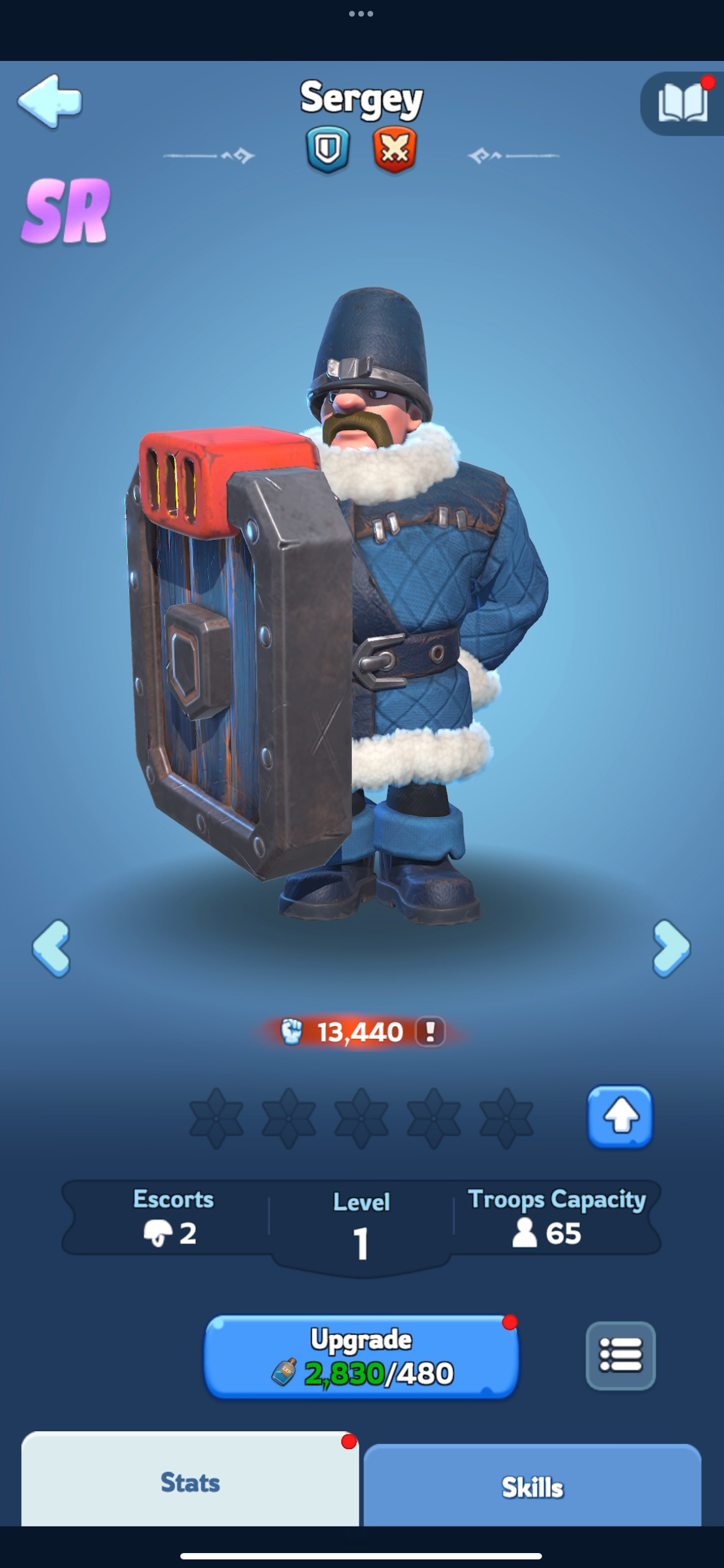
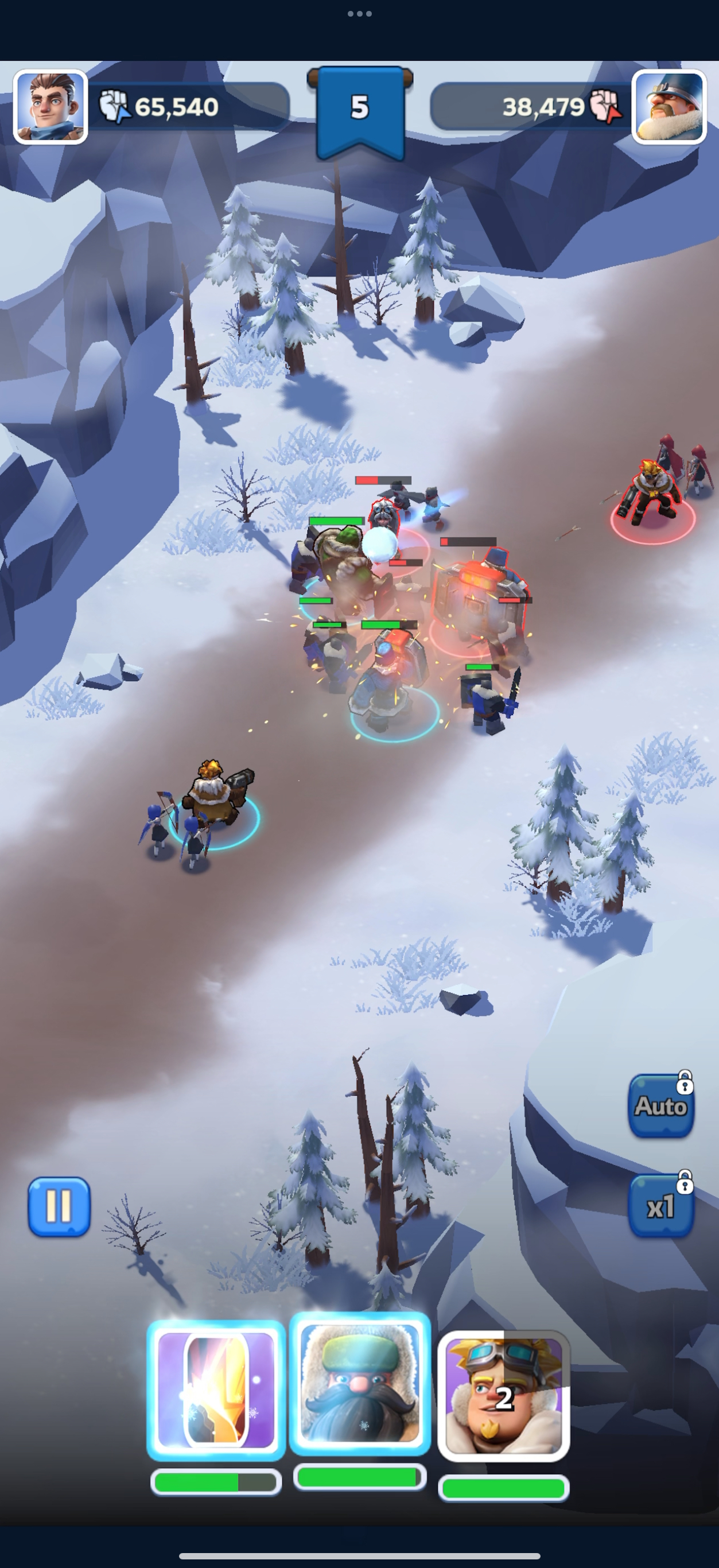
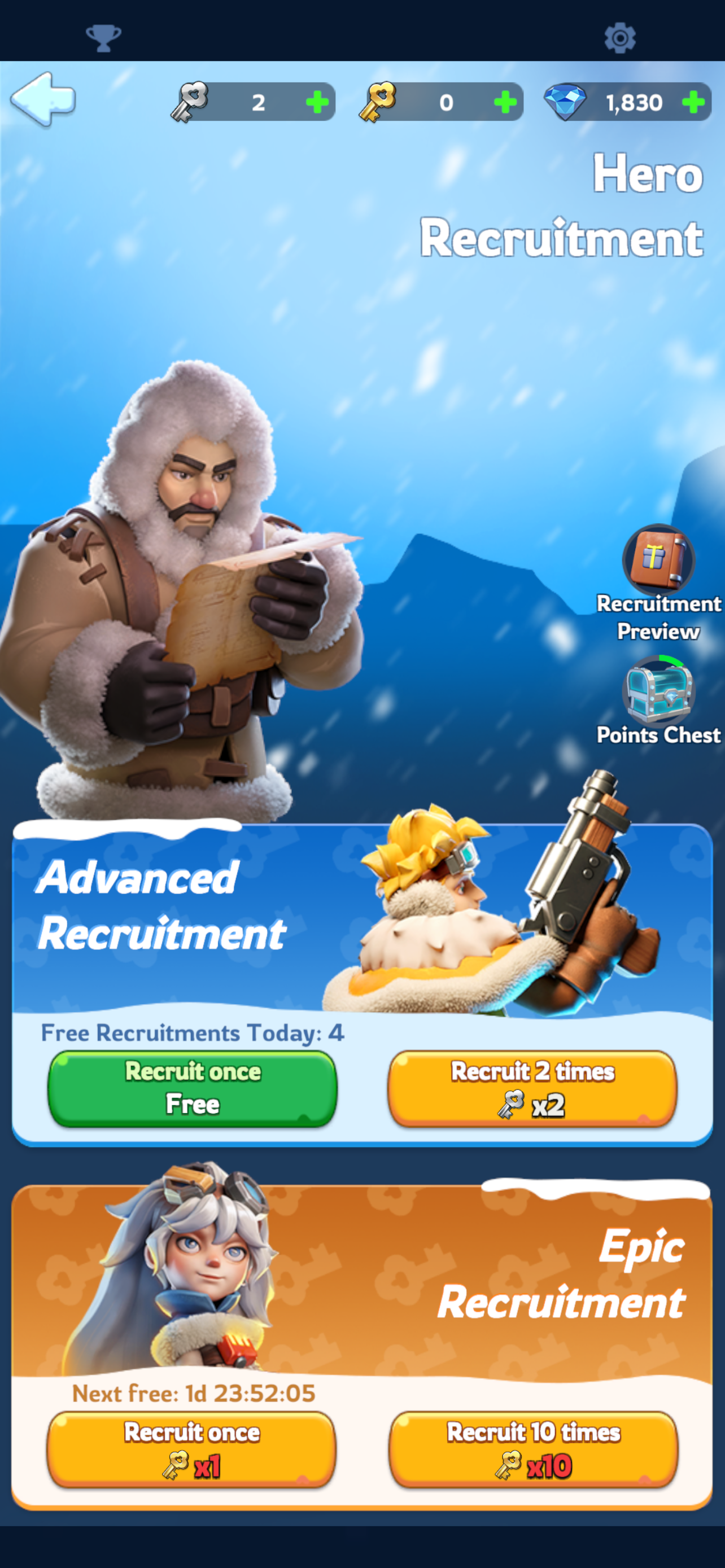
Admittedly, the variable ratio schedule/gambling elements are not as strong in WOS as some others, but a lot of outcomes for things like battles, marches, expeditions, are uncertain. The primary variable reward mechanism can be found in the Hero recruitment system. Besides the Heroes the player unlocks via scripted story rewards, the player can exchange recruitment keys/tickets for what is essentially a slot lever pull (5 platinum keys a day, 1 golden key per two days) in the Hall of Heroes.
The player can see a preview of the potential recruits (blind-box style…) that creates a sense of “Ooou, she looks cunty… Need herrrr!!” Not only is the actual Hero acquisition a gamble, but most of the time, the player will pull these things called Hero shards. It takes anywhere between 10 and 40 shards (as far as I know) to recruit a specific Hero. The odds for each one are posted in a side window, never to be pointed out. (in accordance with app store rules)(sneaky … )
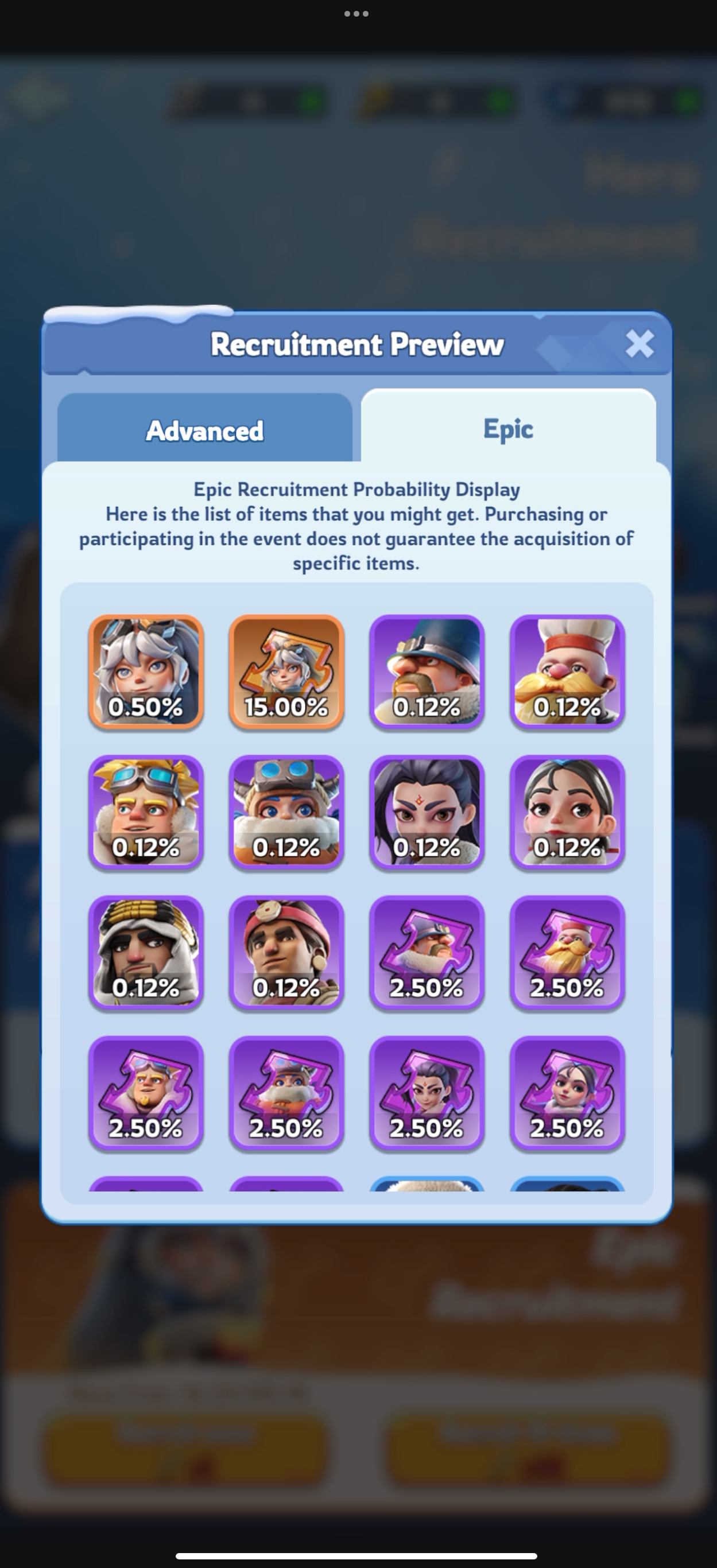
After they’ve gotten enough shards to summon a Hero, the player needs even MORE shards to unlock and upgrade the Hero’s abilities! Which is different from leveling up with XP. I think collecting shards unlocks the ability to level up? It’s super confusing. Bottlenecks inside bottlenecks.
On top of these variable ratio schedules, WOS introduces variable interval schedules. Developers will rotate the events that change which resources matter the most and encourage players to hoard items to prepare for an occasion that may or may not happen. It’s like the stock market except the developers control the supply… and the demand… and the players invest in resources and are constantly trying to predict the future value of their own stock (which, unlike irl stocks, can’t be resold or traded).
A pop-up appears after about 20 minutes: “Dear Chief, We’d really love to get your feedback and suggestions on how your gaming experience is going and how it might be improved. So it’d be great if you could fill out this brief survey!” As a reward for completing the survey? 500 gems. Nothing to sneeze at.
The questions started out pretty standard:
- “Would you recommend this game?”
- “How do you usually learn about a new mobile game?”
Then they got really specific:
- “What other games do you like?”
- “Besides gaming, what else do you like to do on your phone?”
- “What is your employment status?”
They were profiling my idiot ass in real time!!! Of course I lied lol anyways
The variable ratio schedule is present in the process of attaining resources and Heroes, but the biggest drivers in this game come from time management and creating/maintaining alliances. I could write a whole paper on the insanity that is WOS. I have only glanced at the message boards from my account, but the posts on Reddit give me cause for concern. The Reddit community for this game is… intense. There are these intricate webs of alliances with server politics that would rival that of a small nation. Spending months with fellow Chiefs plotting and plundering is sure to produce close relationships. They are also sure to produce loads of interpersonal conflicts and boundary issues. Seems like people tend to conduct relationships or affairs in the chat rooms… like a lot.
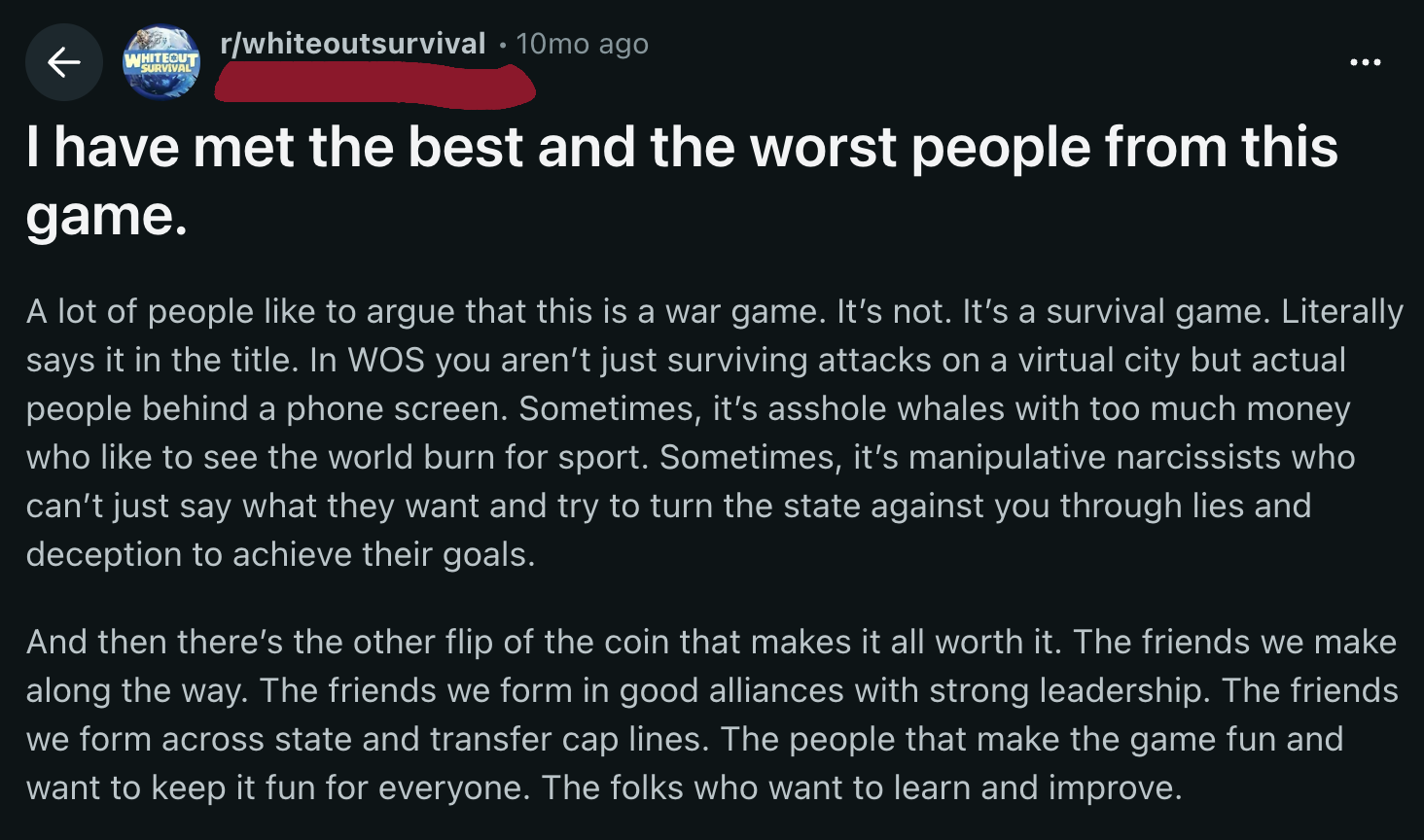
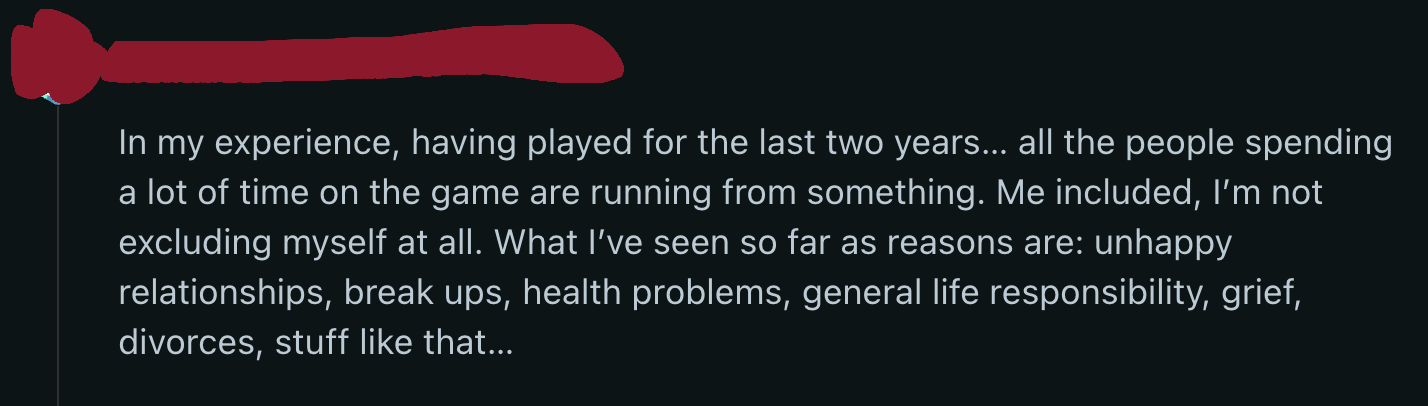
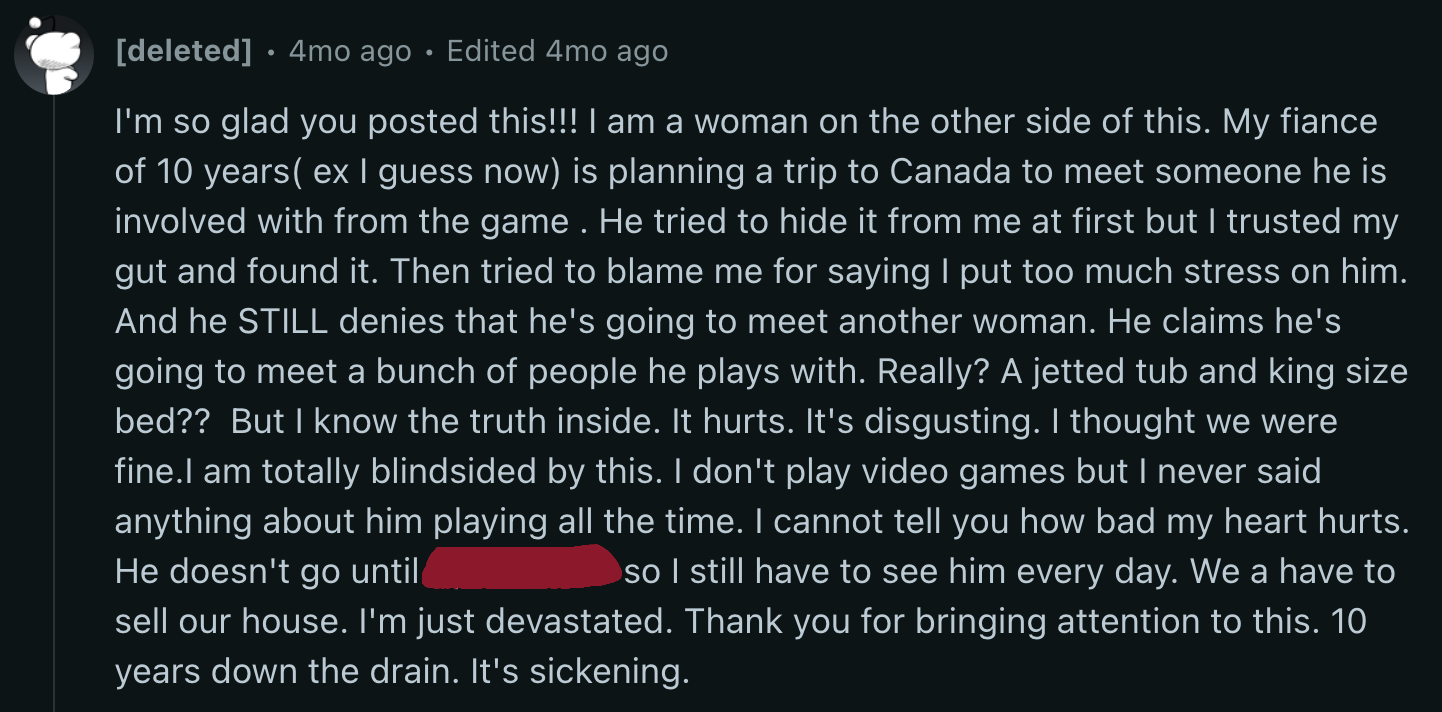

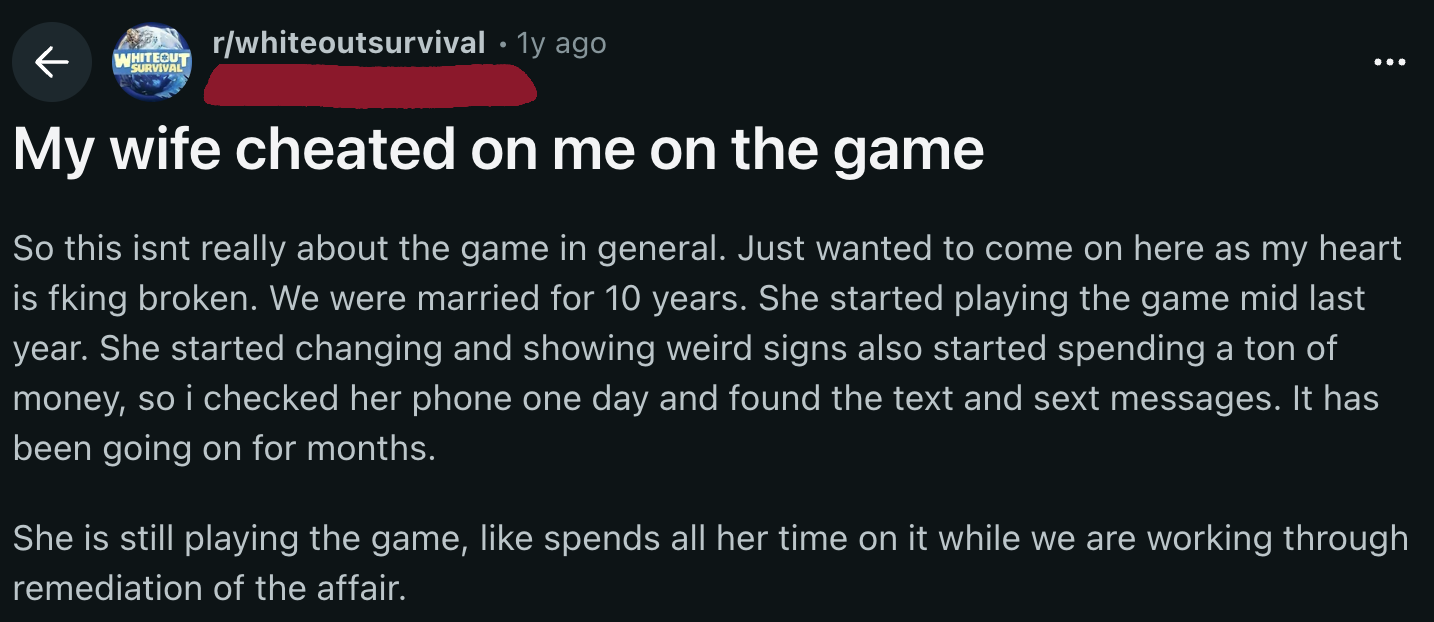
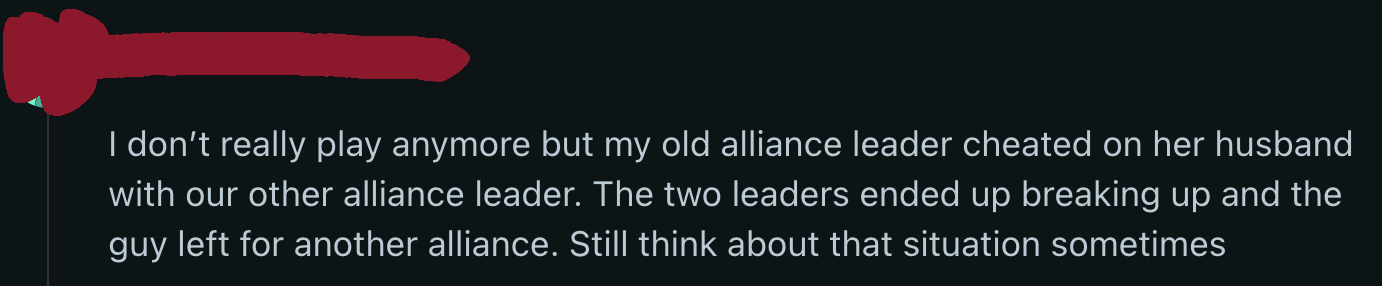
The most interesting phenomenon I came across was the culture of whales and their impact on the social hierarchy. If they have time, will, or money to spend (or even if they DON’T have the money to spend), they can expedite building upgrades and resources by buying their way past the bottleneck processes. One task or upgrade that would take weeks for a F2P player to build or optimize can be knocked out within seconds. Strategy pales in the face of the raw numbers. To ally yourself with a whale is to ensure protection; to face a whale… say your prayers, or be cool with irrelevance.
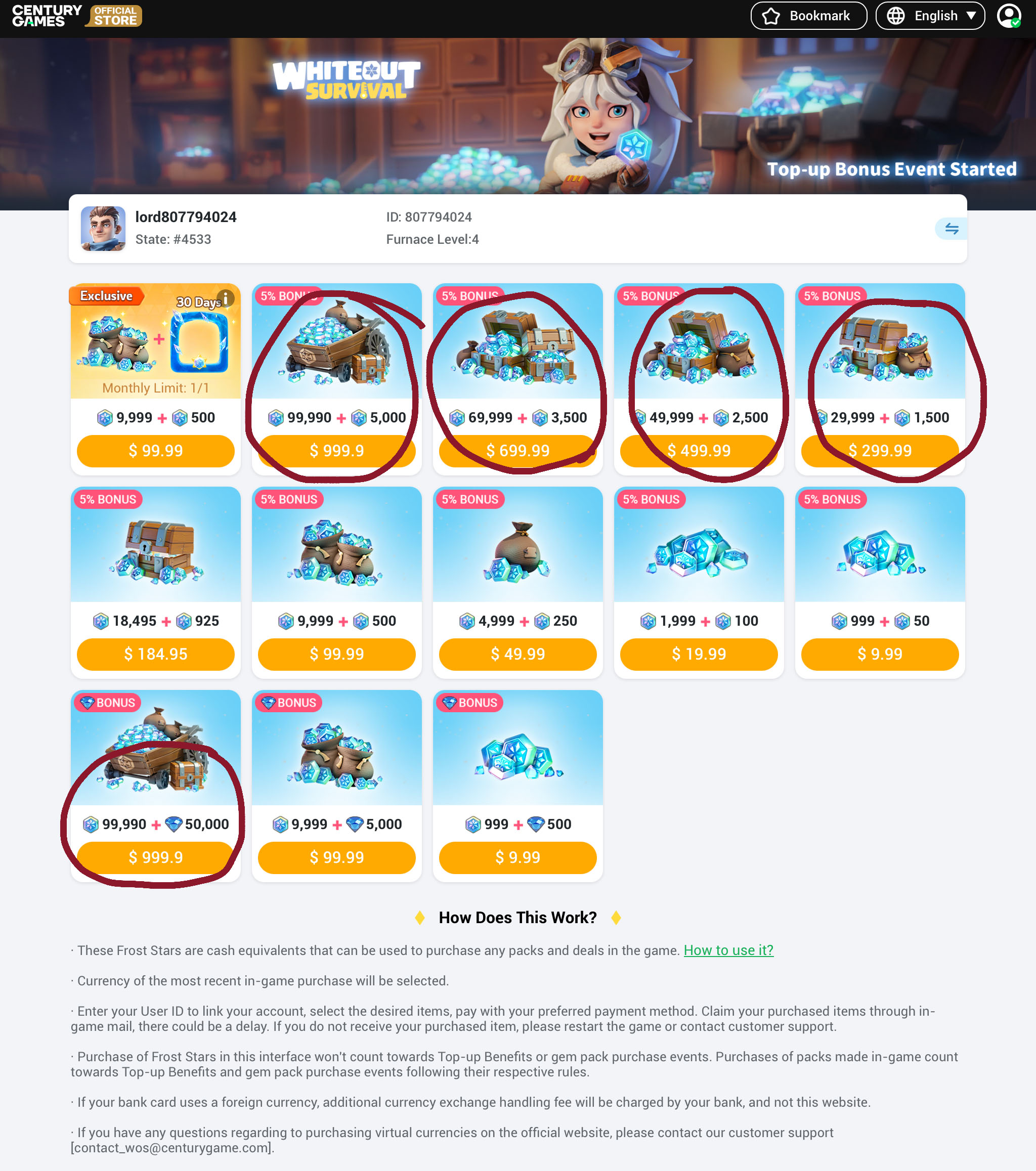
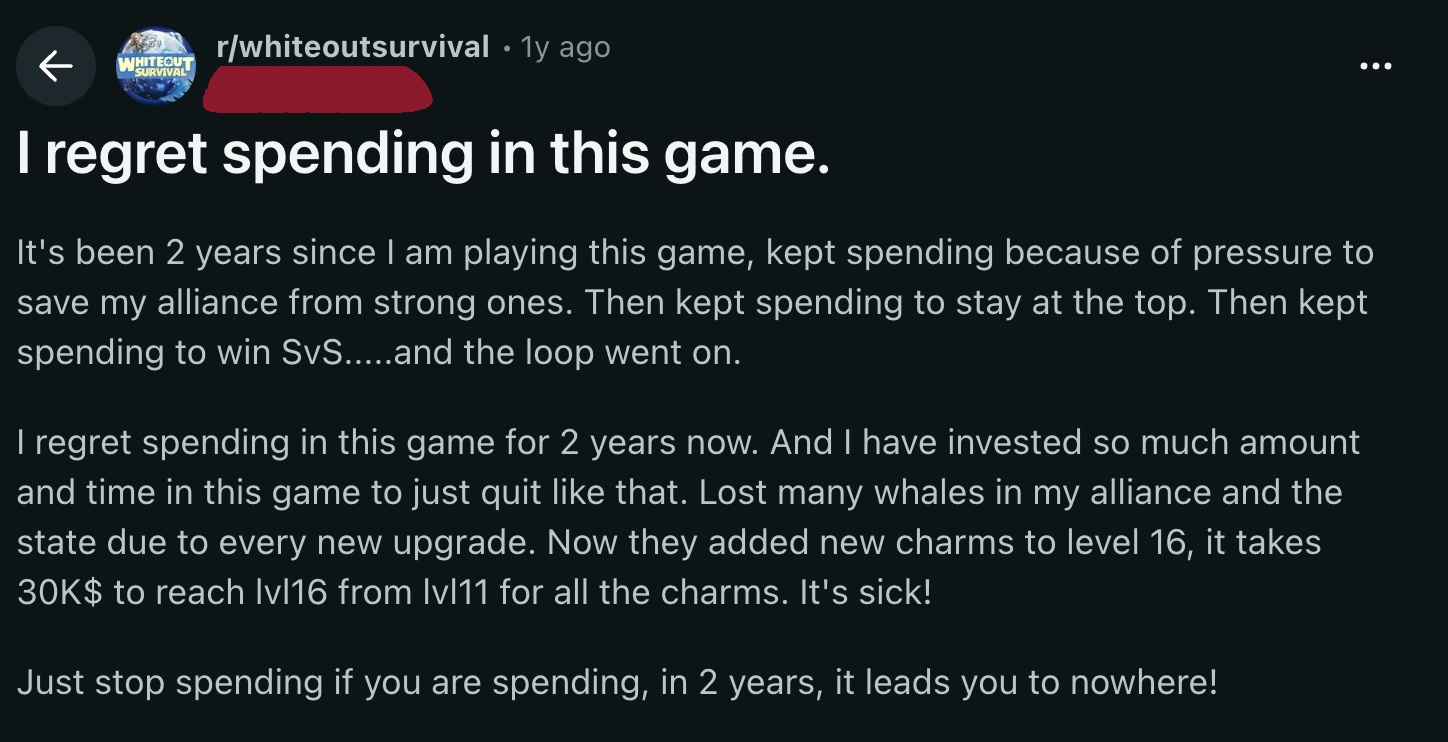
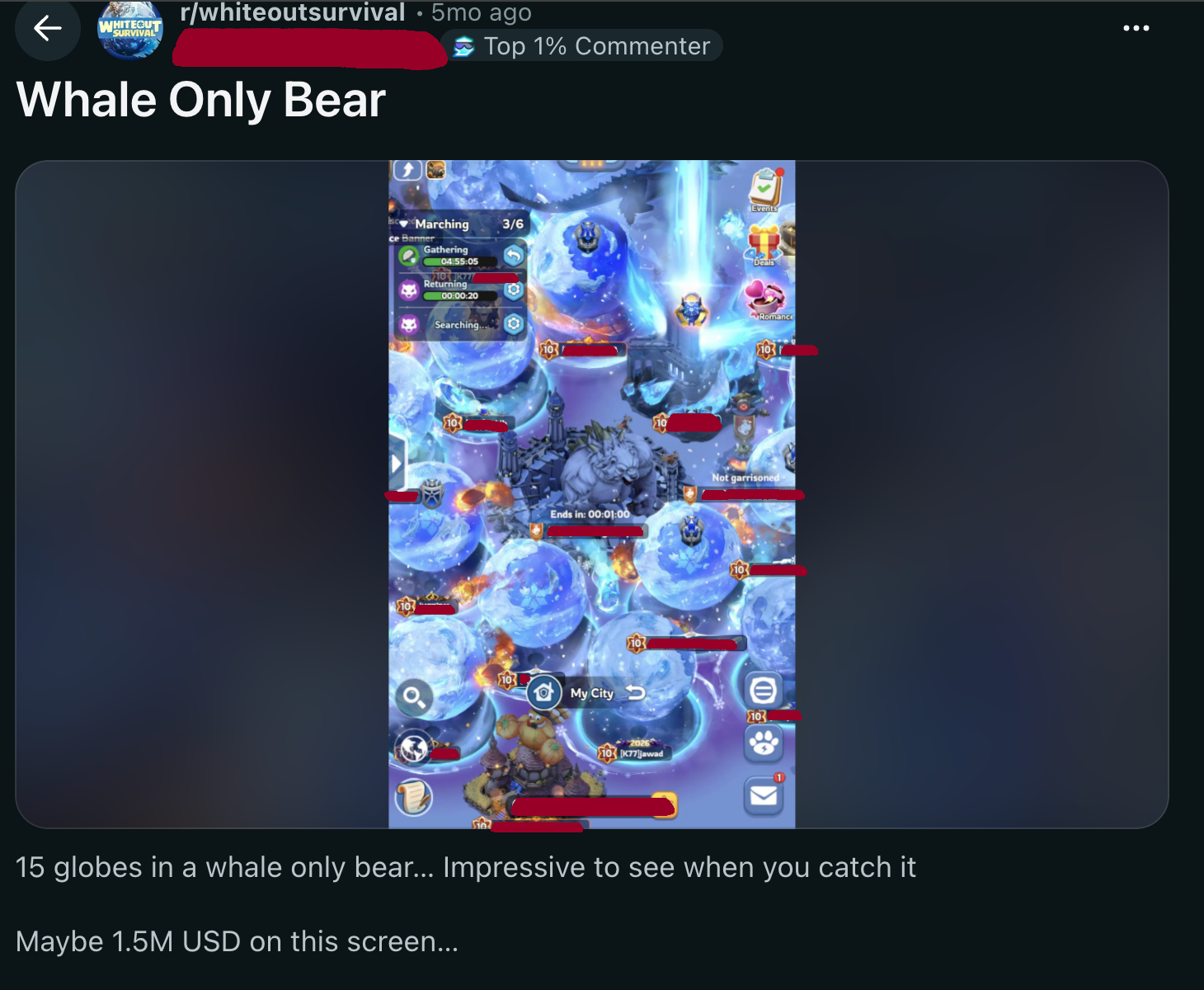
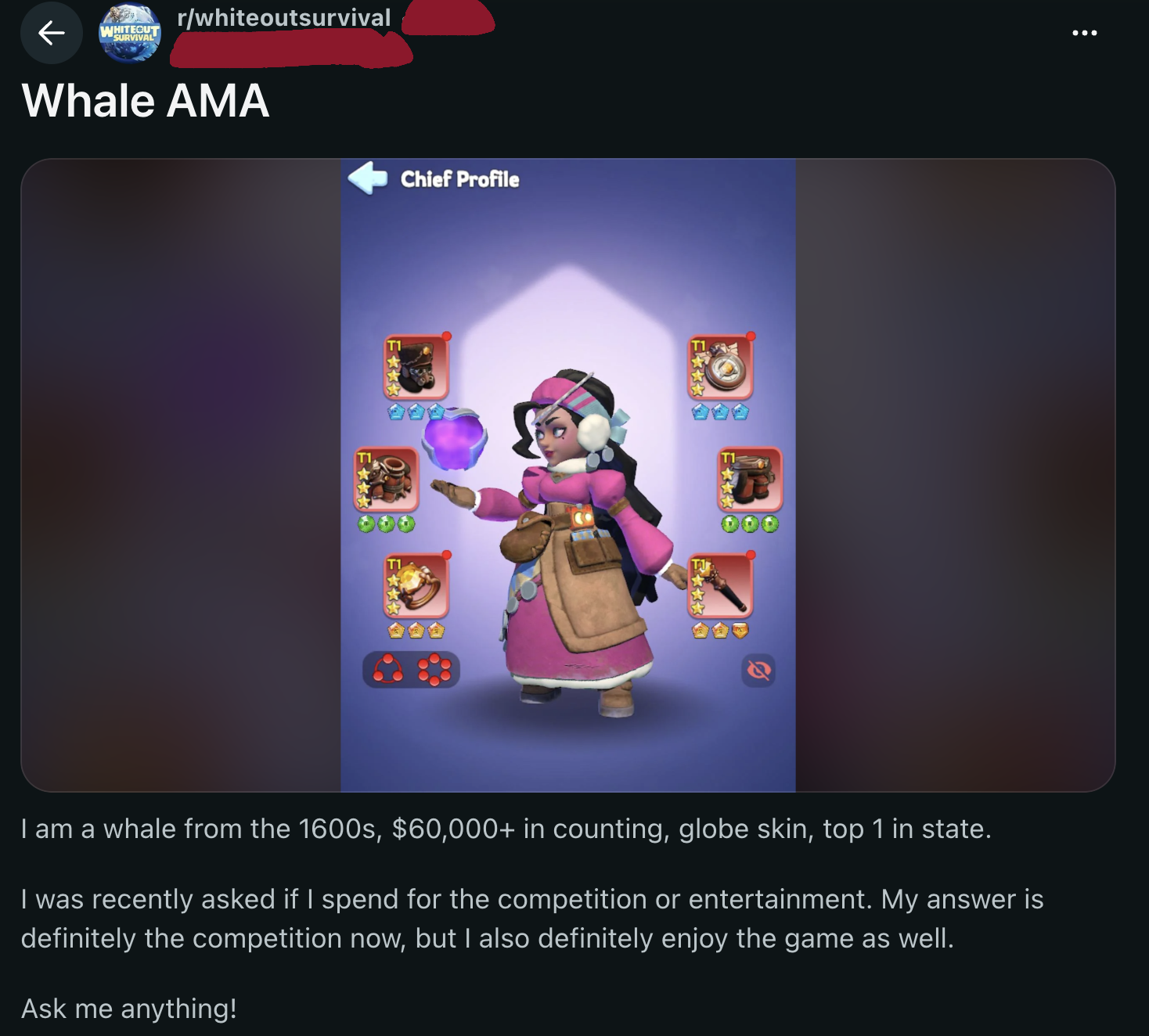
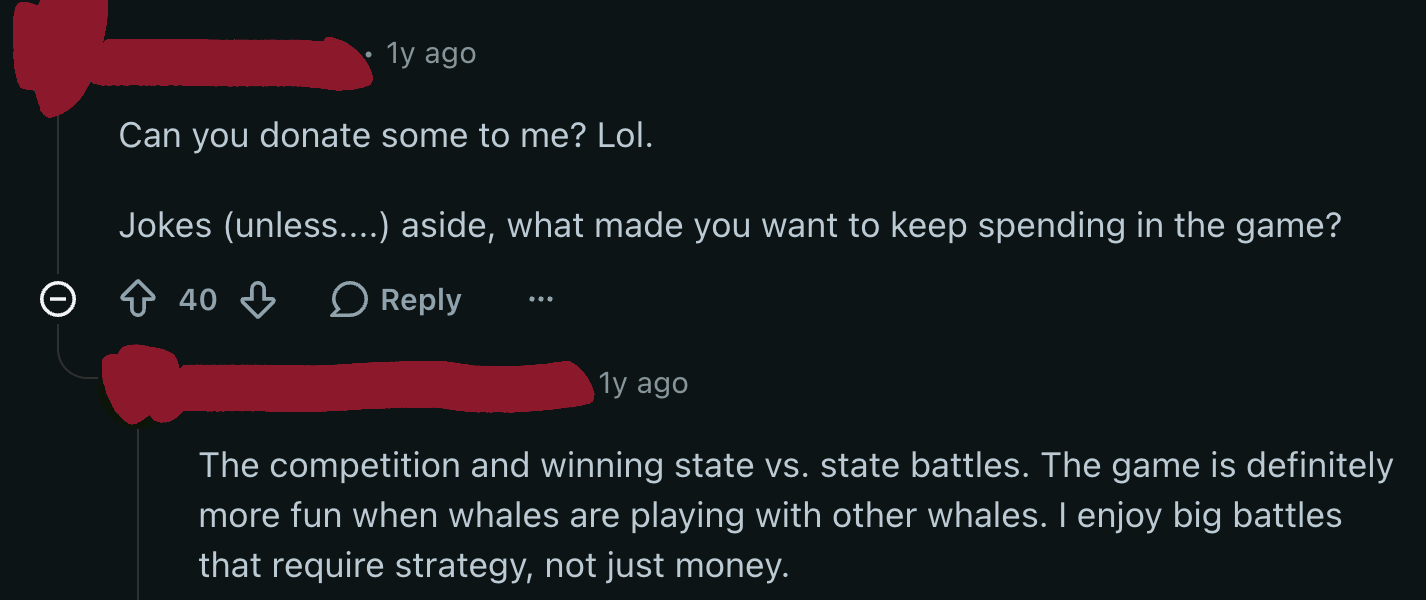
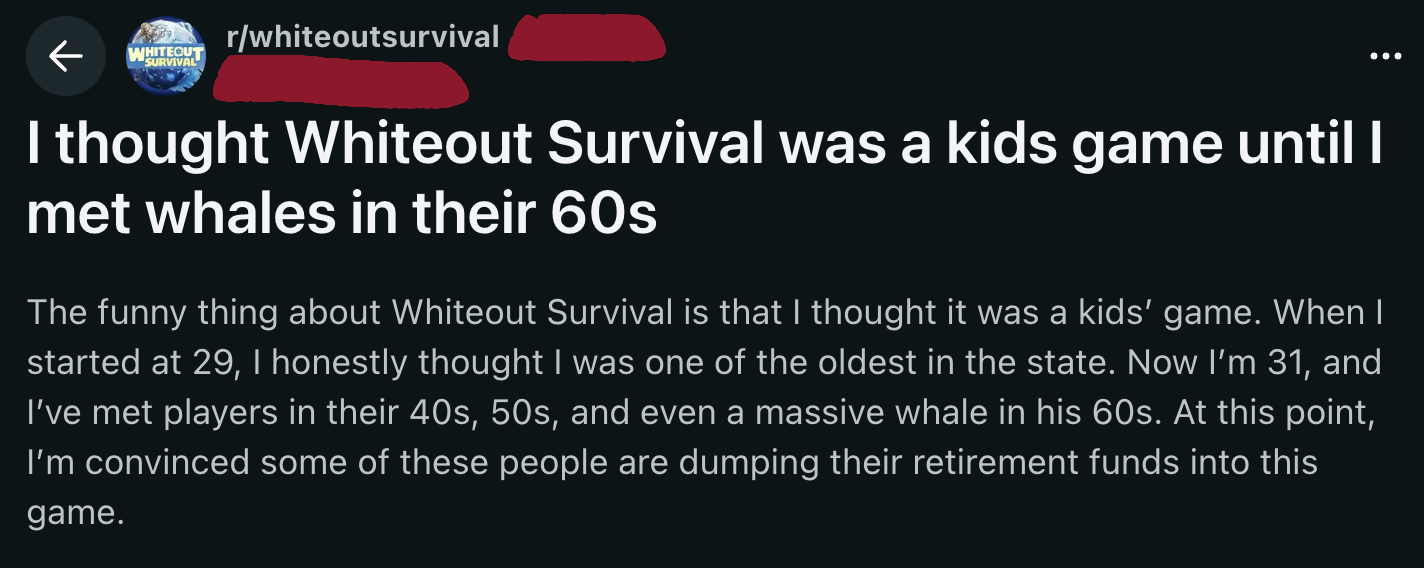
The game is pitched as a winter survival simulator, but unless you are willing to spend enough money to buy a real-life car on virtual goods, you might end up more like a serf grinding in a fiefdom for a king. Whether or not you serve a fair, generous diplomat or a shit-stirring tyrant entirely depends on the person occupying the other end of the screen. The relationship between F2P and whales is complicated; on one hand, whales can make smaller players feel powerless. On the other hand, they provide stakes, aspirational goals, and diplomatic stability. Not to mention they are a significant source of revenue… None of this is outright sanctioned by the developers btw! There’s no way for us to know if this was the structure intended by developers.
I am intrigued by the lack of information on this game. It’s been 3 years since its release with around 188 million downloads with approximately $3.4 billion+ in lifetime revenue. (these numbers are from third party sources, used by reputable outlets but not company-reported “official” numbers.). I can’t find any information about voice actors, the art team, or anything about the production of the game. I don’t think this implies anything sinister. I think it just says to me “this is a product and the visual identity belongs to the brand and not the people who built it.” It seems like the most important design decisions are the least visible in F2P. It raises questions about what the company considers part of the experience versus what they consider to be business infrastructure? I dunno, it’s interesting because so much of the experience IS the business structure… can you tell I’m getting really tired of writing about F2P 😭😭
The gameplay loops and culture of this game are more complex than all the other games combined. Even the systems have systems! A much smarter individual than myself would probably have kept better track of resources, but unfortunately I couldn’t be bothered because I really just wanted to scope out as many features in as little time as possible. I just KNOW there are features I haven’t uncovered yet, so I want to explore this further in the future. I just got other stuff going on lmao I know that a 13-year old me would have gone absolutely bonkers over this but WOS personally isn’t for me at this time. Much to think about. ↩
-
Coin Master
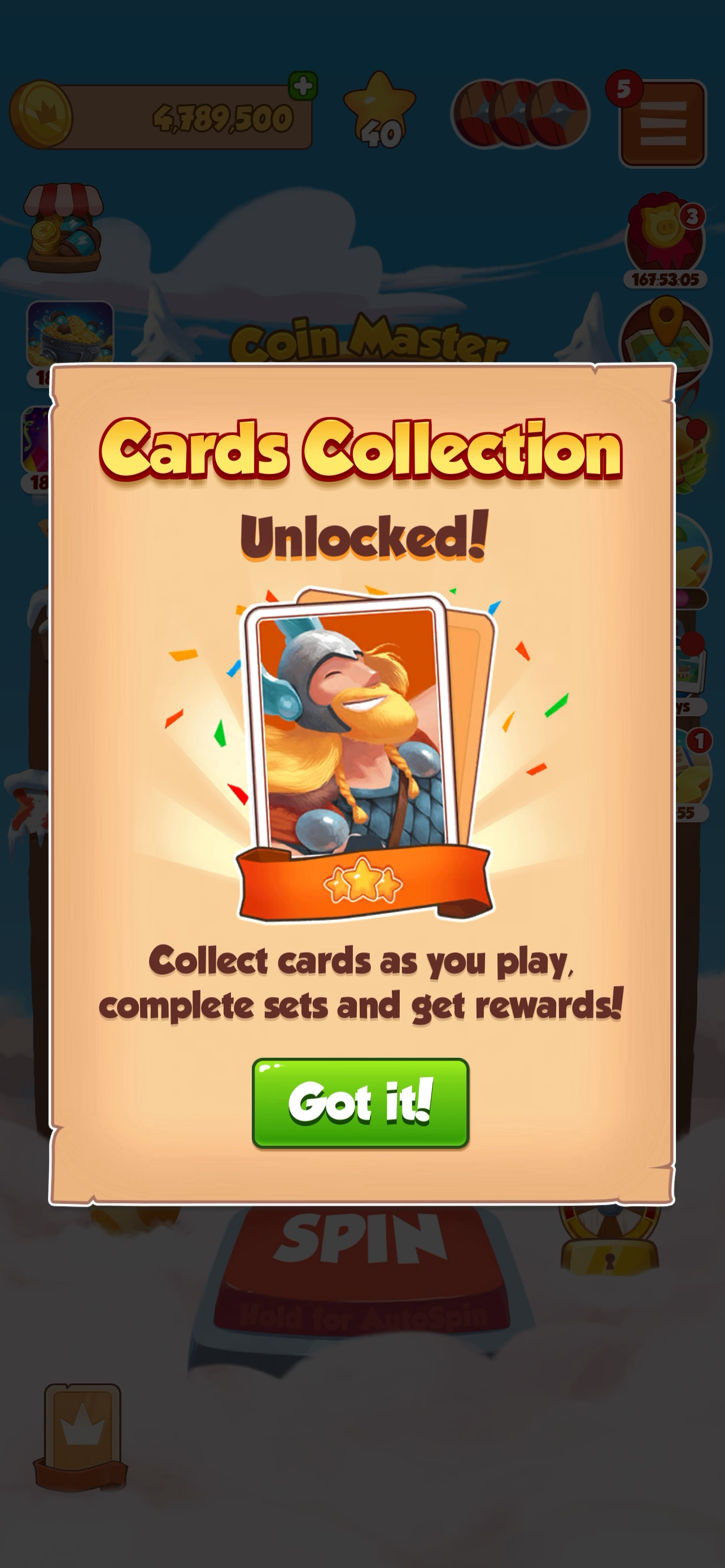
Coin Master is just slots. Straight up. There is no puzzle, no story, no skill. (maybe resource management and timing if you want to get technical with it) it is pure variable ratio conditioning; I press the button and my brain go “brrrr.”
The main gameplay loop is that you spin the slots, accumulate coins, build/upgrade your village, and impede other players’ progress. (There is no pacifist route. I am attacking other players against my will!!!)
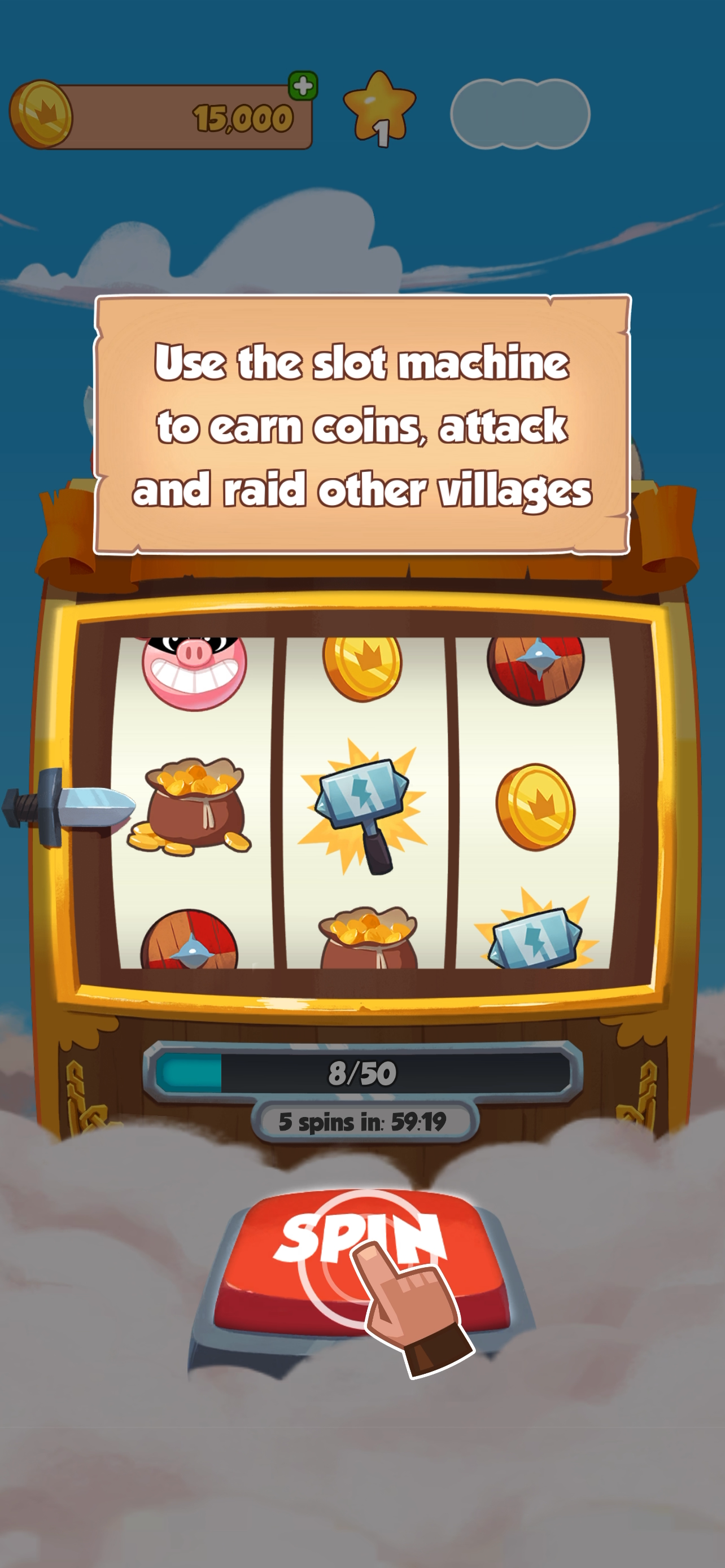
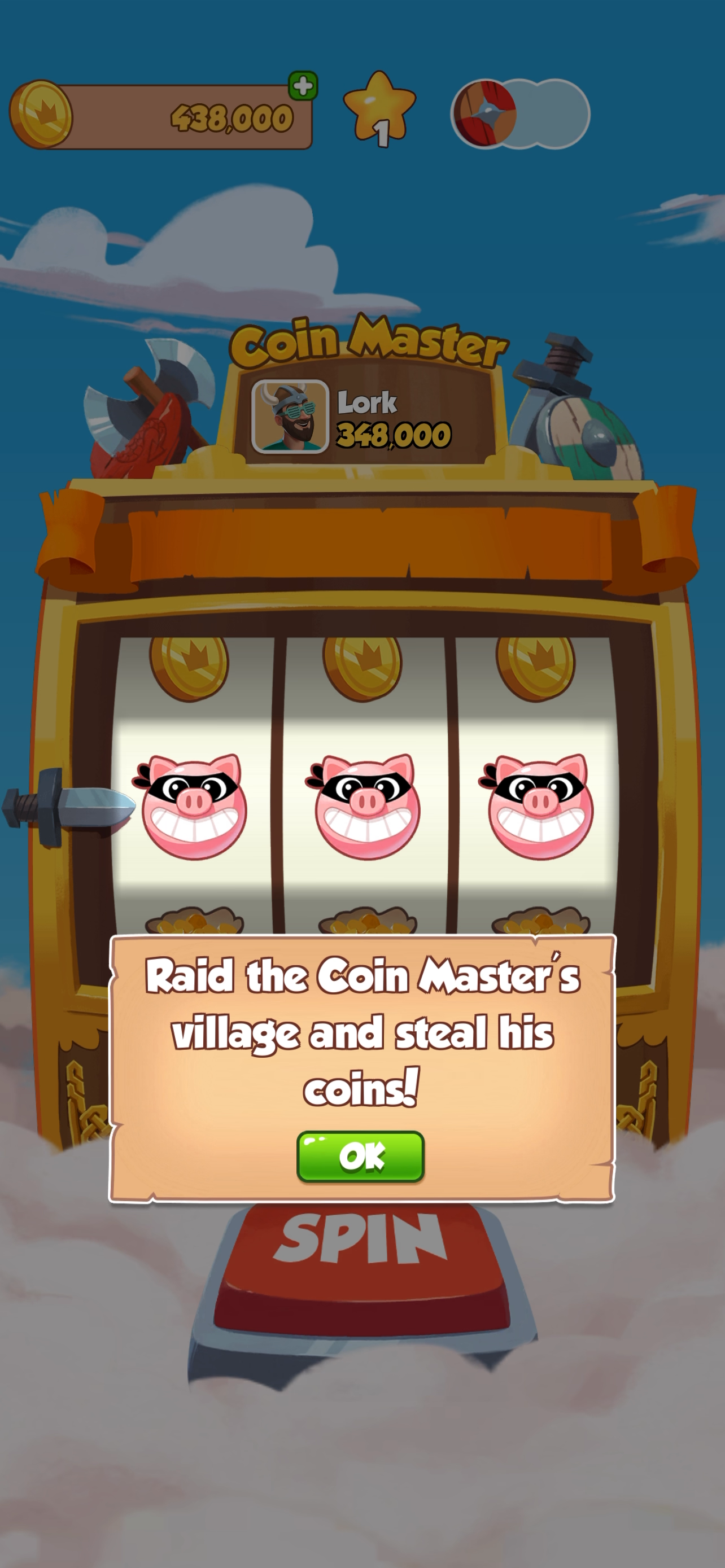
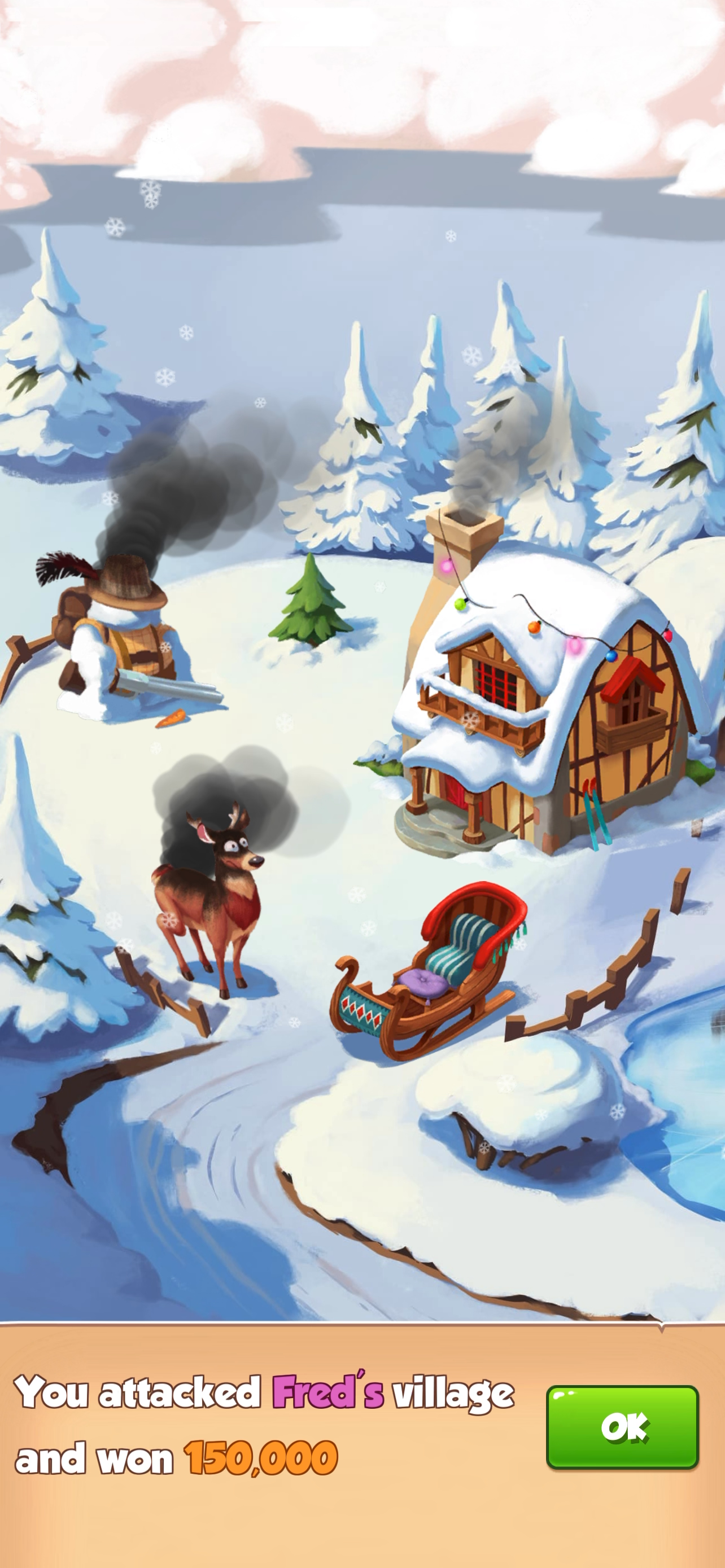
You get a capped number of spins (time-regenerative resource) for the slot machine, which can award:
- Coins (used to build/upgrade your village)
- Shields (defend structures from attacking players)
- Hammers (attack other player’s villages)
- Masked Pigs (perform a raid on another player’s coin collection)
- Additional spins
- Event rewards (when applicable)
The machine gets faster and faster the more you play, basically throwing piles of coins at you. The graphics are so smooth and the sounds are so crisp, it almost feels palpable.
After a few minutes of spinning, a little egg that had been sitting in the corner of the screen starts wiggling around: surprise! It’s your new animal companion who can help you dig up other people’s stuff during a raid. Cute.
Similar to MG!, the player can add autospin so they don’t even have to press the button AND apply a multiplier, which increases your wins but depletes your spins accordingly.
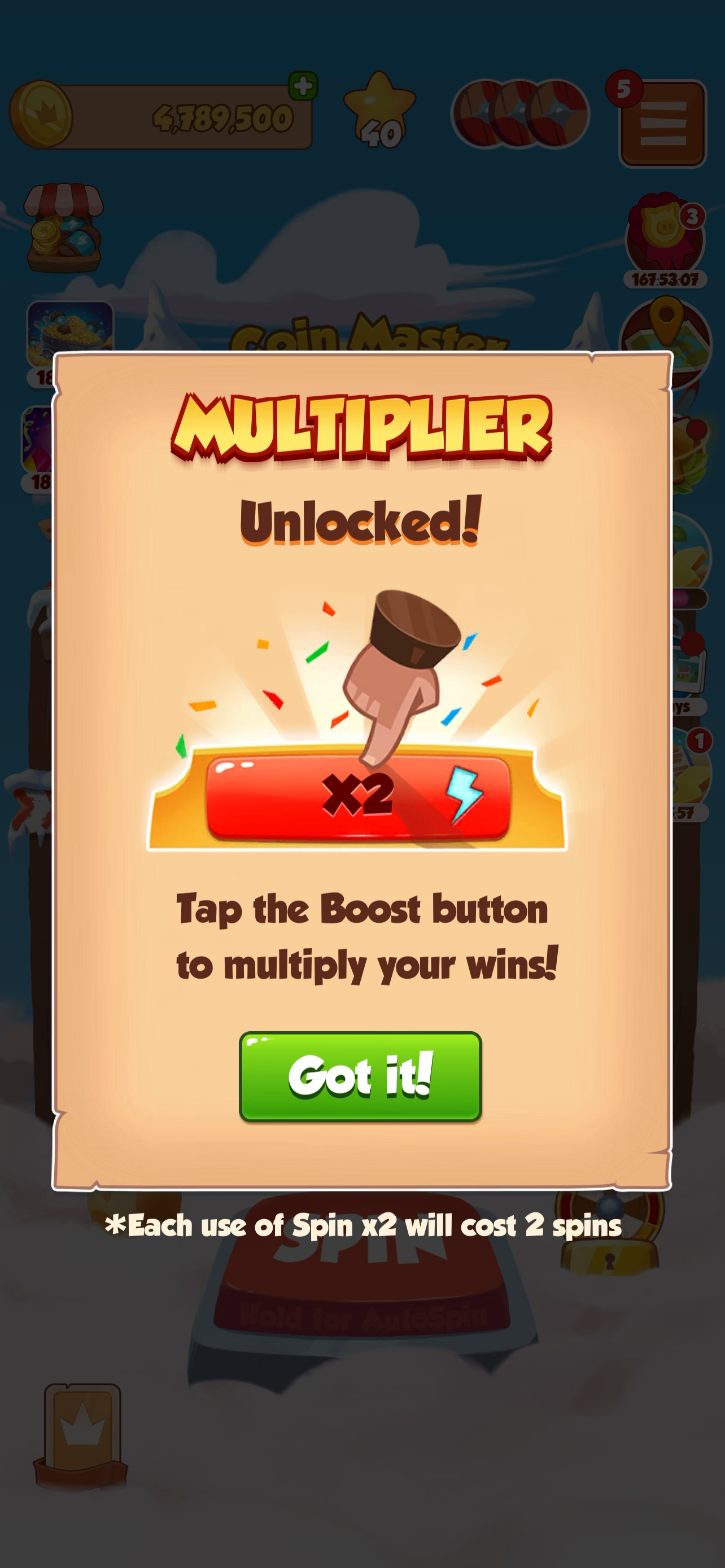
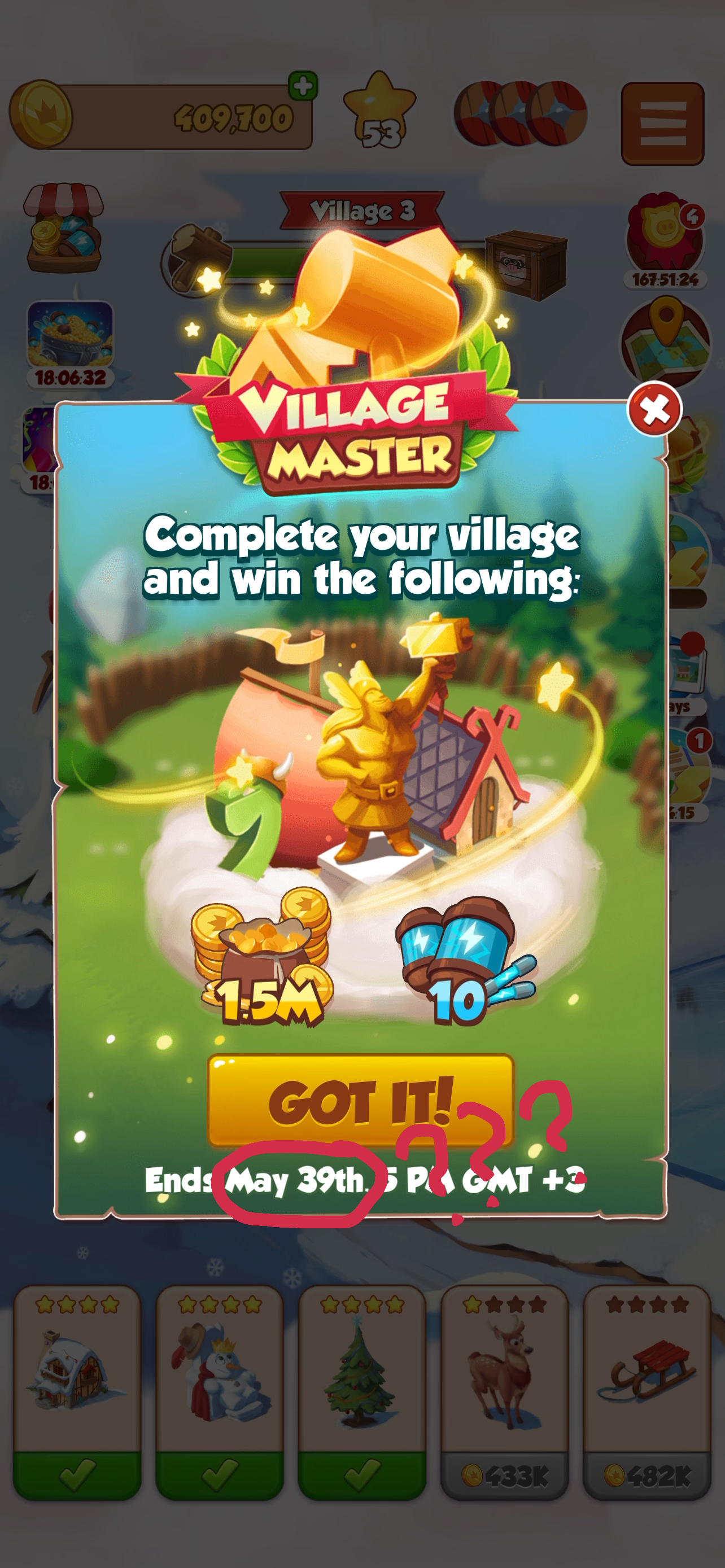
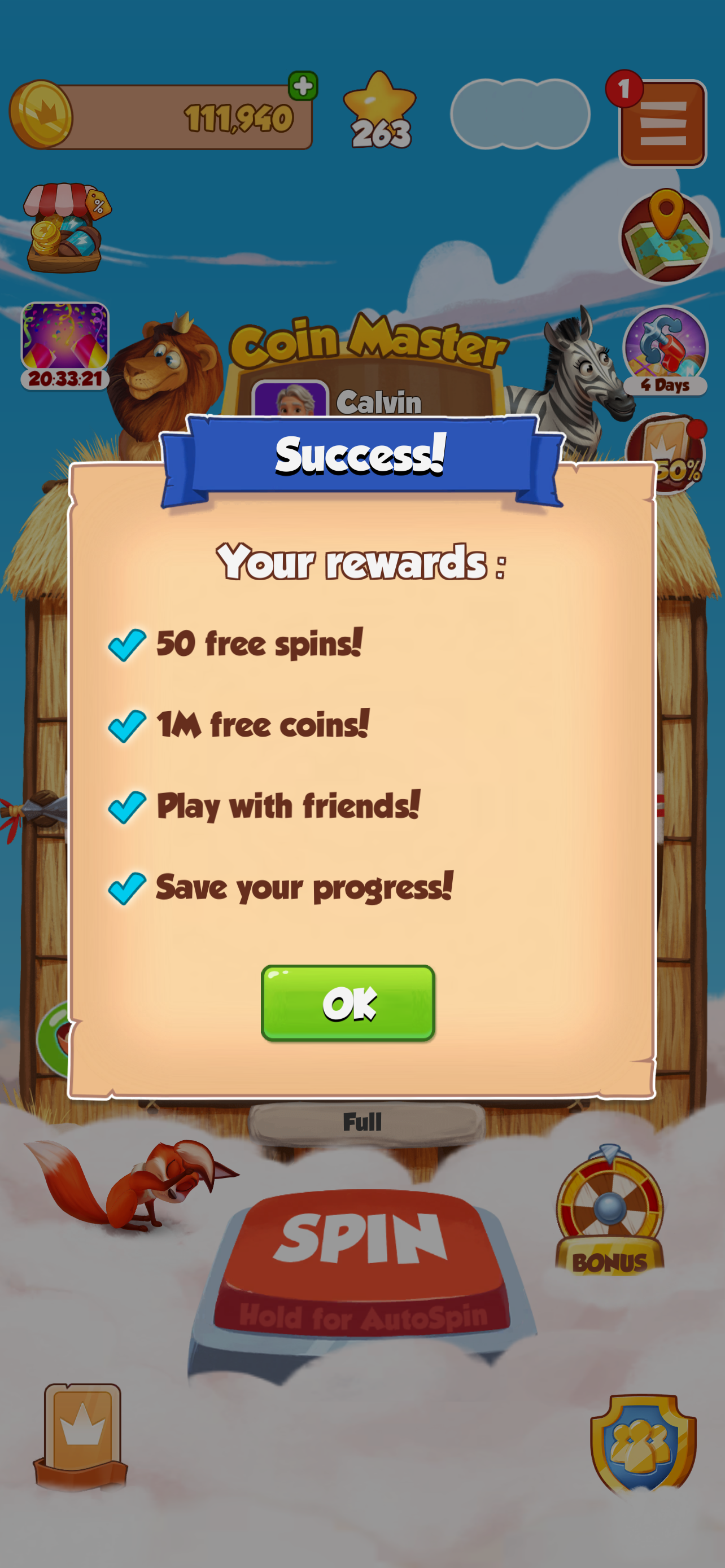
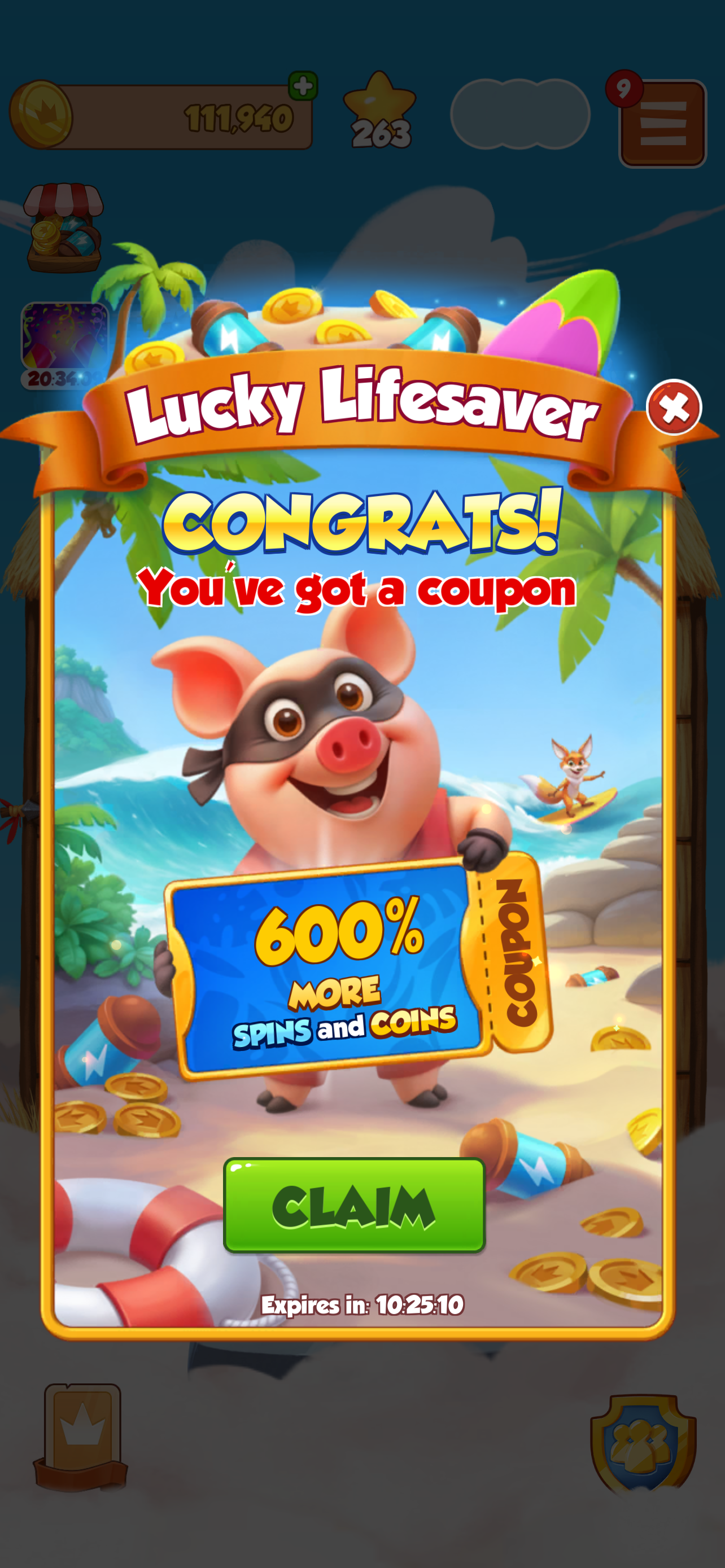
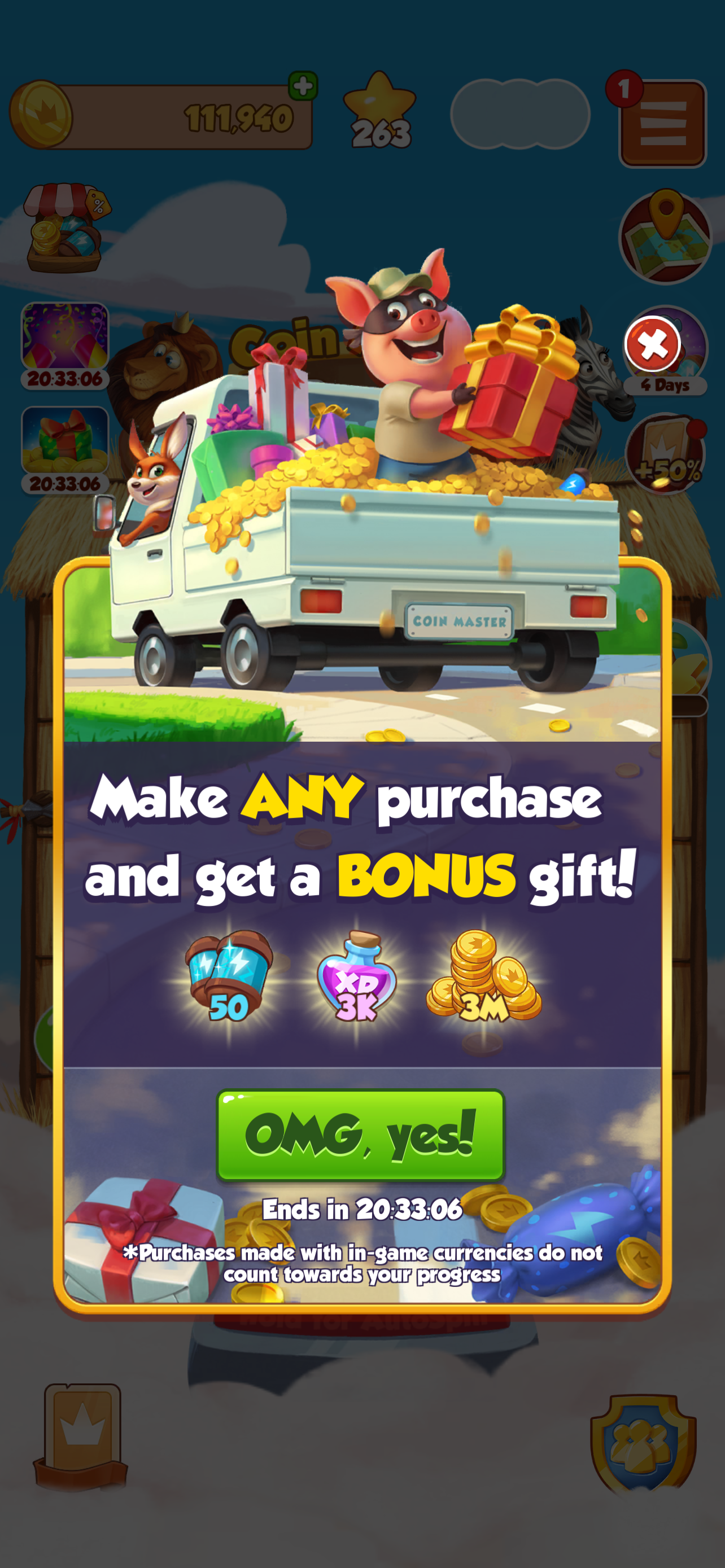
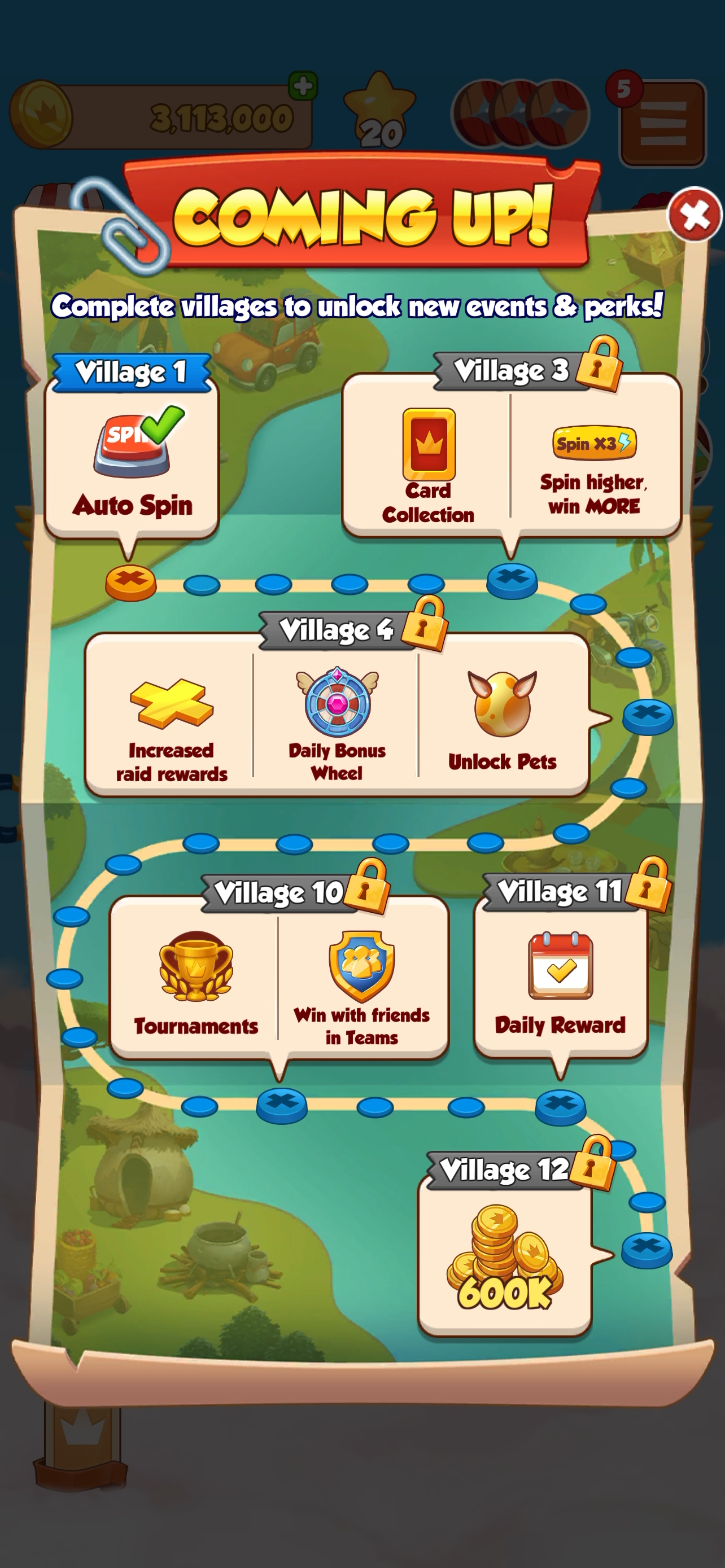
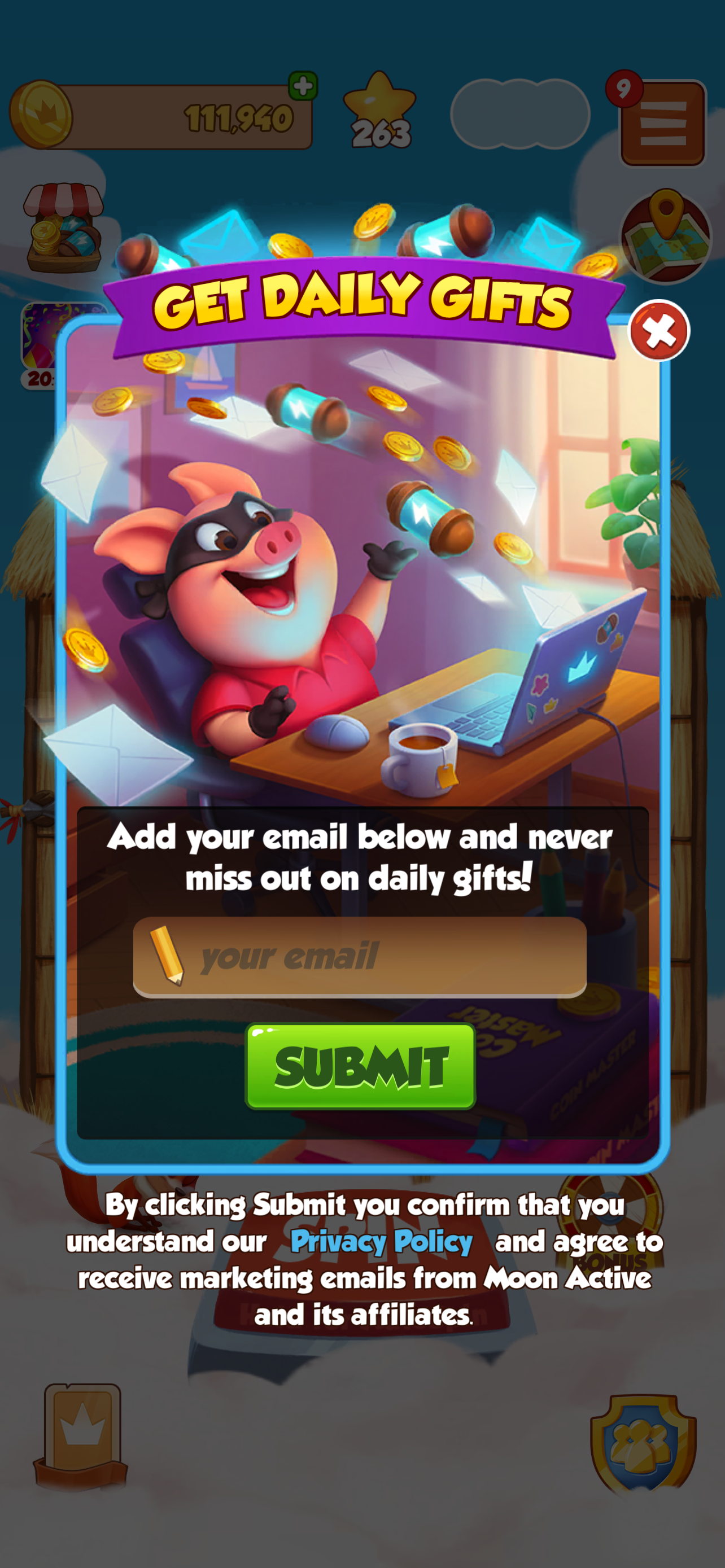
Monetization comes in early and often, presenting cheaper bundles containing a combination of coins, spins, card packs. Some players report that Coin Master ALLEGEDLY changes the price and contents of bundles/offers based on player behavior. ↩
-
How do we define gambling mechanics?
Ugh… getting into gambling law was a fucking riot. I’ve contemplated becoming a lawyer in the past, but researching this has absolutely, without a shadow of a doubt, deterred me from ever doing so. Defining gambling, prohibiting gambling, and enforcing against gambling are all three VERY distinct things.
There is no federal definition of gambling in legal terms. Gambling definitions live within individual STATE laws. In case you don’t know all the constitutional amendments (guilty), the Tenth Amendment basically says “power not given to the federal government is given to the states.” This reserved power, or “police power,” gives states the authority to regulate public health, safety, welfare, and morals (where gambling lives). So it is the states that define, prohibit, and enforce against gambling if they so choose.
The federal law known as the Unlawful Internet Gambling Enforcement Act provides their own internal definition for “bet or wager” for online gambling purposes. Under the statute (31 U.S.C. § 5362), a bet or wager means “the staking or risking by any person of something of value upon the outcome of”:
- a contest of others
- a sporting event
- a game subject to chance
“…upon an agreement or understanding that the person or another person will receive something of value in the event of a certain outcome.” It also “includes the purchase of a chance or opportunity to win a lottery or other prize.”
It does not prohibit gambling itself, but it does prohibit accepting payments for gambling that is already illegal under respective state laws. It is enforced through banking and payment systems.
Free-to-play games, where participants risk only their effort or free promotional credits, fall outside this definition—not because the statute singles them out, but because nothing “of value” is staked or won. This means a game distributed nationally, though it sits outside federal jurisdiction, is subject to state-specific laws.
A proper definition of gambling is tough to pin down because each state has its own little flavor. Most gambling laws revolve around these three elements:
- Consideration: participant risks money or something of value
- Chance: the outcome depends partly on luck
- Prize: something of value can be won
Activities with all three present are usually treated as gambling, but states differ on their stance on skill and chance.
F2P games are not considered gambling because the third element is absent. What makes mobile gaming more interesting, and arguably more sinister, is that there is no payout. The player can endlessly risk money for random outcomes even though there is nothing of value to be won.
Games sell “dice rolls” or “in-game units of payment” that can’t be cashed out specifically so there’s no “something of value” won; therefore no “bet or wager”; therefore outside of the UIGEA’s own definition. The law sets the boundary at real-money stakes like the slots-to-gum-machine pipeline. Following in the footsteps of slot machines, F2P games clear this boundary by precisely one inch. ↩
-
Patents
In 2015, Activision filed patent US 20160005270A1, “System and Method for Driving Microtransactions in Multiplayer Video Games,” and was granted in 2017. The first sentence of the abstract section reads: “A system and method is provided that drives microtransactions in multiplayer video games.”
So how does this work? Here’s an example:
A player may be matched with more skilled players or bots that have advantageous, paid items in their possession. The player can see firsthand the superior abilities of these new weapons and may “wish to emulate” the more skilled player, and therefore may go through with purchasing the same weapon. After purchase, the player may be placed in a gameplay session where their new weapon is “highly effective, giving the player an impression that the particular weapon was a good purchase,” therefore, increasing the likelihood that they would make more purchases in the future.
Activision has made the claim they do not actively use this, calling it an “exploratory R&D,” but have denied its use in Destiny 2 specifically, and in its games generally.
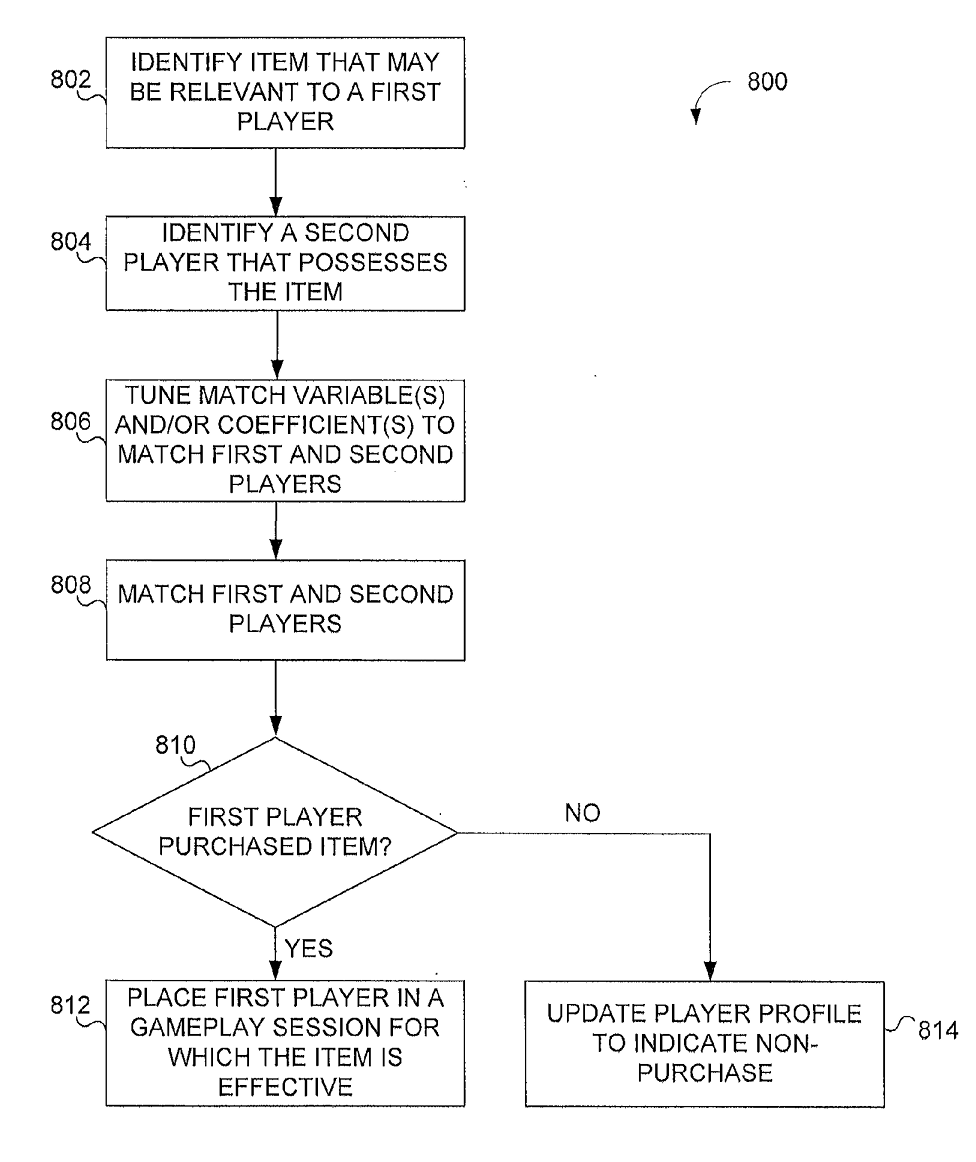
FIG. 8 from Activision’s patent US 9,789,406 B2, “System and Method for Driving Microtransactions in Multiplayer Video Games.”
In 2016, Electronic Arts filed patent US 2017/0259177 A1, named “Dynamic Difficulty Adjustment,” then granted in 2020. It’s a machine-learning system that automatically adjusts difficulty based on the player’s skill-level. This system trains a “game retention prediction model” based on player data—when they are most likely to quit—to make adjustments to things like enemy health, drop rates, and control responsiveness in order to increase retention.
Though EA maintains they hold the patent but have not deployed it in FIFA, Madden, or NHL’s online multiplayer, there has been no public audit. ↩
-
Controlling Your Destiny
Here’s the nutso video of him explaining their whole ethos, starting at 10:40: https://vimeo.com/373842 ↩
-
Who owns Monopoly Go!?
Monopoly Go! was launched by Scopely in April 2023, generating $1 billion within seven months and became the mobile game quickest to reach $5 billion in revenue. Before its meteoric rise in the ranks, Scopely was acquired by Savvy Games Group for $4.9 billion in April 2023, right before it took off. Can you guess who runs the Savvy Games Group? Yup, you guessed it! Obviously, they’re the video game division of the Saudi Arabian Public Investment Fund! :D
Scopely was known for its other popular mobile games based on family-friendly IP when it was acquired (Yahtzee With Buddies, Star Trek Fleet Command, Marvel Strike Force, Stumble Guys and Scrabble Go). Other acquisitions/investments by Savvy also include Pokémon Go (May 2025, via Scopely’s acquisition of Niantic’s games business), EA (a 2021 investment, and as of 2025 the subject of a ~$55 billion PIF-led deal to take the company fully private), Take-Two Interactive (2021 investment), Activision Blizzard (2021 investment), and Embracer Group (2022 investment).
They are one of the biggest sources of financing for mobile gaming revenue. I want to explore the implications of a sovereign country owning a company that distributes games overseas that contain elements of play not even permitted in their own society.
Maysir and Gharar
In Islamic terms, gambling is referred to as maysir. The Quran reads:
“O ye who believe! wine and the game of hazard and idols and divining arrows are only an abomination of Satan’s handiwork. So shun each one of them that you may prosper… Satan desires only to create enmity and hatred among you by means of wine and the game of hazard, and to keep you back from the remembrance of Allah and from Prayer. But will you keep back?” (Quran, 5:90–91)
Another Islamic text, the Sahih Muslim, has a passage about a specific term regarding the sale of that which is unknown to both the seller and buyer—this concept is called Gharar. In his commentary on Sahih Muslim, 13th century scholar Imam al-Nawawi explains the prohibition on these types of sales, stating:
“The Messenger of Allah “Allah’s blessing and peace be upon him” forbade selling by the way of tossing pebbles, and the selling of Gharar. (The first is to say to the buyer: I would sell to you all the garments upon which the pebbles would fall; or to say to him: You are permitted to keep having the option (whether to cancel or to confirm the transaction) until I toss the pebbles; or to make the act of tossing pebbles the same transaction, as to say: If I toss this garment with the pebbles, then it would be regarded to have been sold by such-and-such a price. As for the second type of invalid transaction, it is to sell what is unknown or is not in the possession of the seller such as selling the fish in the river, the milk in the udder, or the offspring in the womb)”
Gharar describes the sale of a thing that is not fully known to the buyer in Islamic jurisprudence. (fiqh)
The player is able to purchase “dice rolls,” in MG! that provide uncertain outcomes in the game as well as sticker packs/loot boxes in which the contents are a surprise.
Gambling is considered haram under Saudi Religious law, but it is difficult to analyze the relationships between state investors and their investments. After all, investments are based on… well… whatever makes money… having a diverse range of offerings doesn’t hurt… The products that hold the highest-revenue-per-user rely on mechanisms of perceived chance and randomness to make money. Excluding such games from their portfolio would severely limit their scope. If a product like Monopoly Go! contains arguably maysir/gharar-like elements, do they only apply to players making the transactions rather than those who own it? Is ownership institutionally separate from ethical evaluation on a product-level basis?
Savvy games in itself isn’t a company that is based on Islamic principles and operates under financial rather than specifically fiqh criteria. Savvy just OWNS Scopely, which runs MG!. Technically, their actual involvement is minimal—yet they still profit from it. Savvy itself is owned and run by the crown prince who himself must abide by the rules of Islam. Again, what does it matter? I do not pretend to know! ↩
Disclaimer: I used Claude AI as a research tool for this piece (basically as a more advanced search engine) and all resources have been vetted by yours truly. Every thought, argument, and word is my own. Any game screenshots, recordings, trademarks, and logos belong to their respective owners and appear here for the purpose of commentary and criticism.
Subscribe to receive emails ONLY when new articles drop xoxo